th2ombre
It's ALWAYS about the light
But why Colombia?
Posted on September 23, 2026
A not uncommon question from local chums. Blythe answer—why not? Not to mention that my main squeeze got it into her head that it being terra incognita for us was ample reason to reconnoiter. Now that we’ve gone and returned, a more informed answer is the country is beautiful and the people are very friendly. With just over 440,000 square miles, Colombia’s area is slightly larger than Texas and California combined. It has two coastlines—on the Pacific and the Caribbean. An Andean nation with three separate ranges (Cordilleras) running roughly north to south, which accounts for elevations of 8,700′ MSL for its capital and largest city, Bogotá (official airport name El Dorado International, a clue) and 4,900′ for second largest, Medellín.
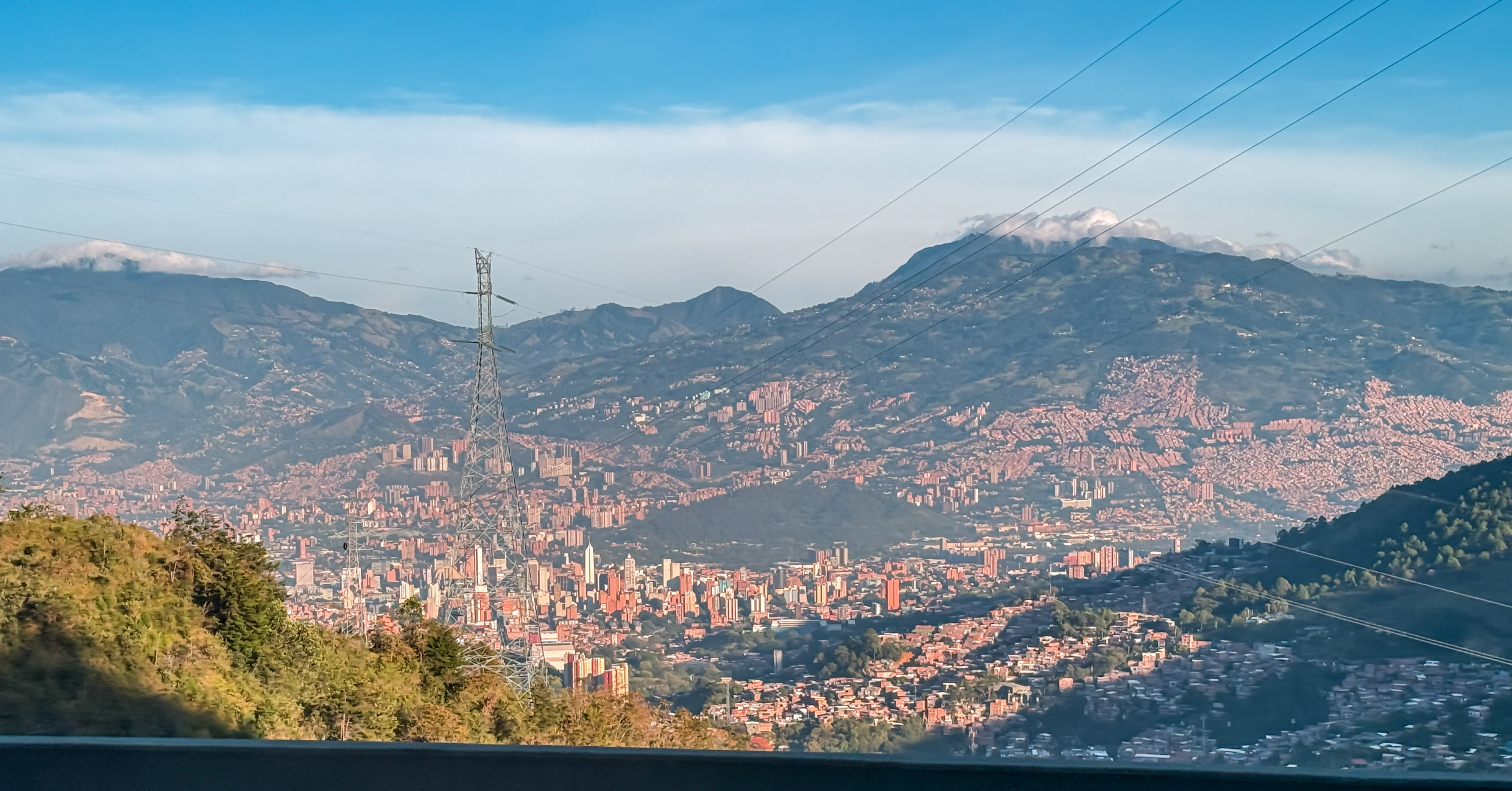
And those elevations are deceiving, as both cities are in topographic bowls with the suburbs hugging surrounding higher terrain. Ambulation, especially on our first few days was slower and more breathless than our sea level normal. Our itinerary had us beginning in Bogotá and exiting from Medellín, while puttering about between 4 and 6 degrees of equatorial North Latitude. Those elevations produced coolish nights and warm days, essentially perpetual Springtime. Though down at the Pacific coast at Bahia Solano in the Chocó region, which our guides were amazed and greatly pleased that a couple of gringos would visit, it was hot and humid with nightly thunderstorms the rule. By the way, I use the gringo term self-deprecatingly. It’s not something any Colombian ever verbalized.
Which is segue to a core experience that says much about the people and validates the pleasure of exploring there. A reservation which I felt as Cathy urged embracing this trip, was safety, given the notorious narco history of the country. Does Pablo Escobar ring a bell? Colombia’s government has had a track record alternating between giving the cocaine trade a light touch, even negotiating a 2016 peace accord with the FARC guerrilla and crime group, counterposed with robust military and police responses. The current president, Abelardo de la Espriella, elected just seventeen days before our arrival, is a perhaps illuminating mix. His prior career had been as a defense attorney defending narco traffickers, and yet he was elected espousing a tough on crime agenda, and a purposeful shift away from the “Chavismo” style practices of other regional leaders. For some time now, a less socialized governance has been ascendent in South America, including Colombia, a reflection of violence fatigue , or perhaps to curry favor with the Donald administration? Unclear to me, but the gente, the people, are pleased to walk peaceably about their neighborhoods these days, police in dark blue and chartreuse uniforms scattered about with no hint of overbearance, not to mention a standing army of 400,000. A vignette perhaps? Dinnertime and after dark, Cathy and I hunting for an Italian restaurant near our Medellín “Hotel Diez,” and not so much getting lost, but just unable to find the place which we knew to be nearby. Cathy fretted, but (this time) not being challenged like so many men with map aversion, I turned to a policeman and in my best halting Spanish asked if he knew where the Romero Artisanal Cuisine was? His hand did not go to the Glock on his belt, but smiling, he asked a shopkeeper next to him, and with those directions gestured for us to follow. We joined him in crossing the street, him holding up his hand to advancing autos in a classic “PARE” (STOP in Colombia) gesture, walked us down the block and around a corner, heading uphill, to find Romero up on the second floor, just over yonder. You see the bedrock safeness evidenced here for the citizens and visitors?
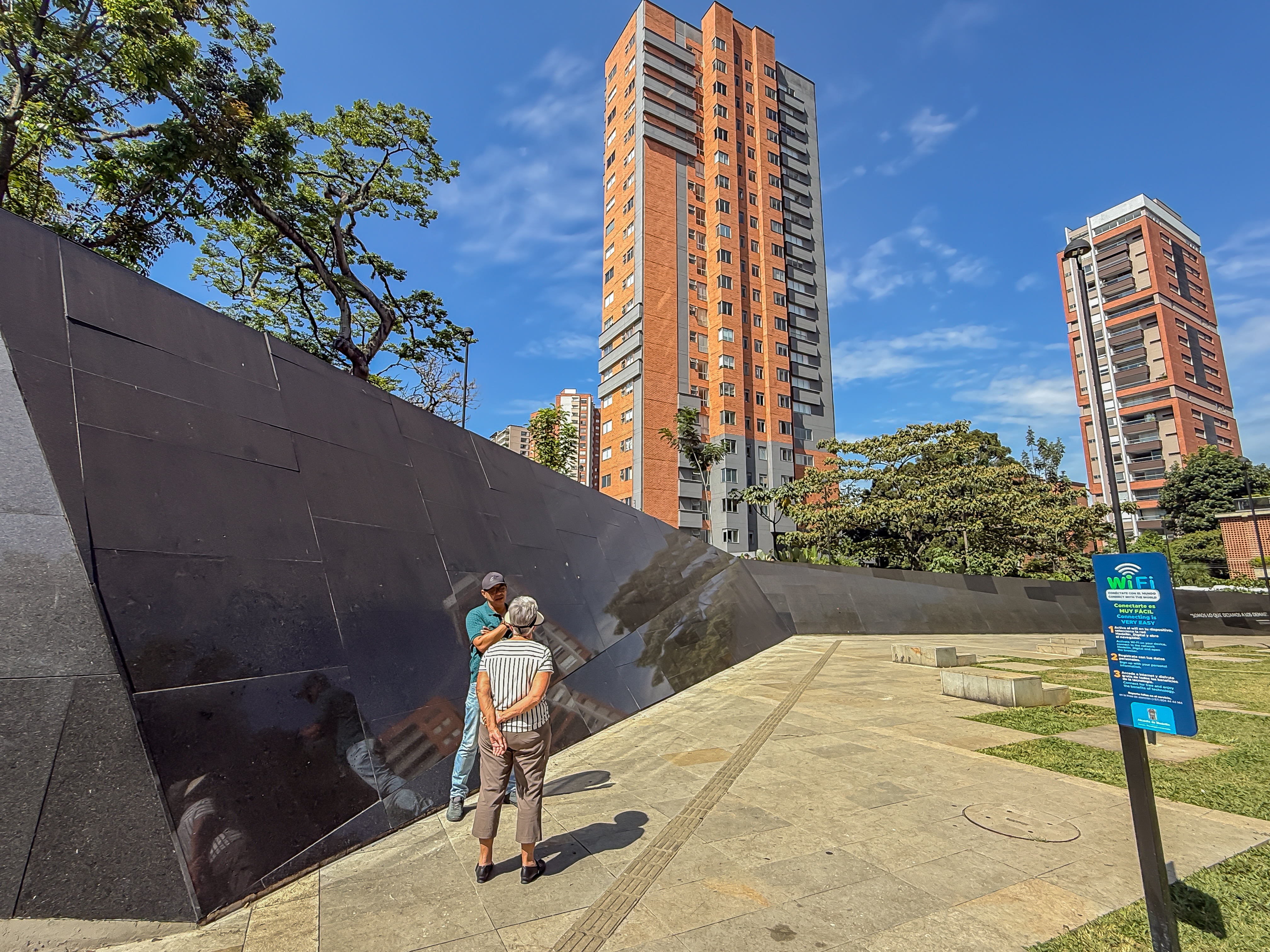
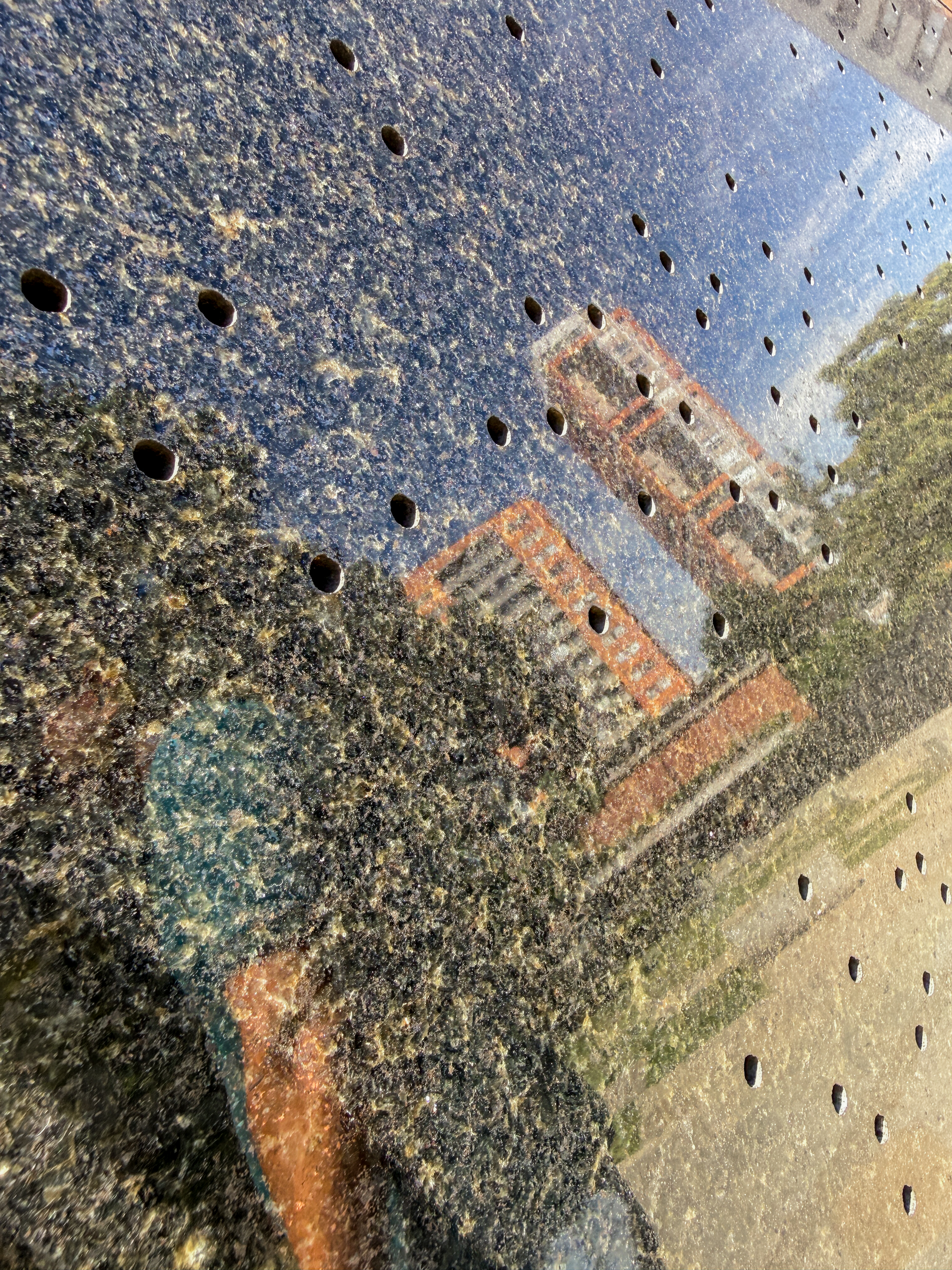
Another Example. We had personal local guides every step of the way throughout our two weeks there, arranged for, as were our lodgings and vehicular and Colombian air travel by our in-country outfitter Impulse Travel Colombia. https://impulsetravel.co/ I give them a gold star recommendation, by the way. Be sure to give Felipe my regards, ditto operations Sergeant Major/Girl Friday/Itinerary Director, Laura. On this particular day, our guide, Doriel, started us off at Medellín’s Inflection Park. It’s roughly a block square, and was previously the site of Pablo Escobar’s compound before he was killed by an elite Colombian National Police unit. Note the park’s name, as in change point. His compound is gone, razed and removed. They’ve erected a wall, very reminiscent of our Vietnam Memorial, of great poignancy to me. The north side is riddled with 46,612 holes, as acknowledgement of the known number of individuals whose lives were violently ended in narco violence. The south side is covered with etched dates/locations/number of deaths from narco bombings. Inflection park—demonstrable back-turning on crime violence.
Doriel was bent on sharing Medellín’s multi-faceted personality. Next up on this full day was a visit to Plaza Botero, where we took in the twenty-three sculptures by Fernando Botero, a painter and bronze sculptor with a unique distorted proportion take on the human form. Sense of humor, political critique, personal vision problems? Who knows, I’m no multi adjective art critic. A touch of whimsy—these bronzes are dark, except where human hands frequently touch them, the skin imparting a polished golden copper hue over time. These statues are physiologically correct nudes. Guess where the statues are most golden in color?
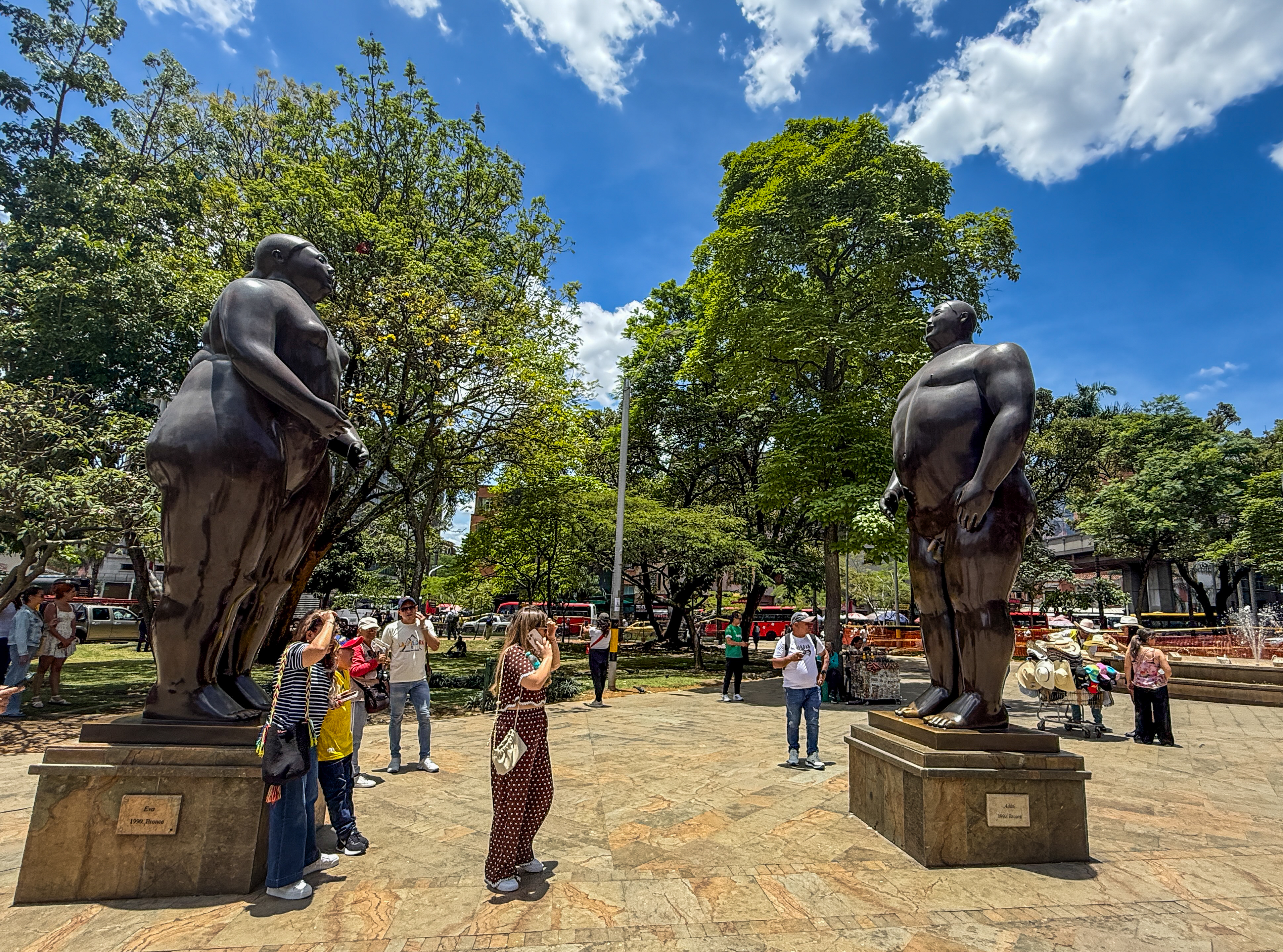
This was a busy and crowded plaza. Doriel advised keeping a sharp eye and grip on I-phones, wallets and such. Human nature being what it is, not all of River City is trouble-free. And walking about were more than a few ladies (and gents?) making their charms rentable. Prostitution is not illegal in Colombia. The “is she or isn’t she” judgement somewhat complicated by the demonstrable embrace of T & A in this Latin culture. No puns intended. I should also convey that Cocaine is not Coca, even if made from it. The Andean countries all have long histories of indigeõs cultivating and using coca. Just a pinch between cheek and gum and you’ve a mood-enhancing energy boost. You can buy it legally, make tea with it, whatever. It’s the chemical alteration to cocaine where the trouble comes in. And not to make light of the violent nature of traffickers, but there wouldn’t be a problem if there wasn’t a market. Just sayin’.
Leaving the park, Doriel guided us onto the metro system, getting about by going native. The system was clean, and while crowded, there was no sense of menace, nor the whiff of unwashed humanity! Just the gente going hither and yon in their daily ways. This included both metro cars and gondolas to reach the steeply ensconced communes.
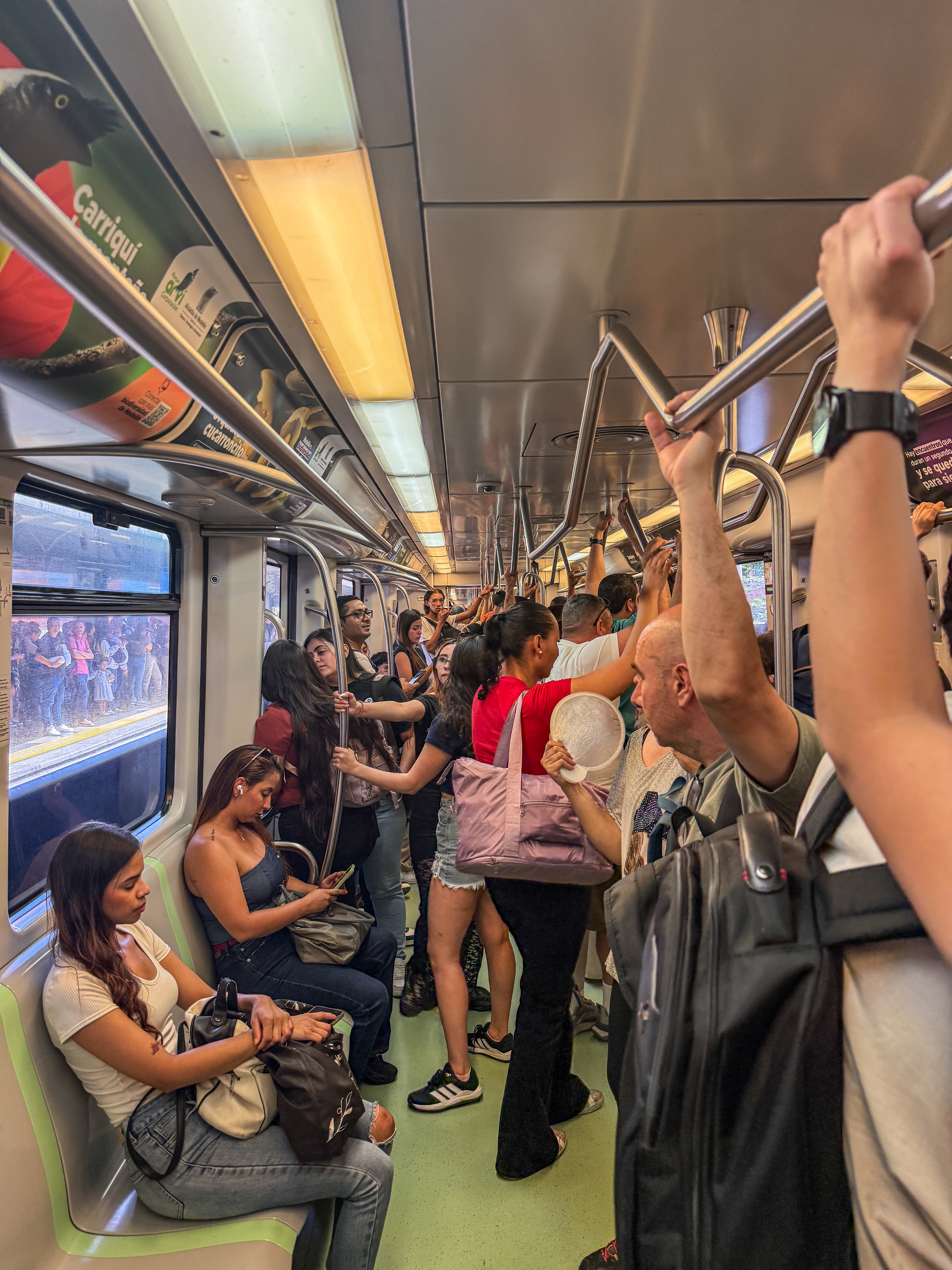
We were headed to Commune 13, Comuna Trece en Español. One of several in the larger Medellín area, and until recently not a safe place for just about anyone. Now, a thriving and teeming place, post inflection. Doriel connected us to an earnest young man who grew up there, and whose mother was a “13” kindergarten teacher who joined others in seeking a life without the violence. She and like-minded folks thought their future lay with tourism, and that could be enhanced with art. There was always art, but before inflection, it extolled violence, now a more peaceful and colorful life.
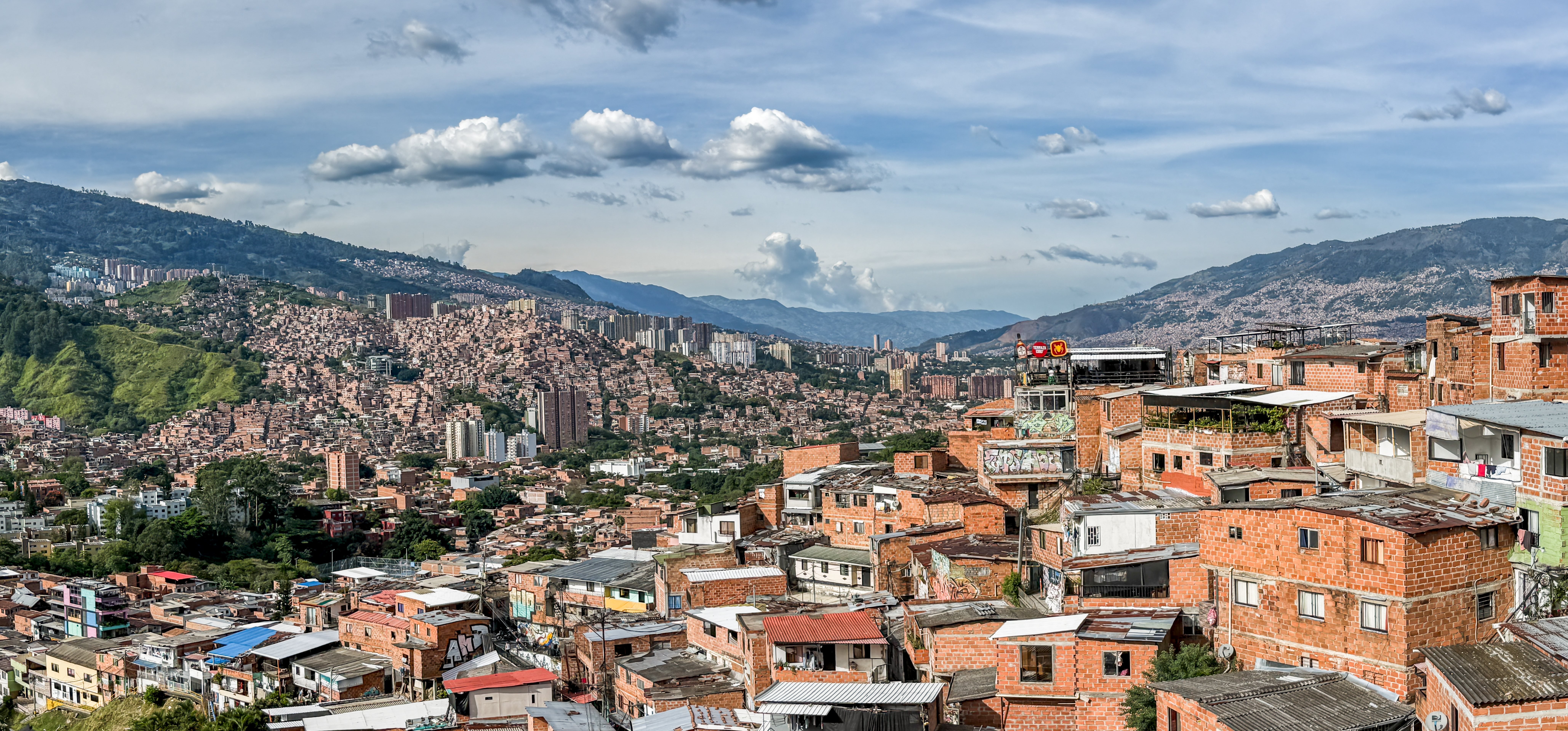
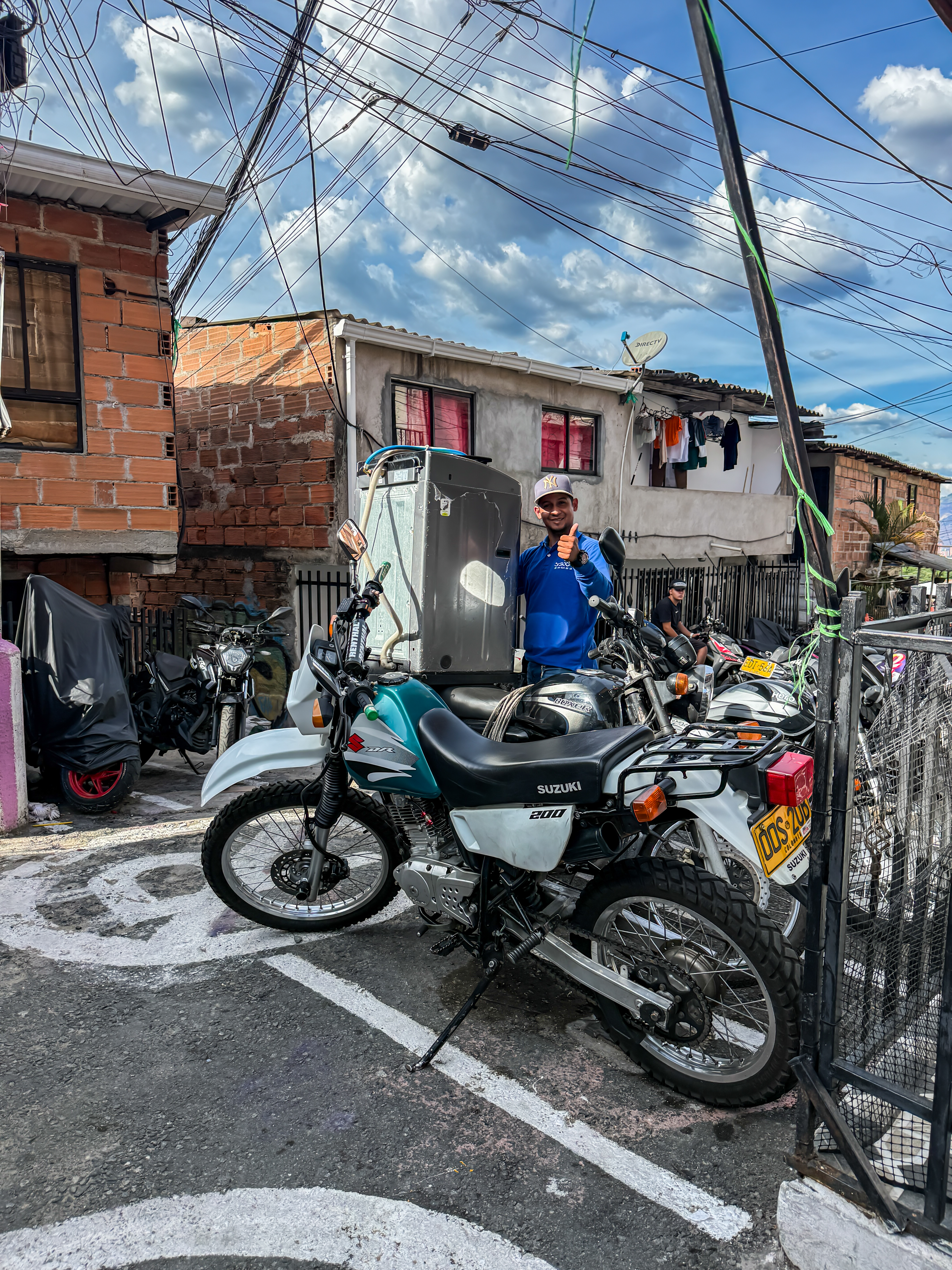
After taking in the airs with the gondola, our driver rejoined us for a short drive uphill to where the streets gave in to the vertiginous crowding of the commune. Now it was climbing the steep hills on narrow foot paths between the cheek to jowl residences and businesses. And by narrow, I mean largely shoulder width, Cathy and I walking hand in hand, not an option. No more autos, but plenty of the ubiquitous motorcycles and scooters. This resourceful fellow strapped the washing machine to the back of his bike, and when the motor vehicle could go no farther, used the same straps to lash it to his back before humping it up the hill to wherever it was headed.
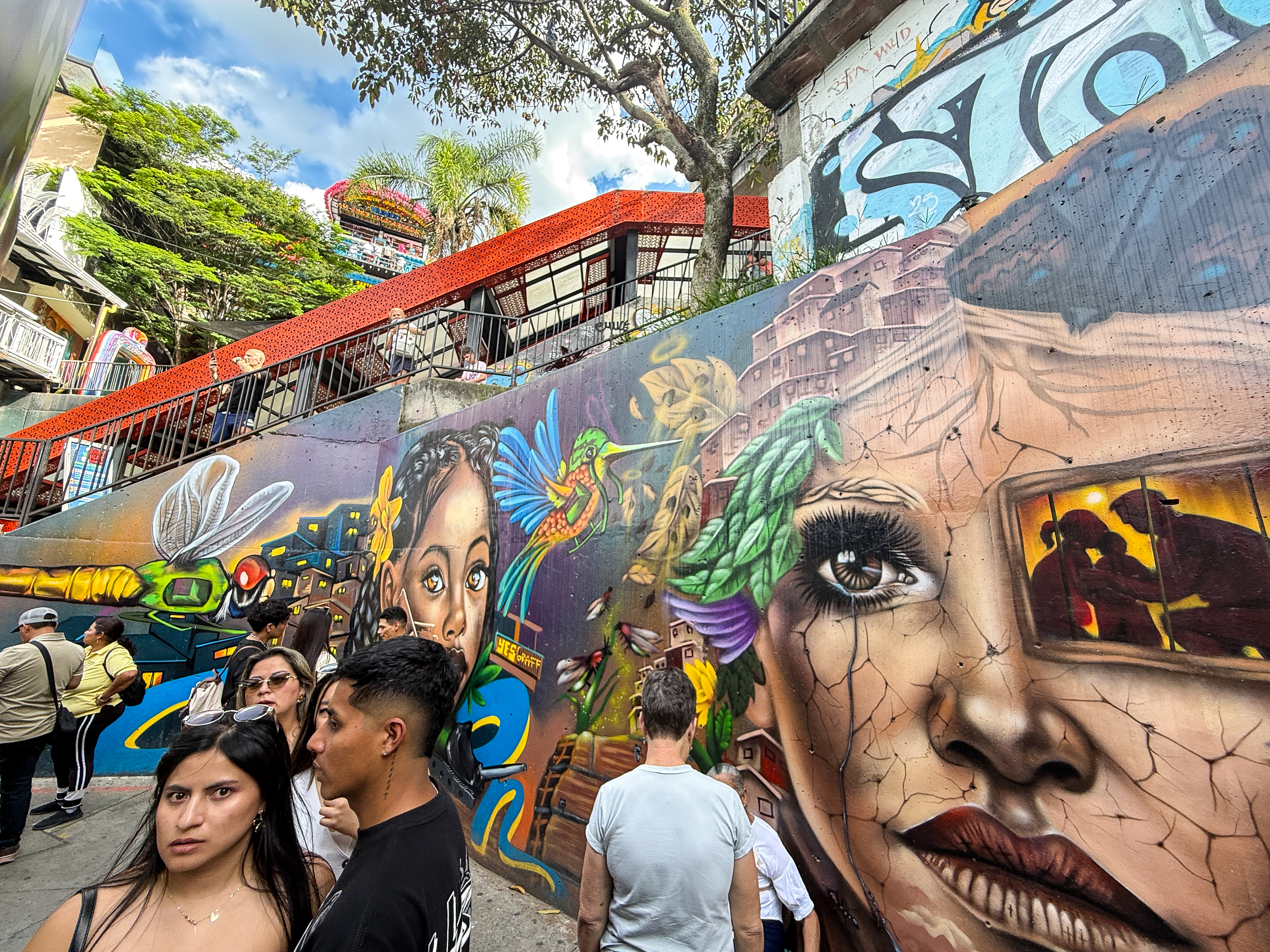
One of Impulse’s sales pitches for would-be travelers was the integration of graffiti in daily Colombian life, particular evidence of the broader embrace of color. Colombians are a colorful people in a colorful land. Graffiti is found everywhere from retaining walls, as here, to the full height sides of towering modern skyscrapers. Not counterculture art, but proudly extolling beauty and vibrant energy. The government, responding to ambulatory need in crowded and steep Comuna 13, built within the footprint of a couple of lengthways blocks of pathways, electrically powered escalators. You can see the side of one stretch with its red roof. The way the escalators are juxtaposed produces small plazas, the accompanying retaining wall the artists’ canvas. This one tells the story of Comuna 13 before and after inflection. The woman’s left eye depicts a family huddling in their apartment seeking safety over thuggery. Countering this there’s a colorful native colibri (hummingbird) and blue morpho butterfly, the latter as natural stand-in for transformation and renewal, spiritual awakening and plain good luck. Our commune guide steered us to a presentation of hip hop dance and over-the-top gymnastics all creatively choreographed as an income-generating show for and by local youth. Very entertaining. It inescapably dawned on us that Doriel had arranged all of this day to extol a transition to a vibrant, colorful, national navigation towards normalcy, to safety and artistic beauty drawing on the natural gifts of Colombia. And not to be left out, look at the lush greenery in the background. Medellín is a beautiful city, laced everywhere with pathways and plazas chock full of trees.
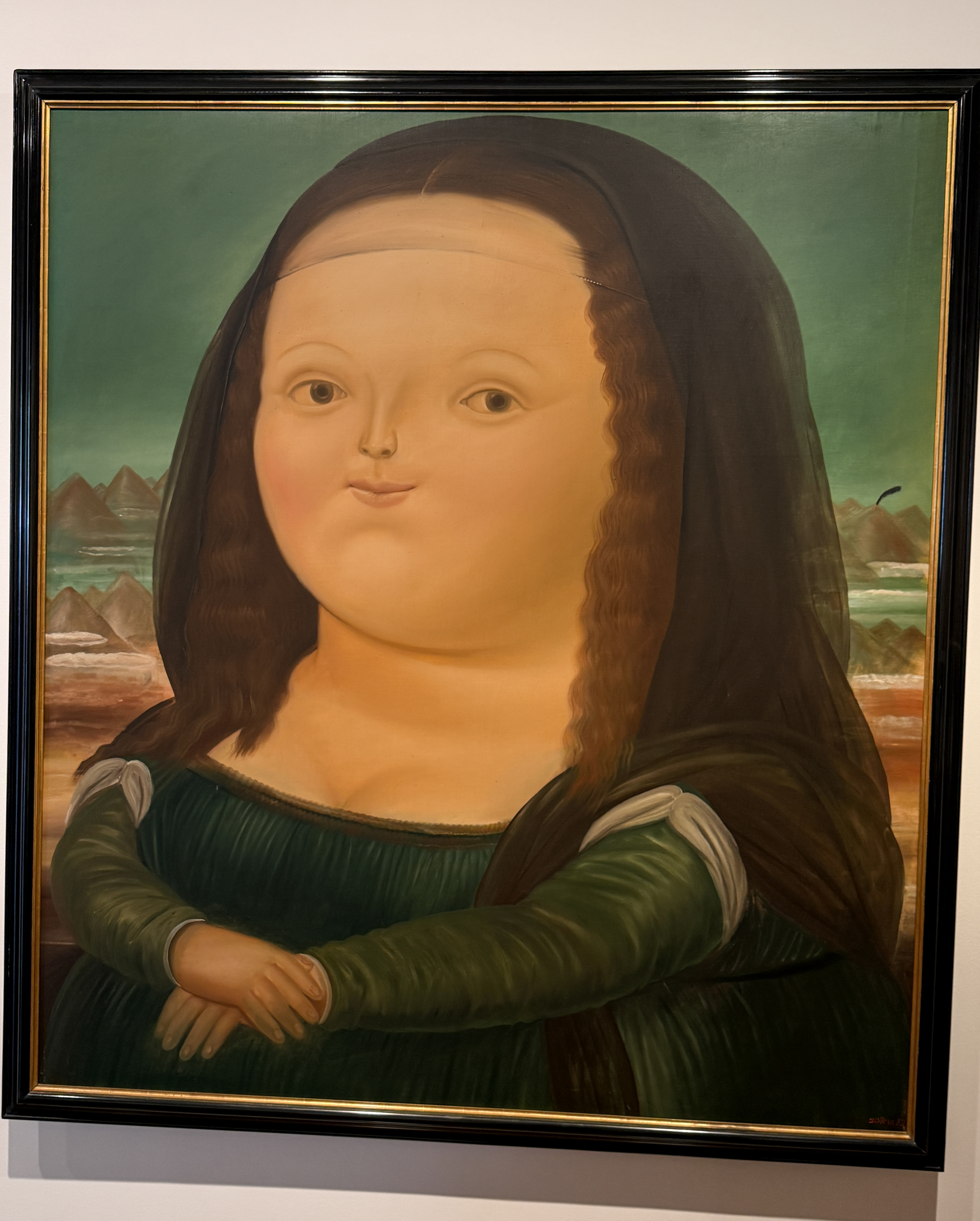
I’ve gone down a bit of a Tom’s careening mind narrative, my posing an answer to the “Why Colombia?” question, in ways so worn on their sleeve in Medellín. In fact, we began our visit in Bogota, including time with the Botero art museum and his take on the Mona Lisa. I don’t think Leonardo da Vinci feels artistically threatened.
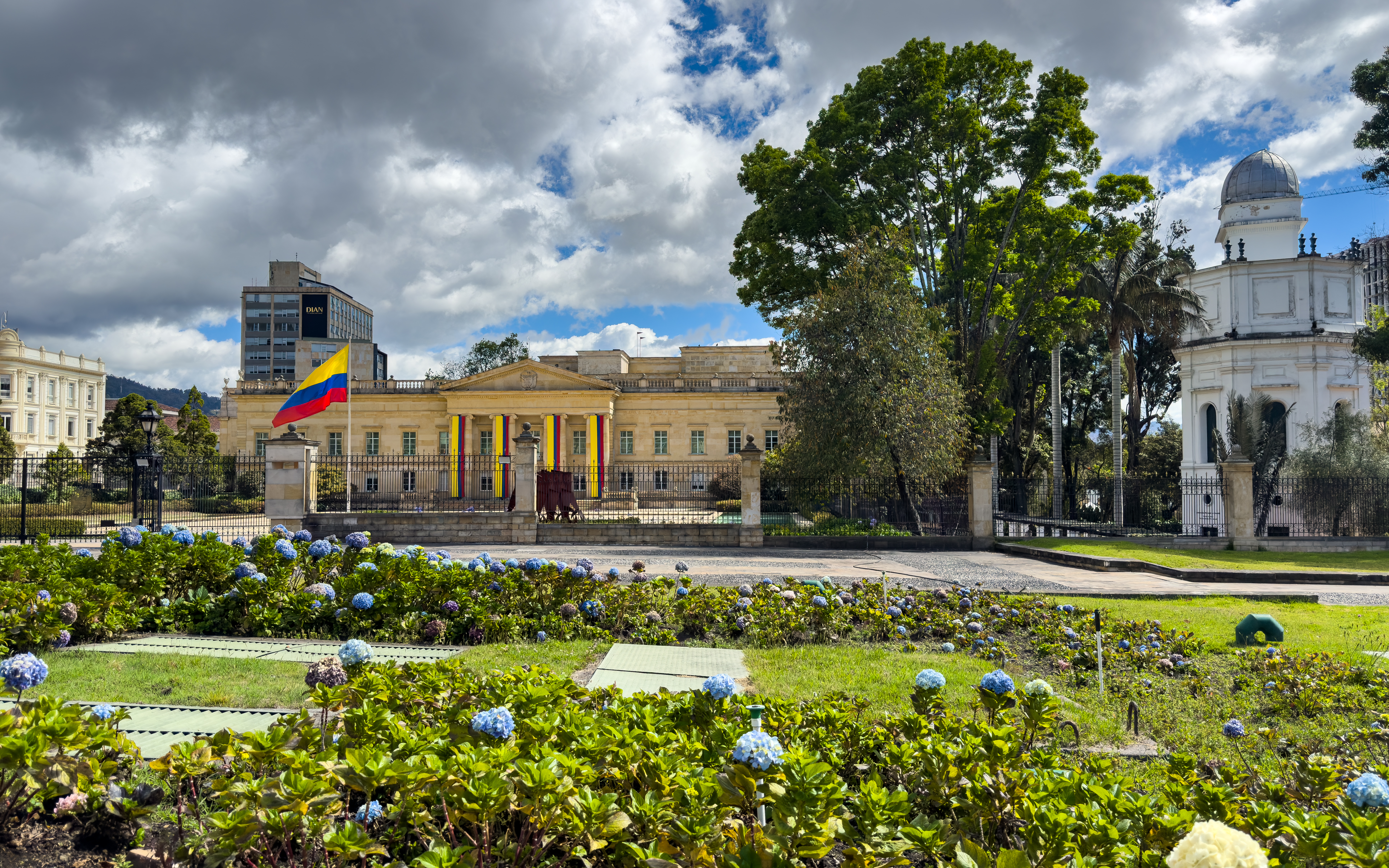
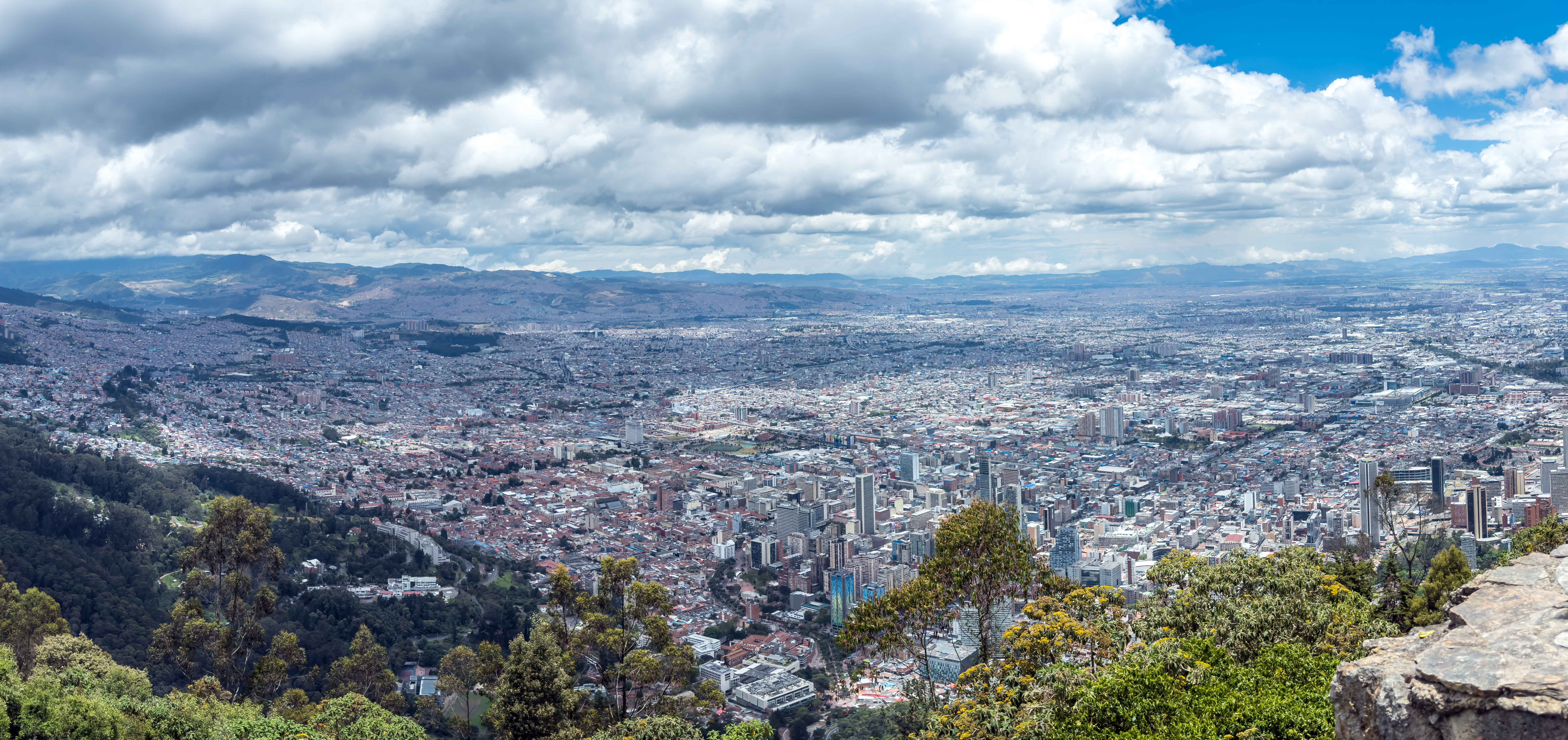
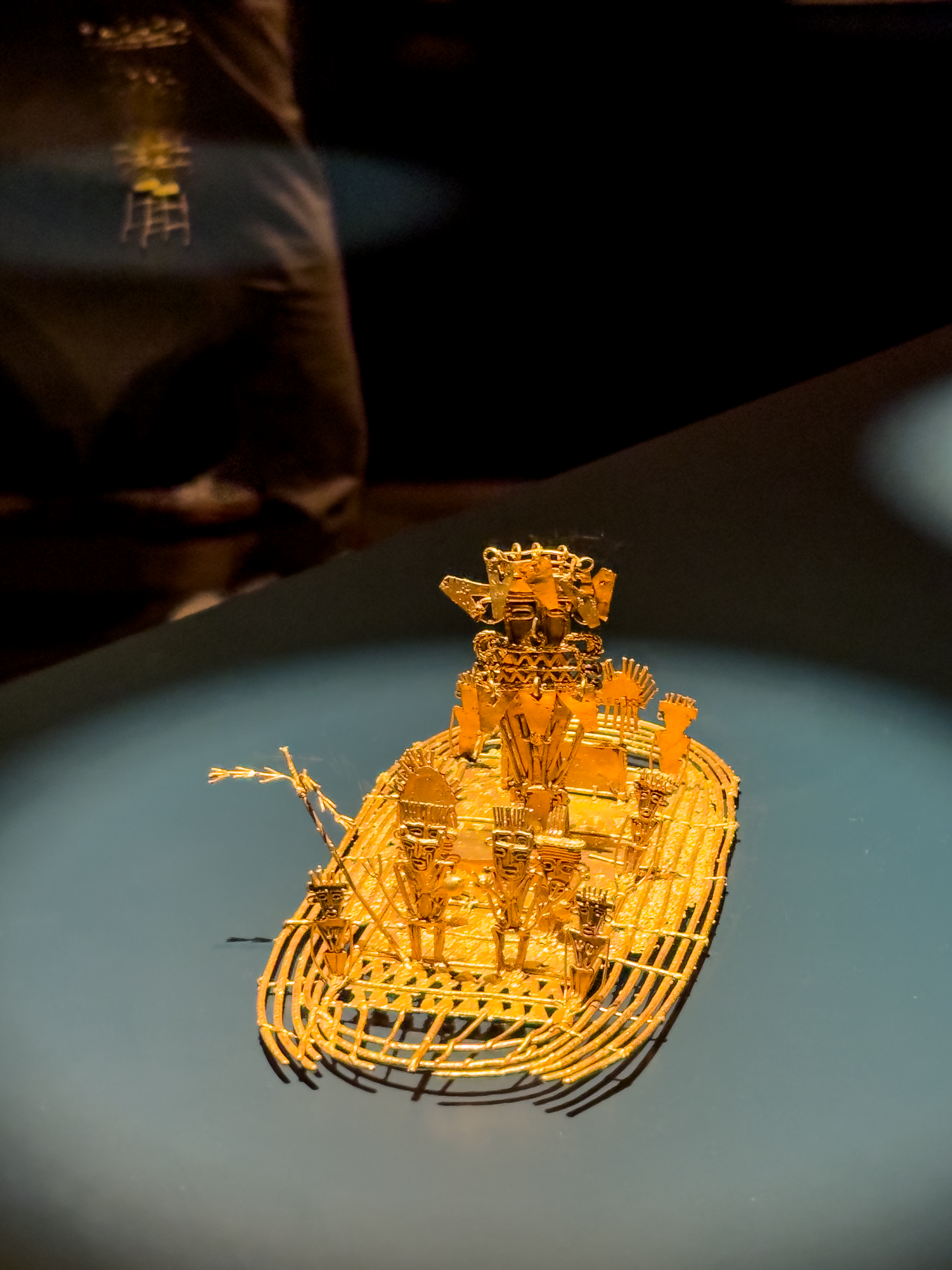
Guide “GiGi” took us up the funicular to the Monserrate overlook with its over 10,300 foot perspective (the very first image above). Both the Bogotá funicular and Medellín’s cable cars received engineering input from the Swiss, but were manufactured and installed in Colombia by locals. Meanwhile the Gold Museum glittered its prominence. The stuff of Spanish Conquistadors seeking a mythical city of gold and galleons shepherding their plunder to Spain. Not to mention the airport name.
On the third day we flew aboard a Colombian regional carrier Clic Air ATR turboprop from Bogotá’s El Dorado airport to Manizales—west of Bogotá and south of Medellín to access the coffee and cacao growing regions and where we also planned some hiking and bird watching. The original plan was to fly into Pereira but that was too few miles from ground zero of the 10th August magnitude 7.4 earthquake that threatened to make a “Why Colombia?” shambles of our plans. But Impulse quickly rerouted us to undamaged Manizales, confirming that operations there were normal and our lodgings, the roads, and our local guides were all thumbs up “Go.” Press on.
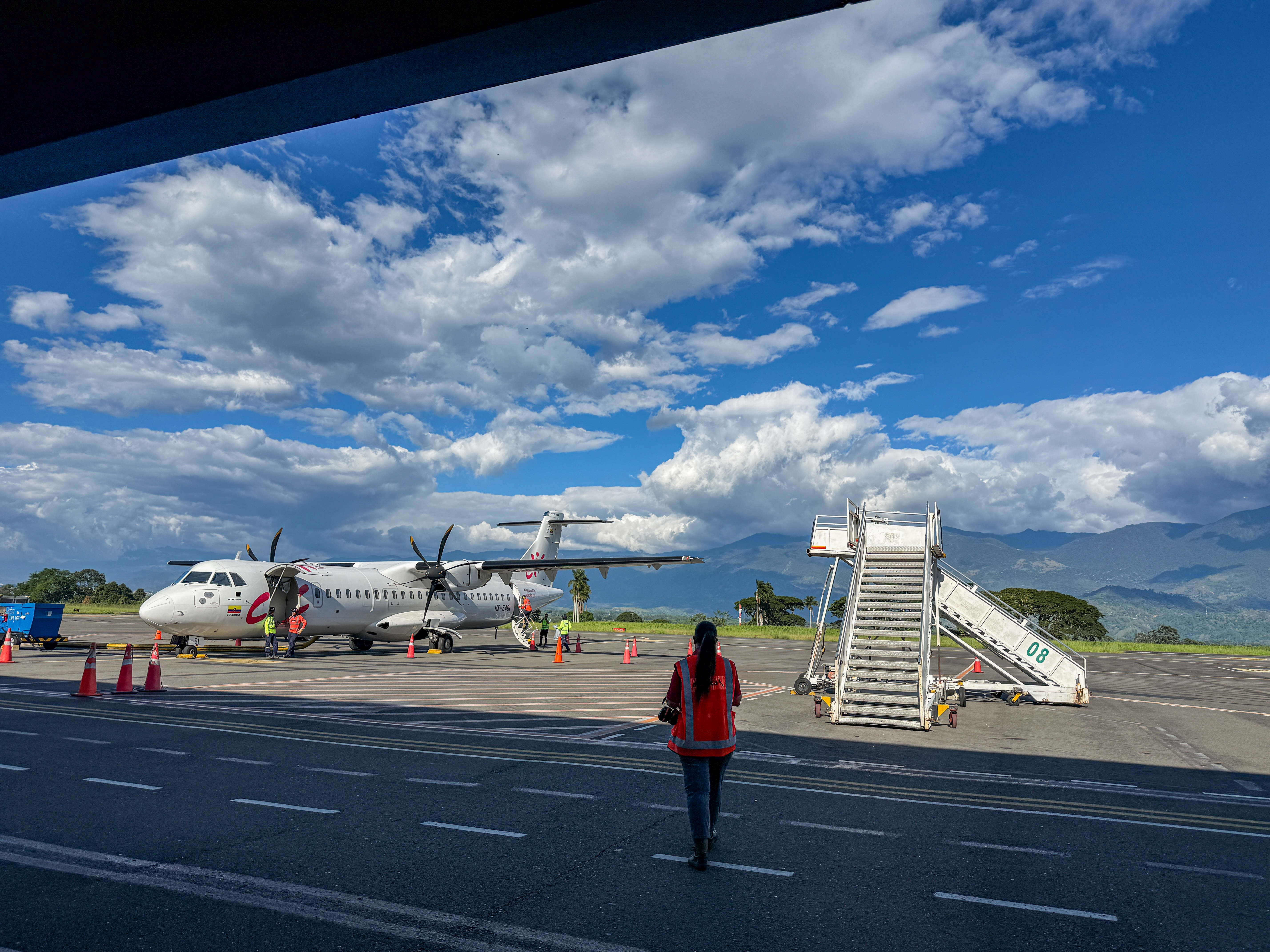
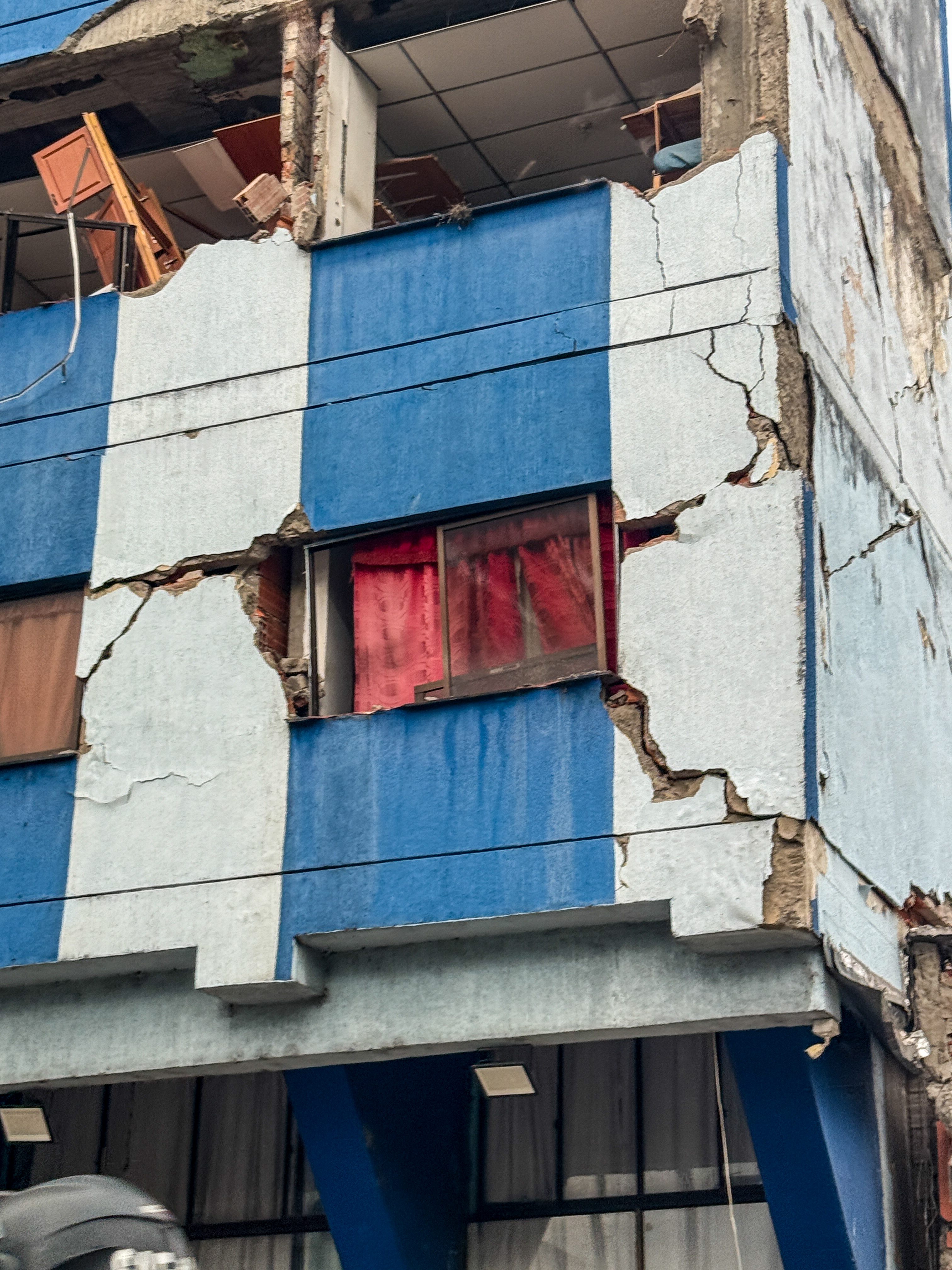
Here, as everywhere, it was just us with our English speaking guide and driver. The vehicles were always modern and in good repair. Which is more than we could say about Pereira as we drove through after arriving at Manizales. Significant damage like this, rubble strewn across the ground, people living under tarpaulins in neighborhood parks.
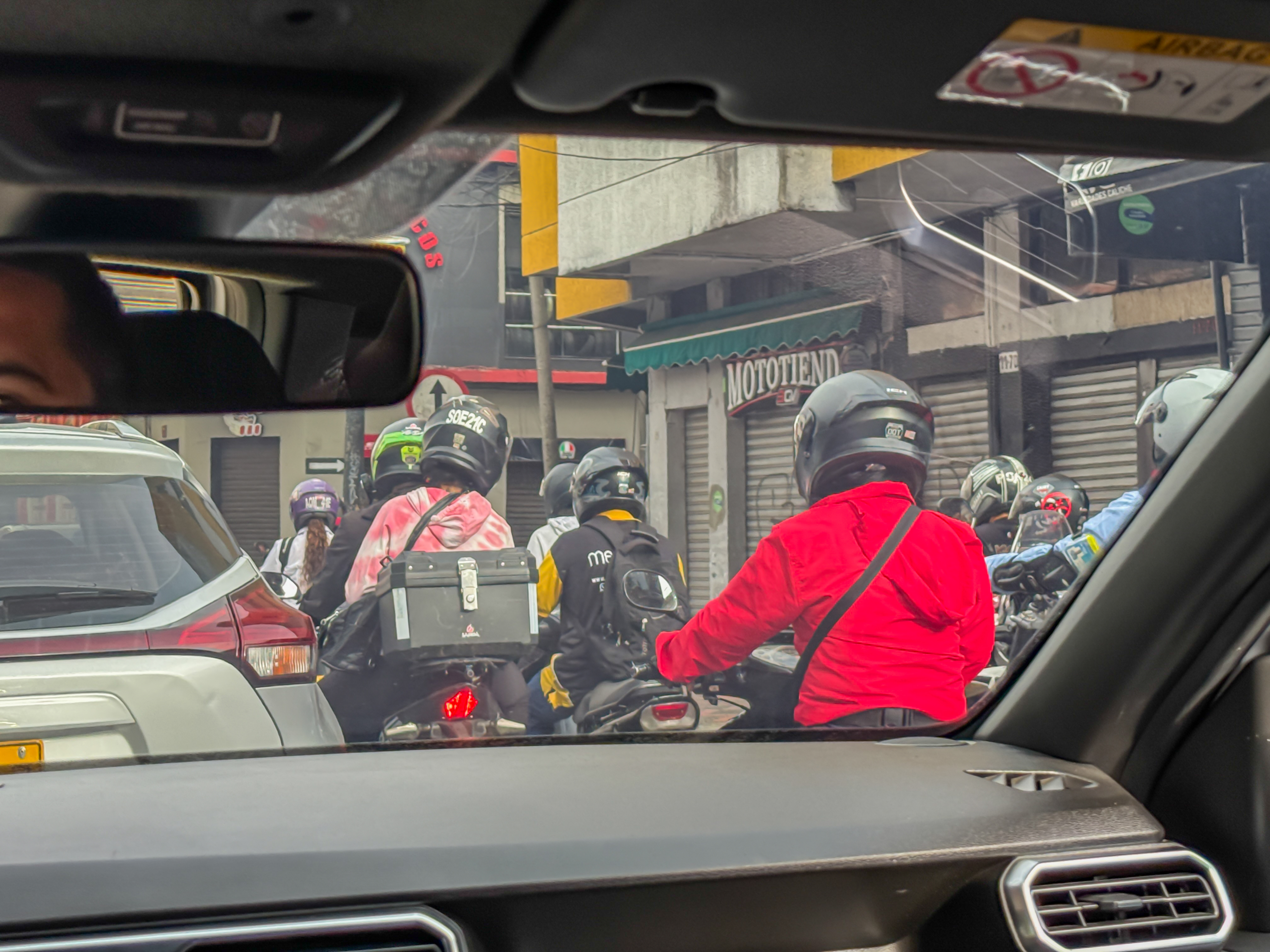
And as everywhere, traffic was heavy and charging ahead. Not as horrific as driving in India, but it is not for the faint of heart. The space between lanes was routinely clogged with countless motorcycles and scooters. The black box on the bike in this scene was quite common and was used for personal effects or the Colombian equivalent of DoorDash.
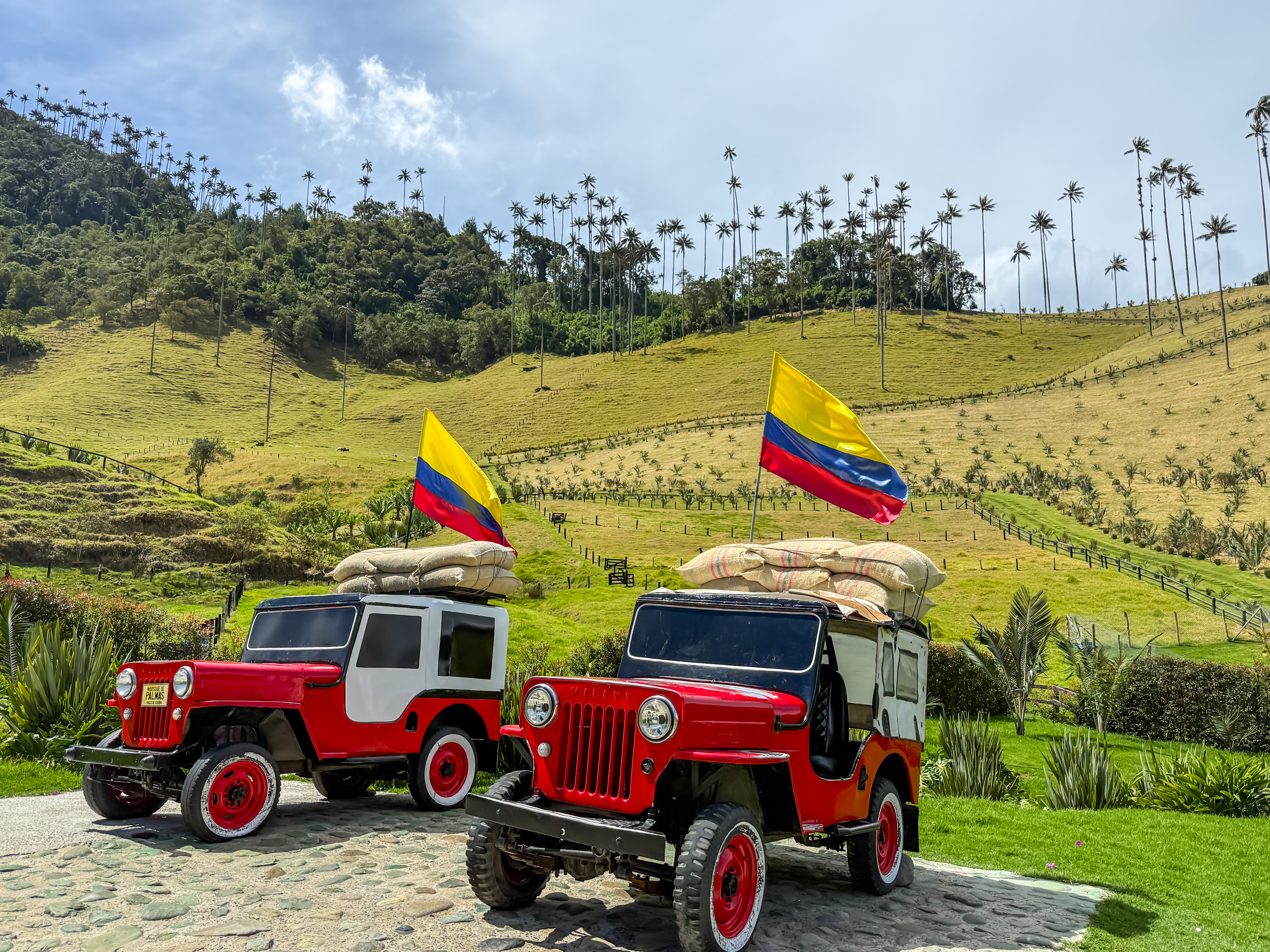
An hour’s drive from our lodging brought us to the Cocora Valley with its remarkable wax palm, the national tree of Colombia, and the tallest palm in the world, reaching over 75 meters of willowy height swaying languidly in the Cordillera breezes above a tiny 3-5 meter root ball. And in a bit of “if you’ve got it why not flaunt it” fun, the trailhead area for our hillside trail climb featured a pair of Colombian-essential Willys. Willys, the original manufacturer of what we now think of as Jeeps, and in-country, are still Willys. Many of them go back well into the last century, still in service due to their robust simple design and ease of maintenance. They are used everywhere to connect the centers of small towns to the outlying areas, taking goods and people in both directions. The people transport is a hoot, passengers stuffed inside and standing on the rear bumper hanging onto whatever amounts to a handhold. At drop-offs, it’s like watching clowns exit a VW under the big tent.
That’s Cathy and guide Juan Pablo ahead of me as we embark on a 1200′ elevation gain to 9700 feet. The trail is laced with those rectangular pads to keep it walkable in spite of not infrequent mountain rain. I found that with my particular gait sometimes it was easier to walk the side of the trail like where Cathy is standing. Besides, what little boy doesn’t want to play in the dirt?. My internal combustion engine valves didn’t float, but I might have missed that sound over my gasping inspiration. The physiological kind. The scenery was plenty quiet with the inspiration it supplied.
Now, Juan Pablo—ex Army, BTW—was not only keen to urge on our stamina like a somehow soft-spoken Drill Sergeant, while regaling us with the sights, wide and close at hand. He also wanted to do his own clever take on capturing our moments along the way.
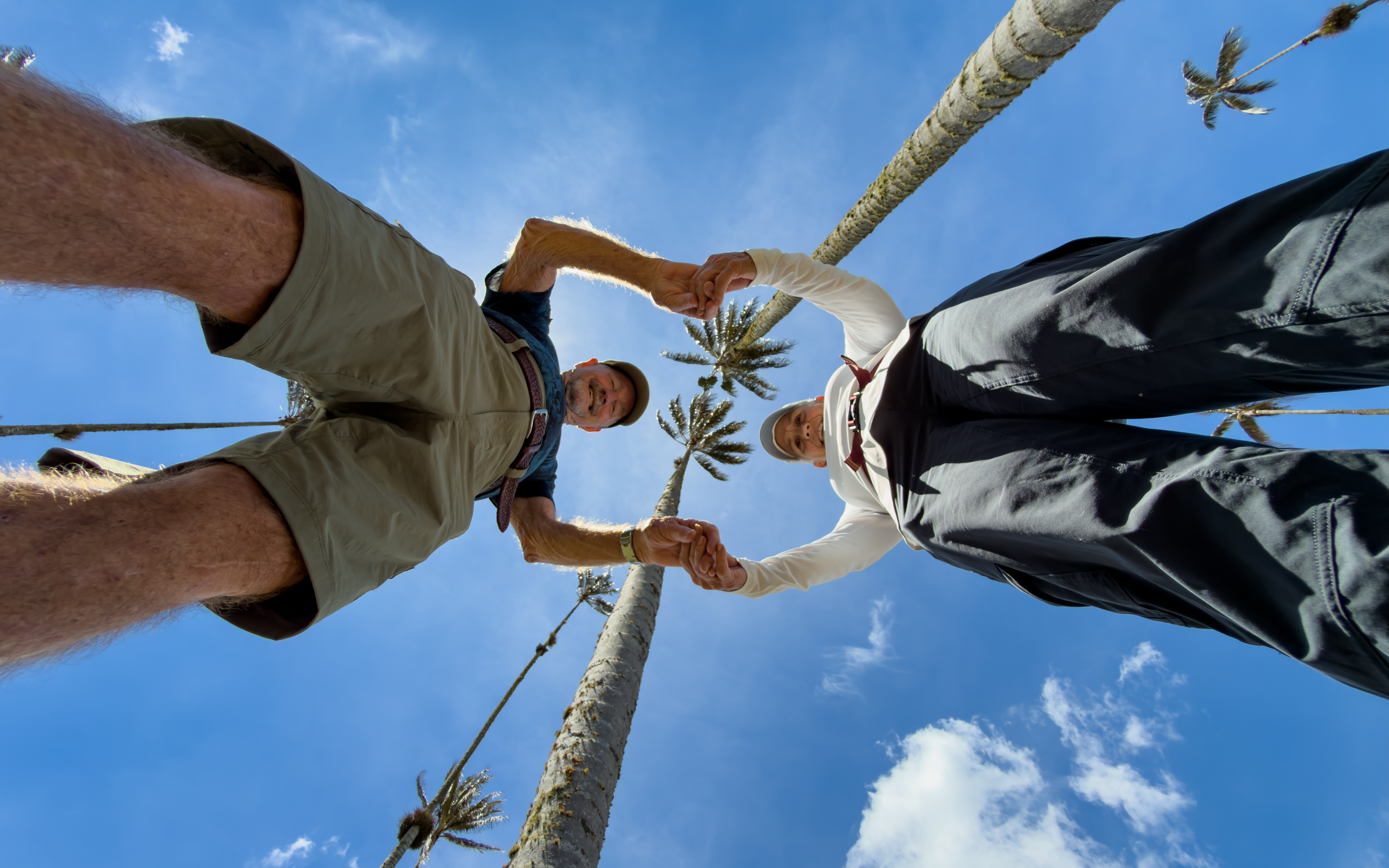
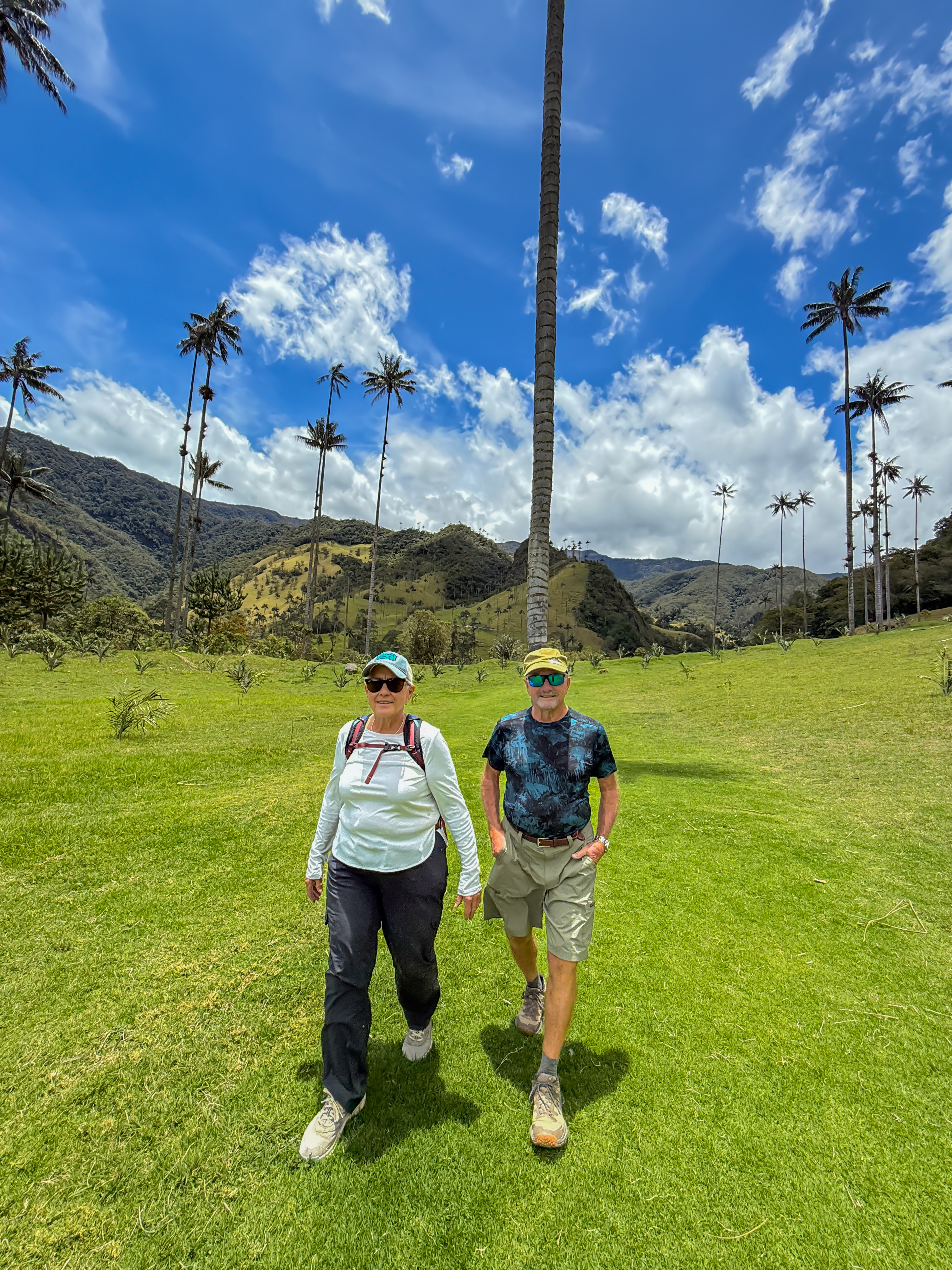
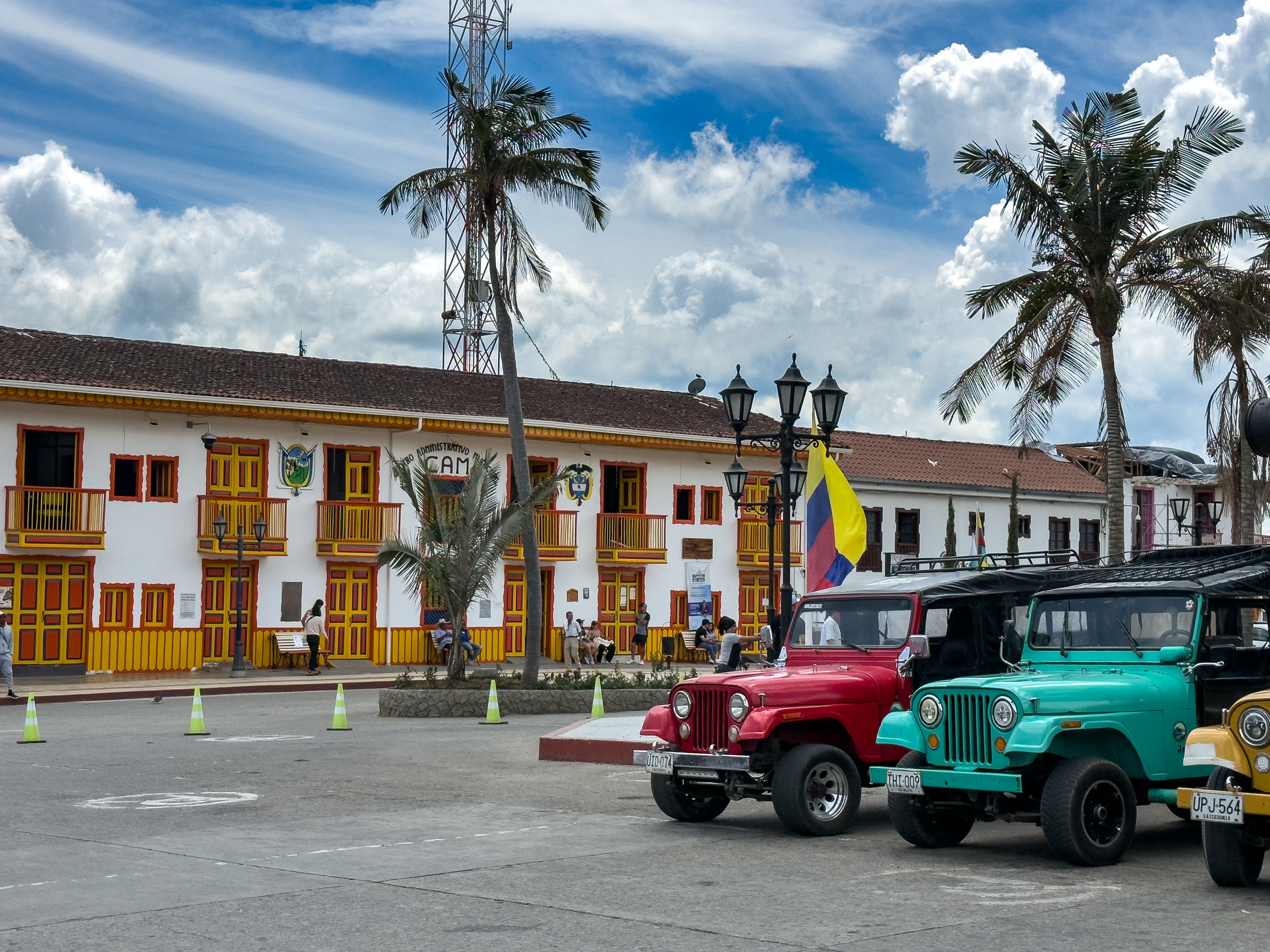
After the hike we had lunch off Salento’s plaza principal, the colorful town offices as background to three Willys waiting to depart to the town’s hinterland.
Our second lodging in this coffee and cacao growing region as we thought of it, turned out to be a true gem. The 10-room boutique Casa Rivera del Cacao. https://www.casariveradelcacao.com/en. Ensconced in the midst of its own cacao plantation, sprinkled with coffee and plantains, all of it hidden in a lush valley. Innkeeper and chocolate guru José, positively grinned when I enquired if he was nicknamed Pepe? An icebreaker that got us along even more famously as I caught him momentarily off guard with such a question by an Americano. (You should know that Pepe stems from the Spanish pronunciation of the initials “P. P.” from the Latin, standing for “Pater Putativas,” the putative father that was Joseph—José in Español—to Mary.) An educated and worldly businessman who has forsaken his previous life in the furtherance of all things chocolate, he guided us throughout the plantation, and settled us into an amiable world history including of the gastronomic science turning cacao fruit into our own finished dark chocolate bars. It’s DELICIOUS being mentored by a gent who recently won gold medals at a Chocolate competition in Paris. And you need to know—those gold medals are emblazoned with the French phrase “Un Coup de Coeur” roughly translated as “a Blow to the Heart.” A blow of the love at first sight variety. Sound like what your tastebuds tell you?
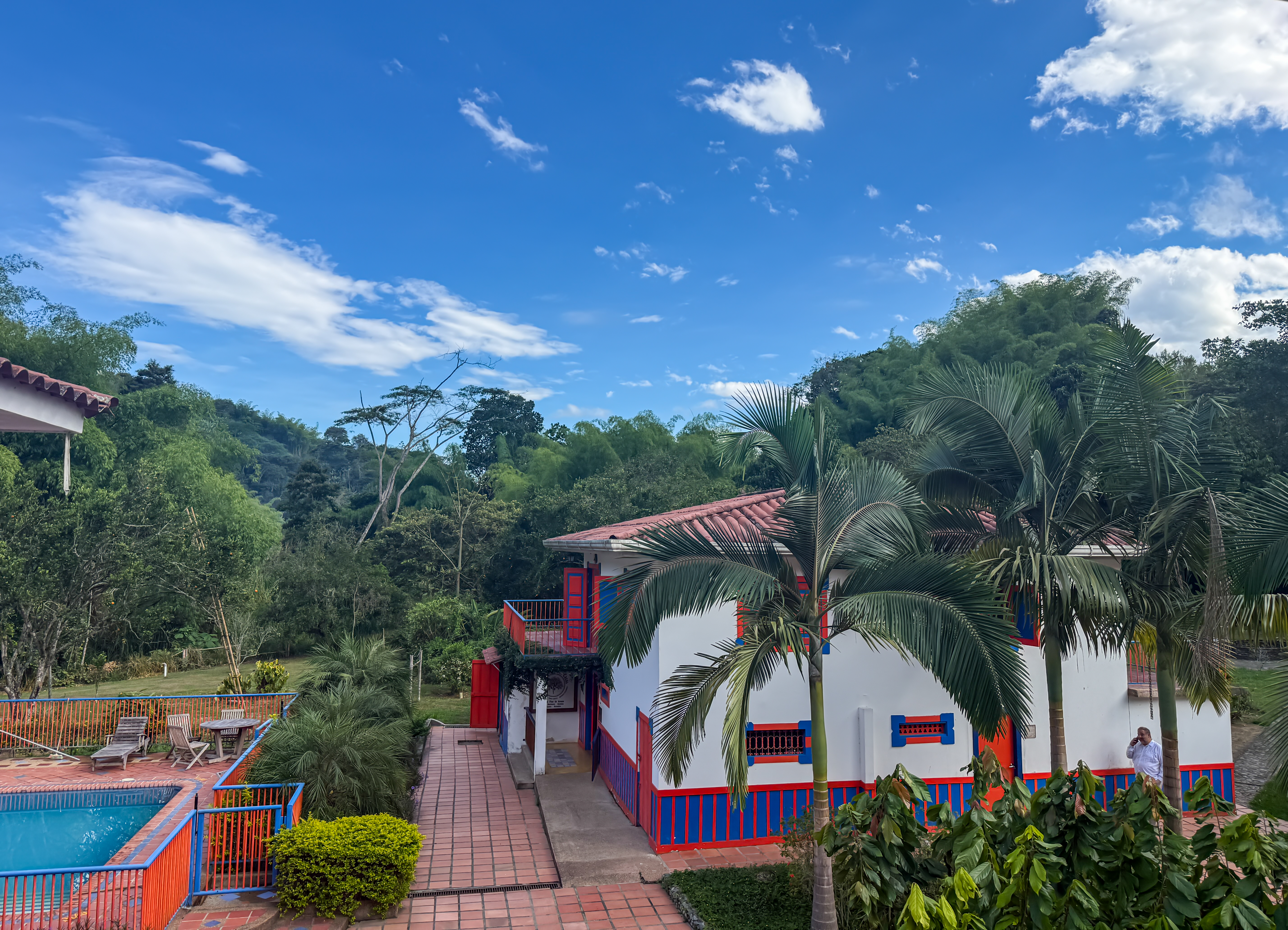
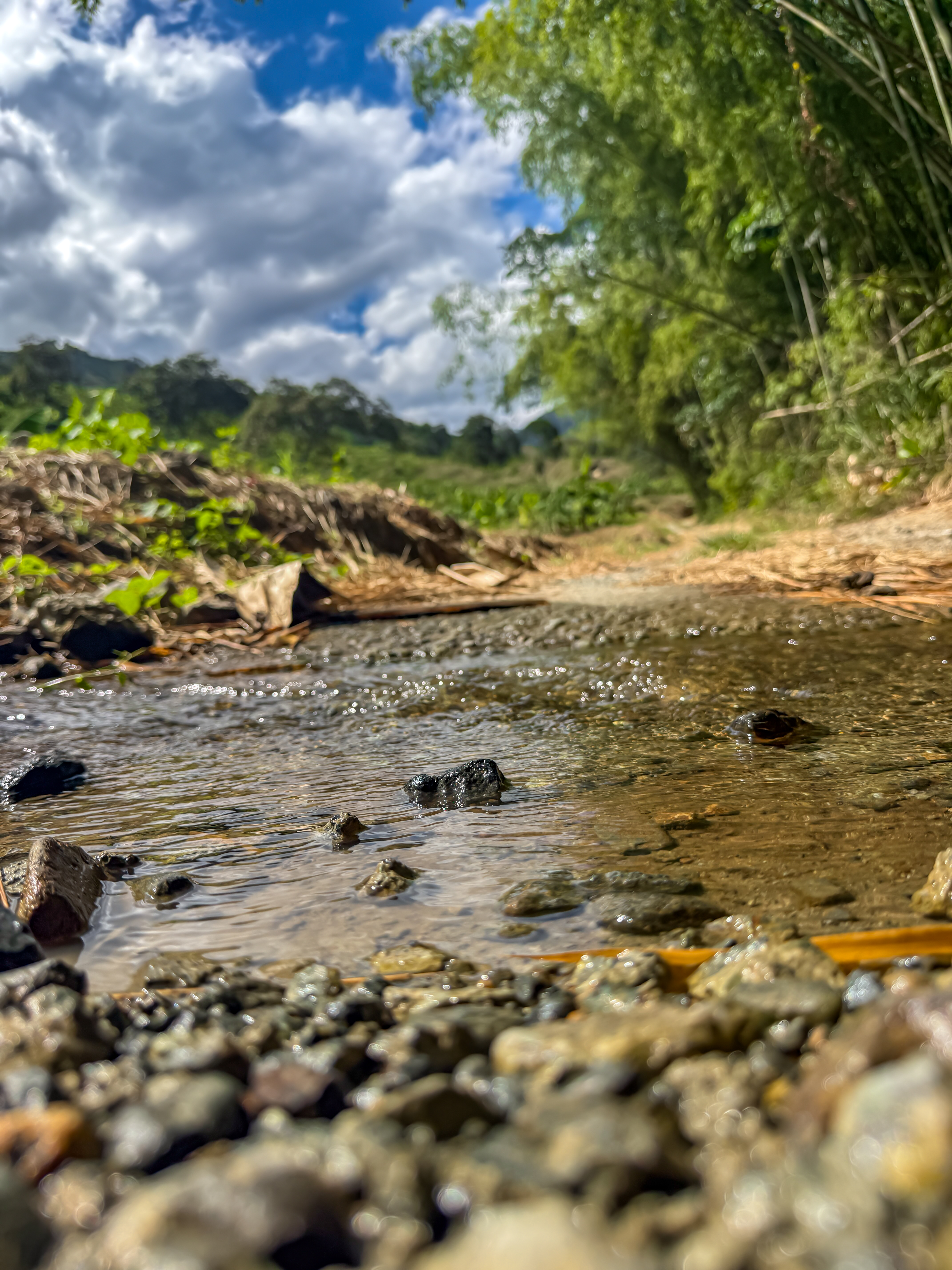
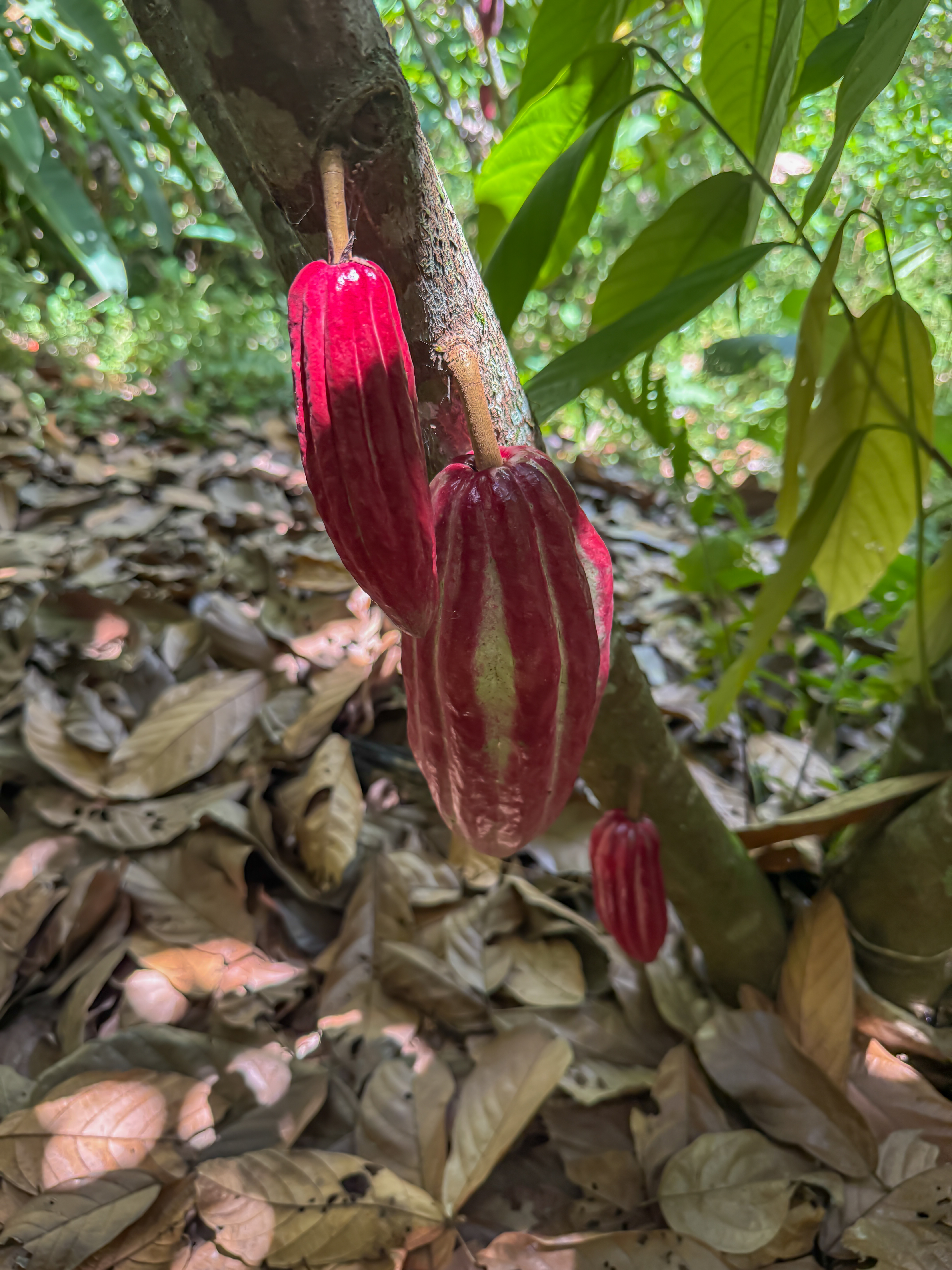
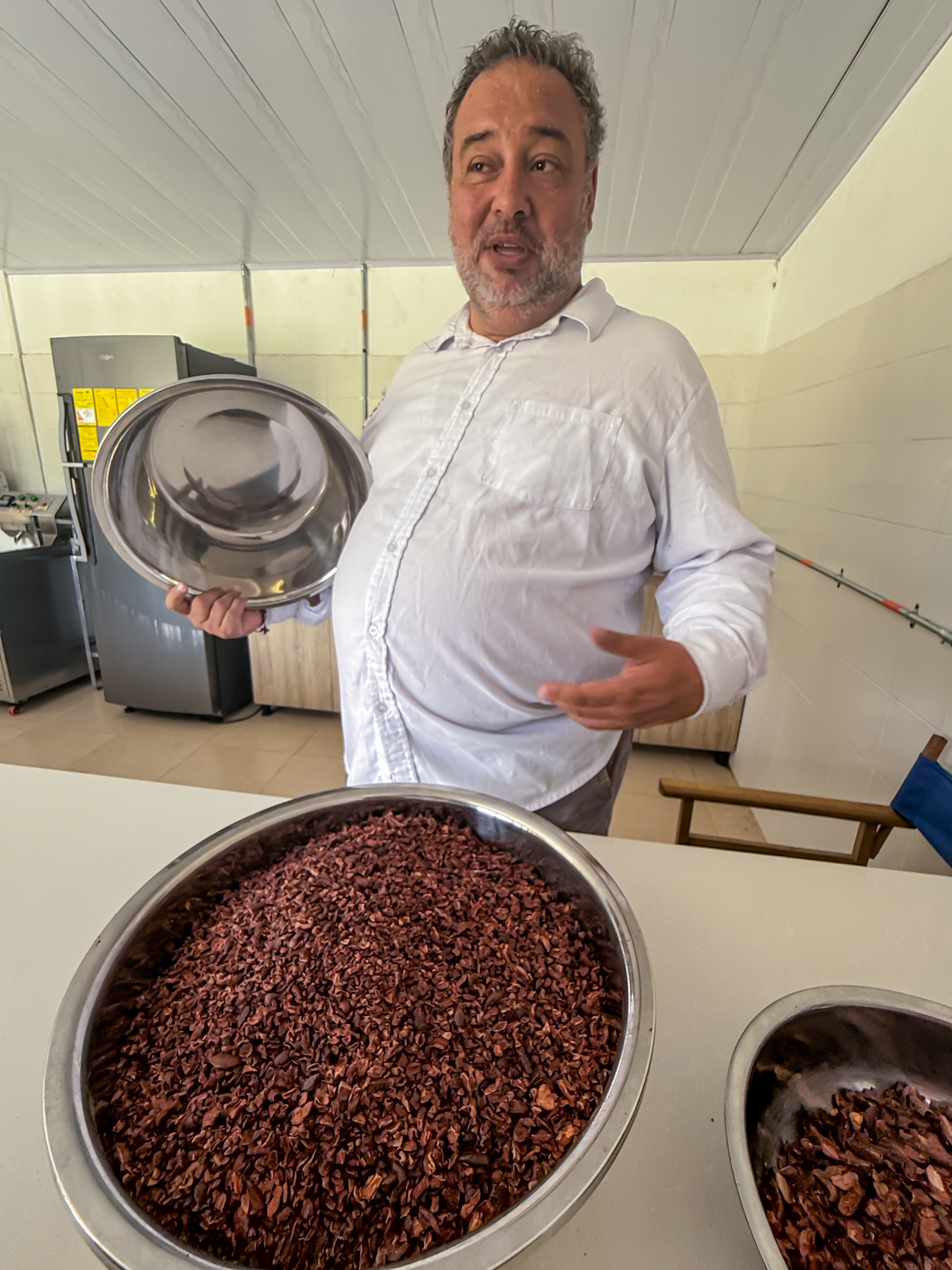
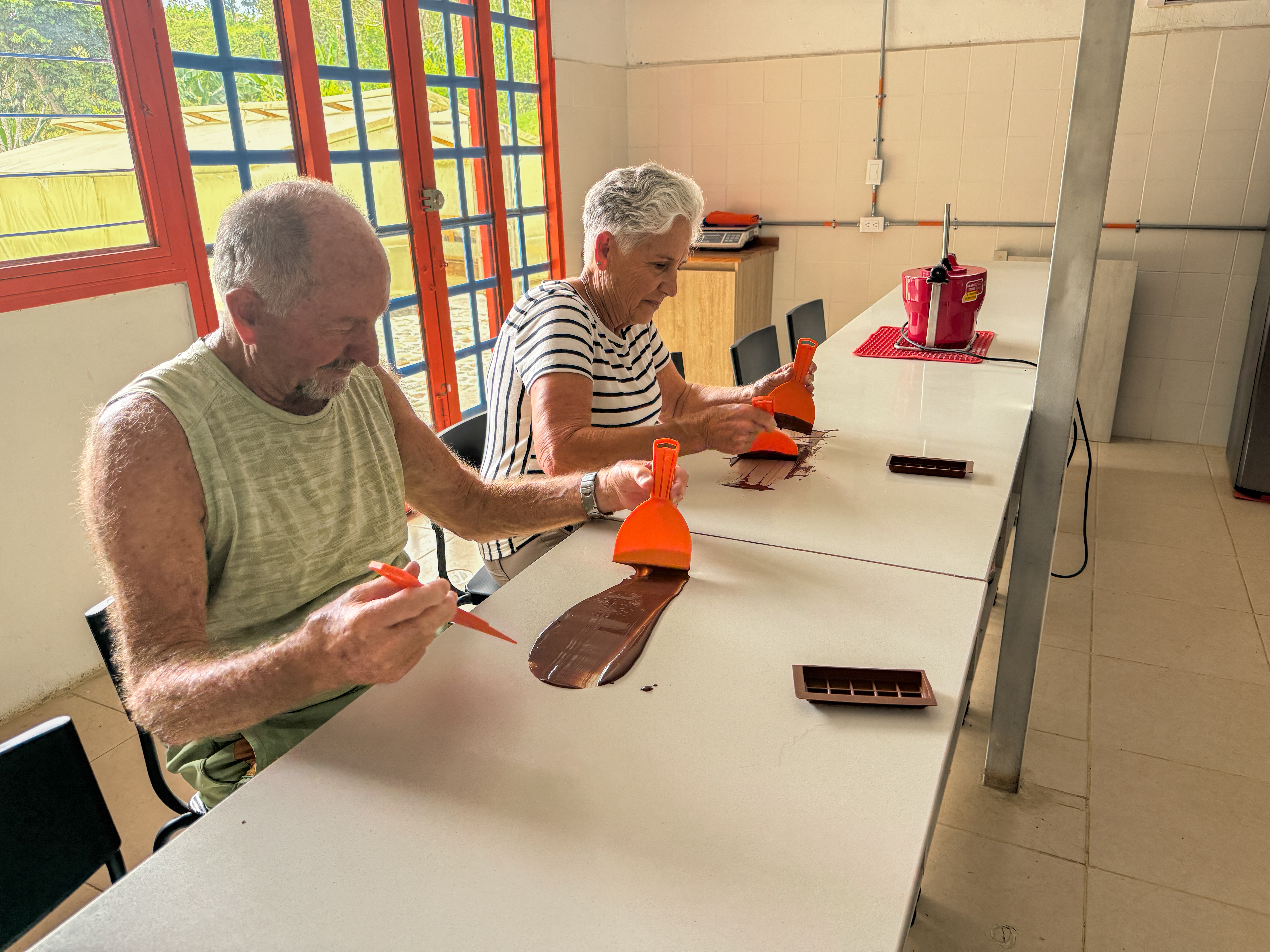
Decidedly rural…country. But a place of gustatory delight. Would we care to partake of a five course meal featuring the chef’s offering of specialties from as many different Colombian regions? Oh, twist our arms.
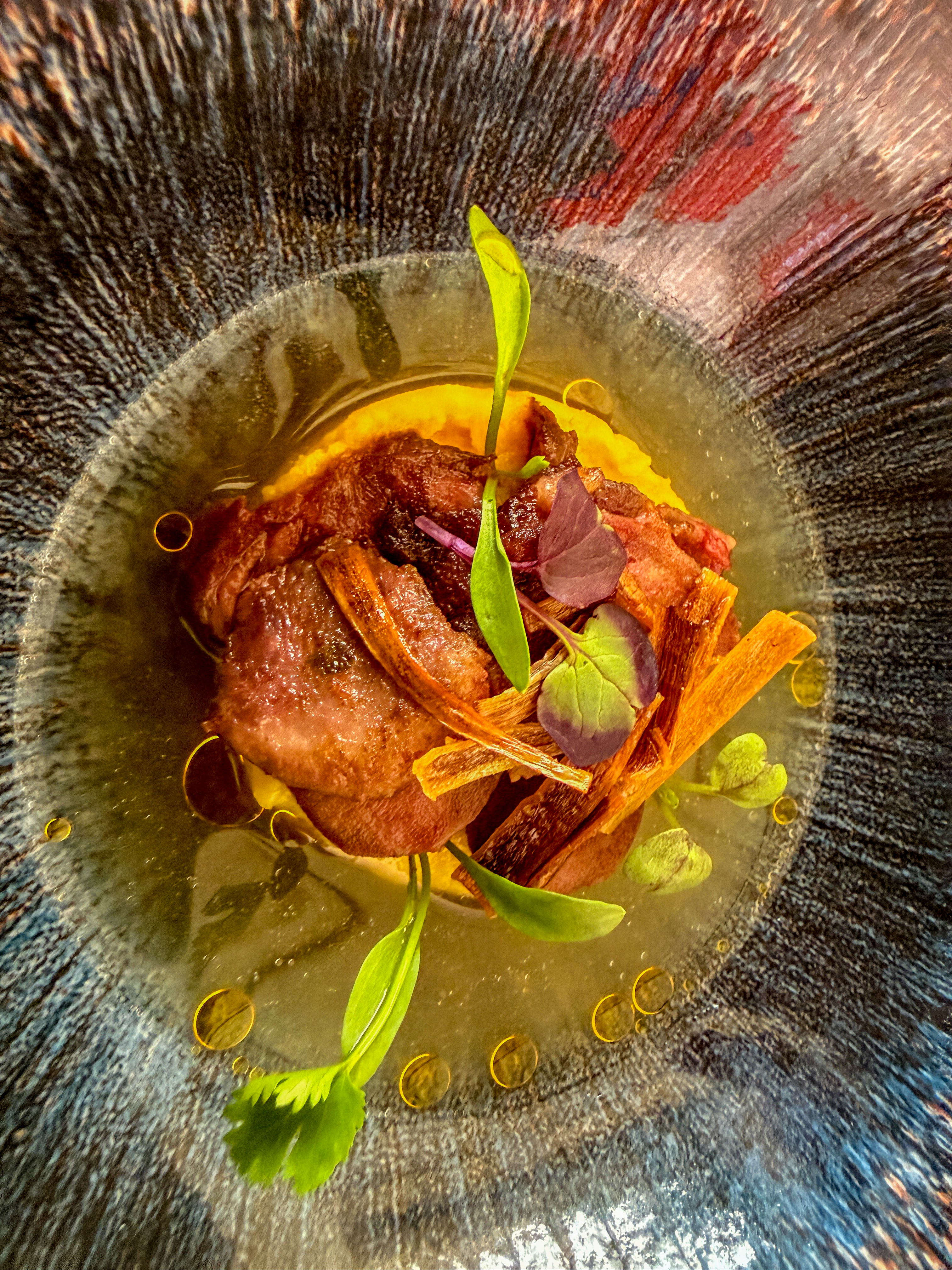
This the place to “Why Colombia” wonder as to traveler turistas? In cities like Bogotá and Medellín the water is safe to drink from the tap. Elsewhere in Colombia, stick to purified bottled water and beverage ice, and it was provided everywhere. We ate in small local cafés and upscale restaurants. Routinely delicious, and nary a problem. I even tried Colombian coffee, quite the lark for this non-coffee-drinker, and of course the hot chocolate at Casa Rivera. Club Colombia cerveza was quite serviceable, but we were warned off local wines, preferring Chilean and Argentine. Margaritas were always a delight, but we struck out on pisco sours, a distilled grape liquor that caught our fancy in Chile decades back.
Traveling, we are informed by our personal past. The lushness of the early morning jaunt to the SoñArte nature reserve before flying to Medellín, transported us back to Rwanda’s “Gorillas in the Mist” Virunga mountains. Why we travel—new experiences in old memories. Life.
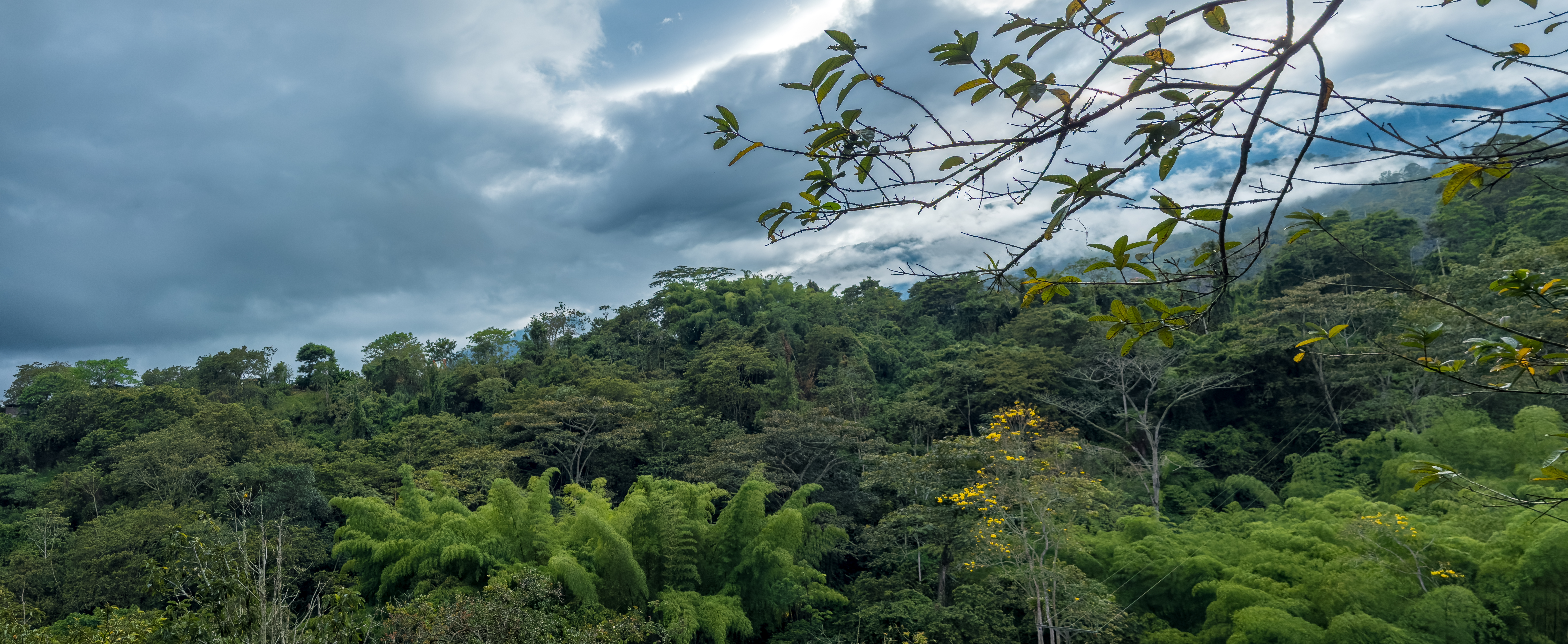
SoñArte is a private birder’s nature reserve, applauded by the Audubon Society, and in the heart of the Colombian North-South migratory routes. The country’s mix of mountains, plains, and coasts playing host to 20% of all bird species on earth and nearly 80 or so that are endemic to only here. Given the way tropical birds’ iridescent plumage reflects the light differently depending on viewing angle, our guide, Daniel, confirmed that determining a species is helped by both behavior and song. I’m no bird expert, but find their antics a delight, and their colors in keeping with the vibrance of Colombia and its people.
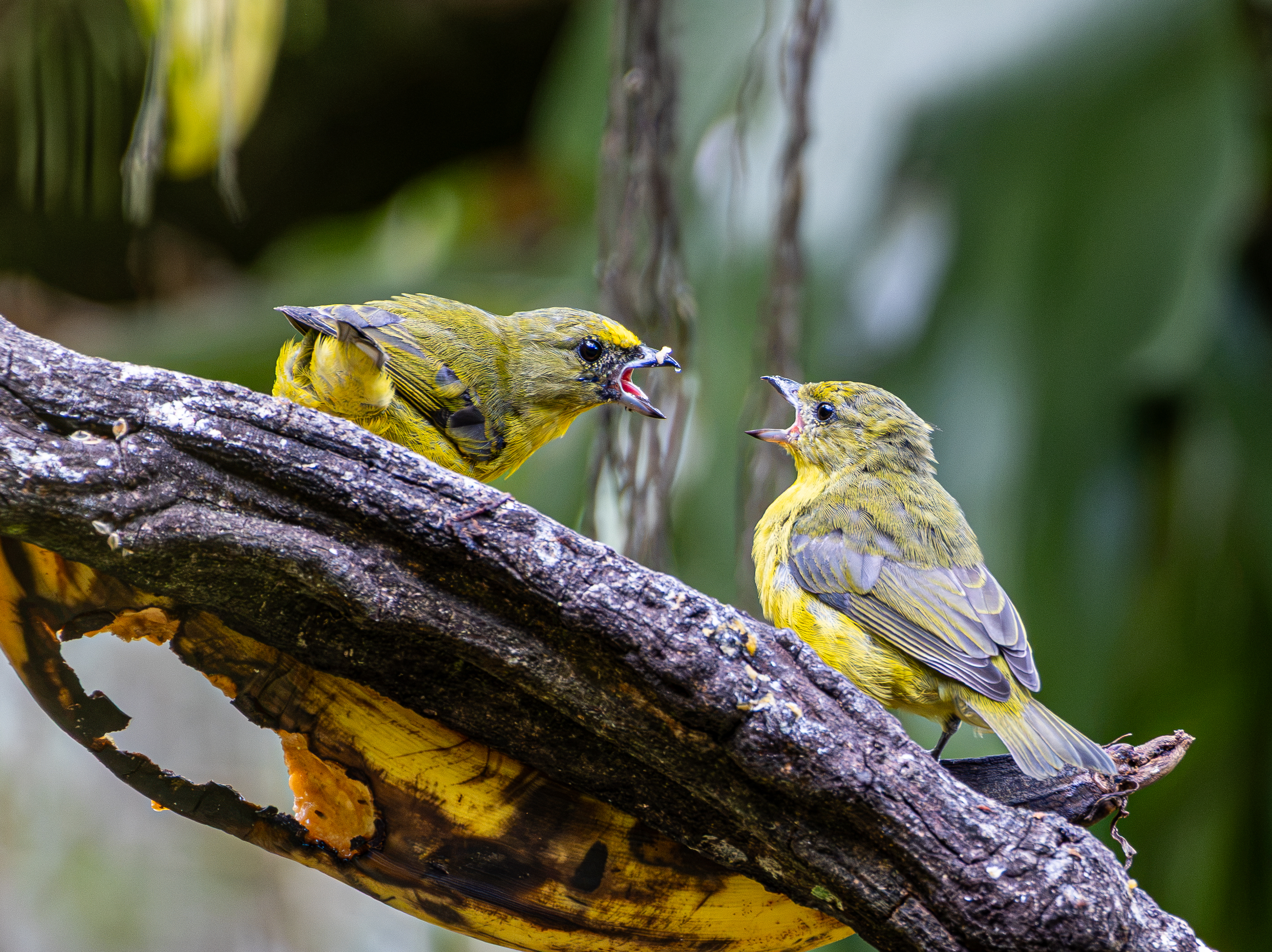
My birding friend Billy says the above is not a marital spat, but likely adult and youngster sorting out some life lesson.
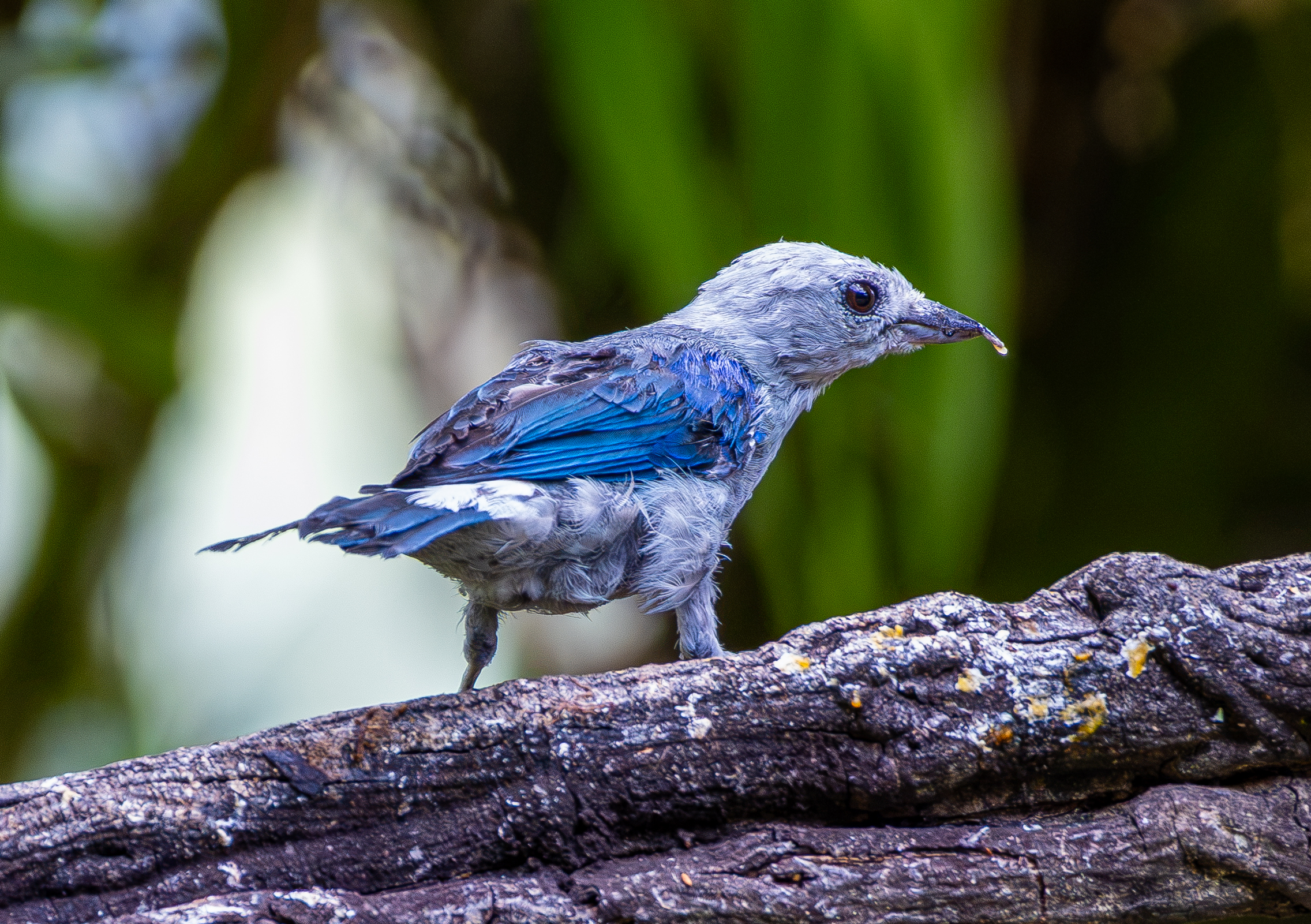
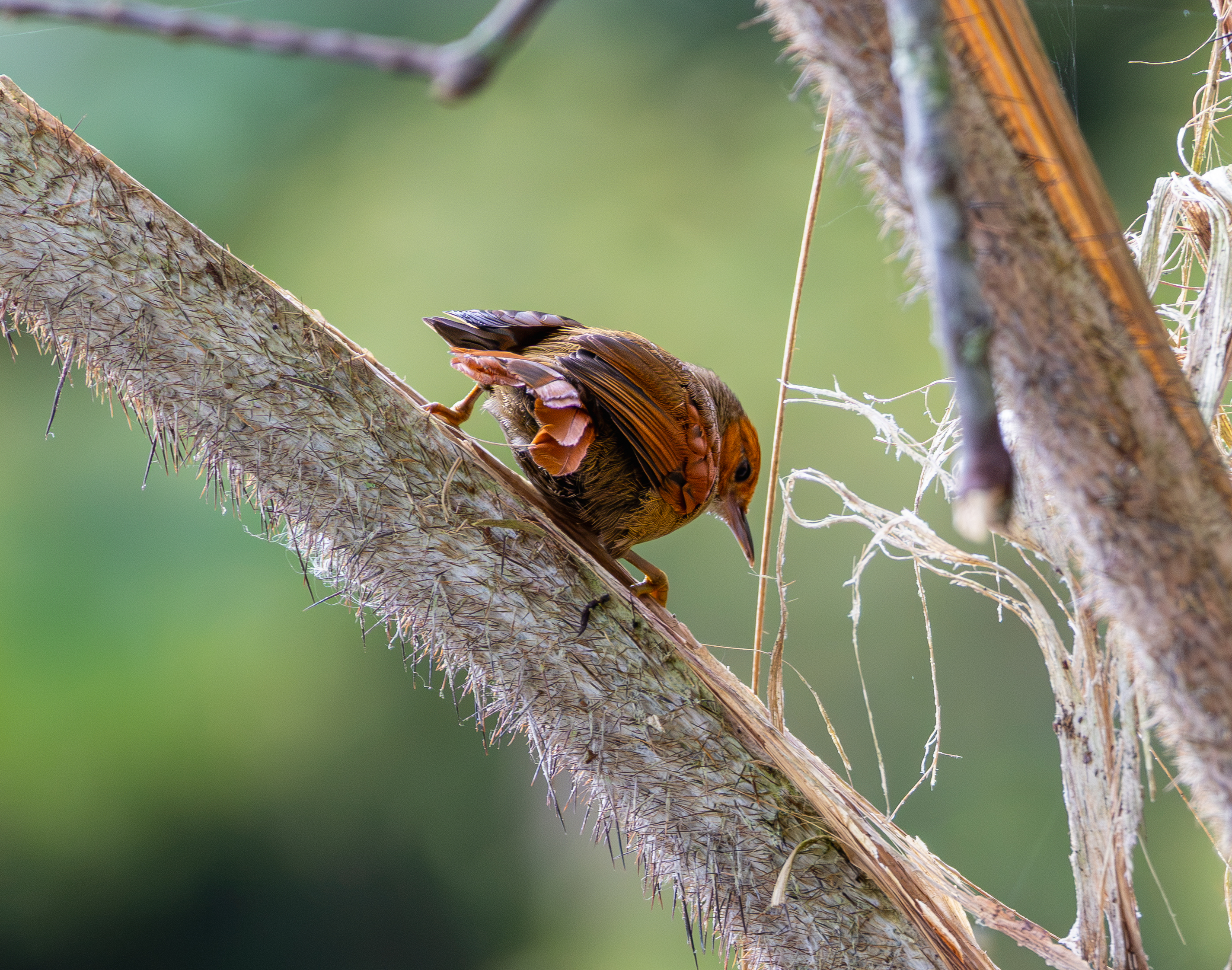
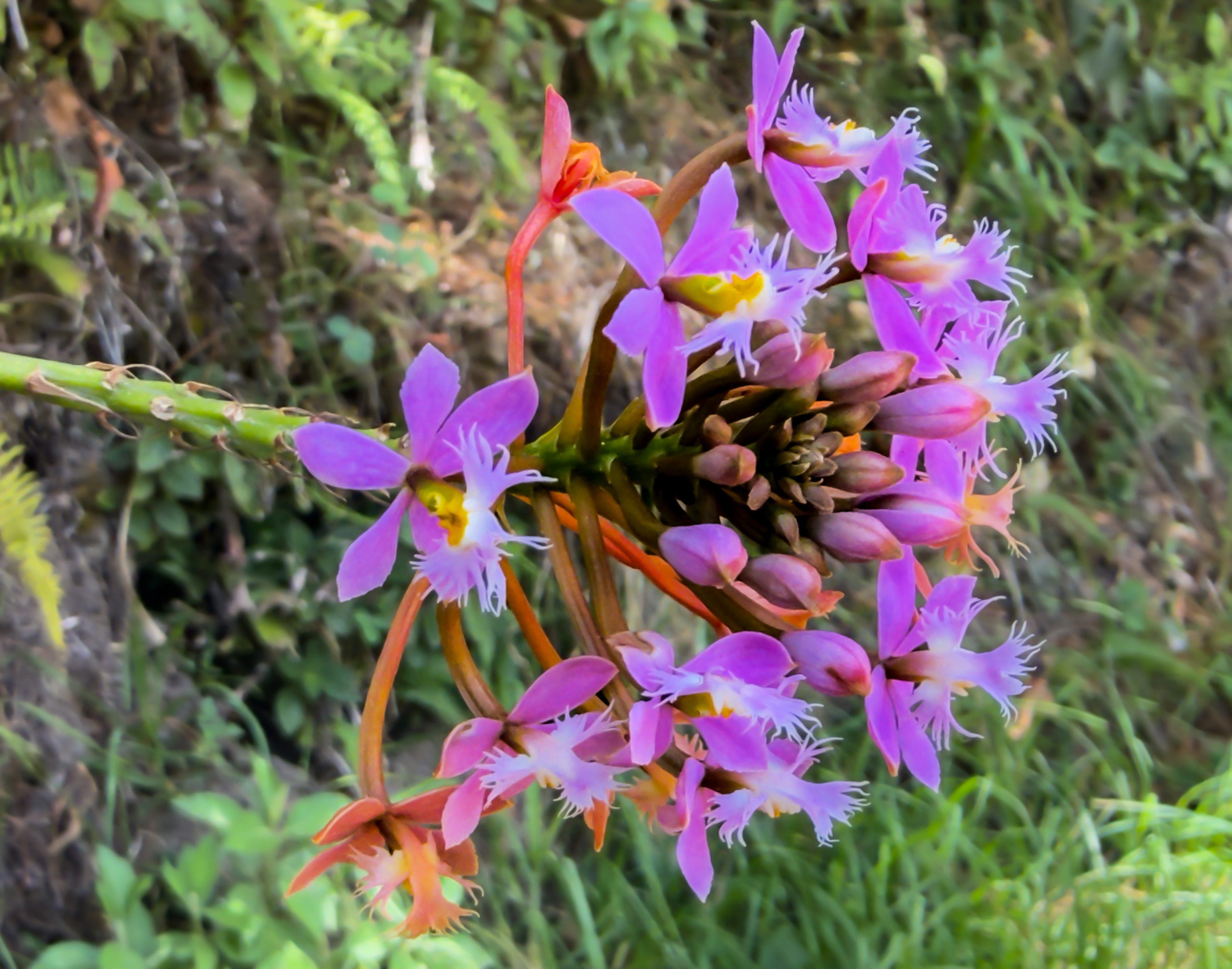
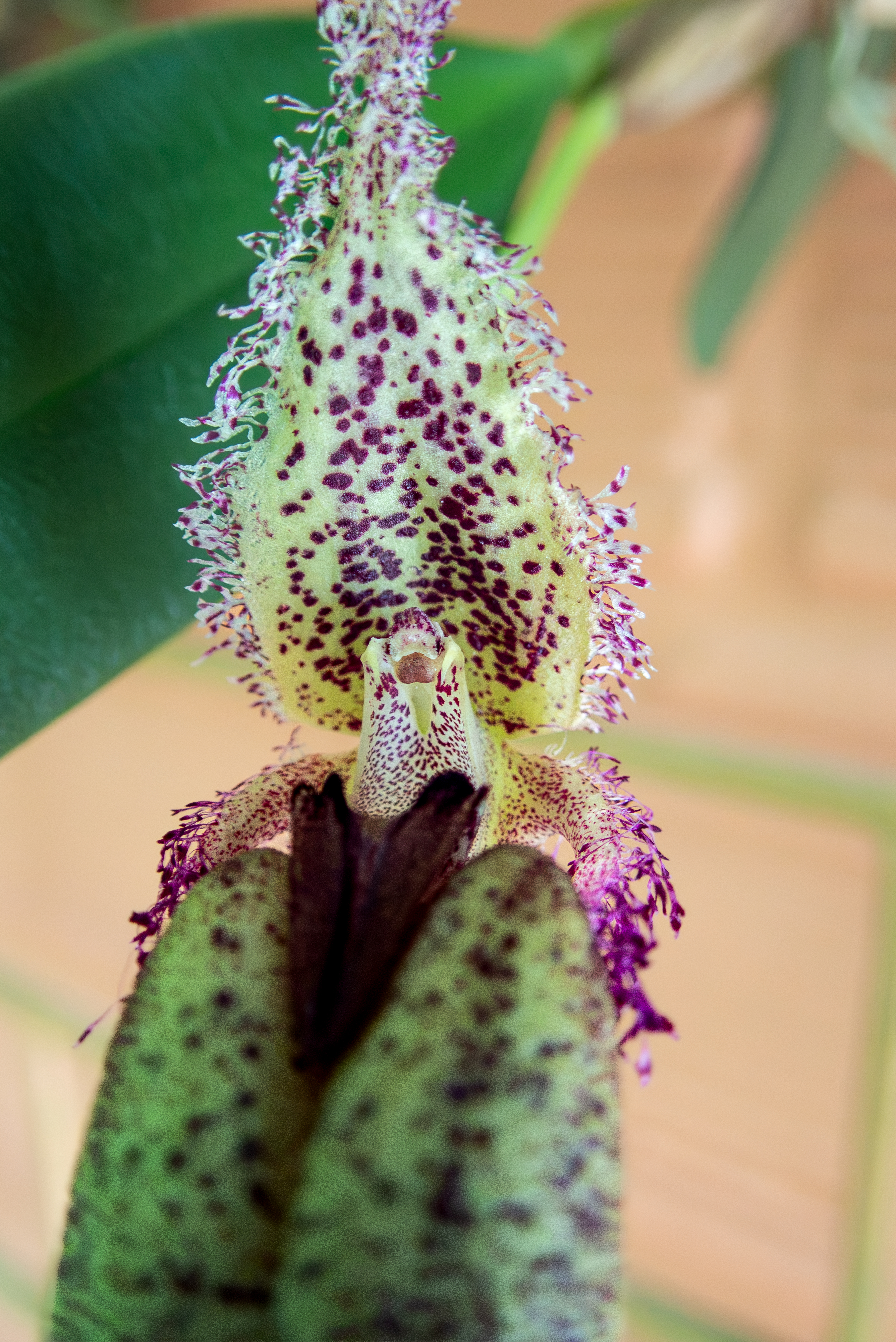
And hereabouts at Finca Romelia there were orchids and pollinators.
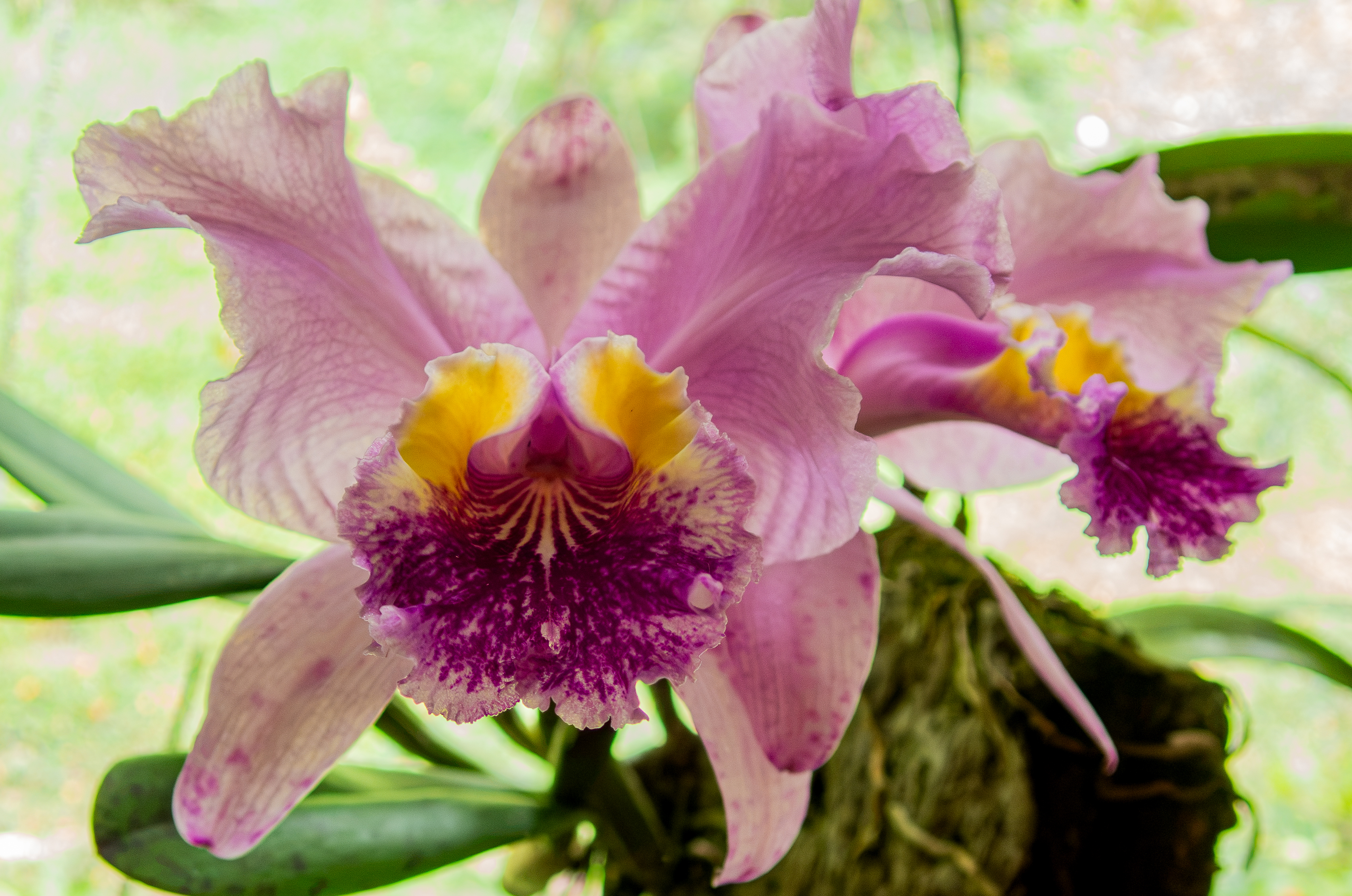
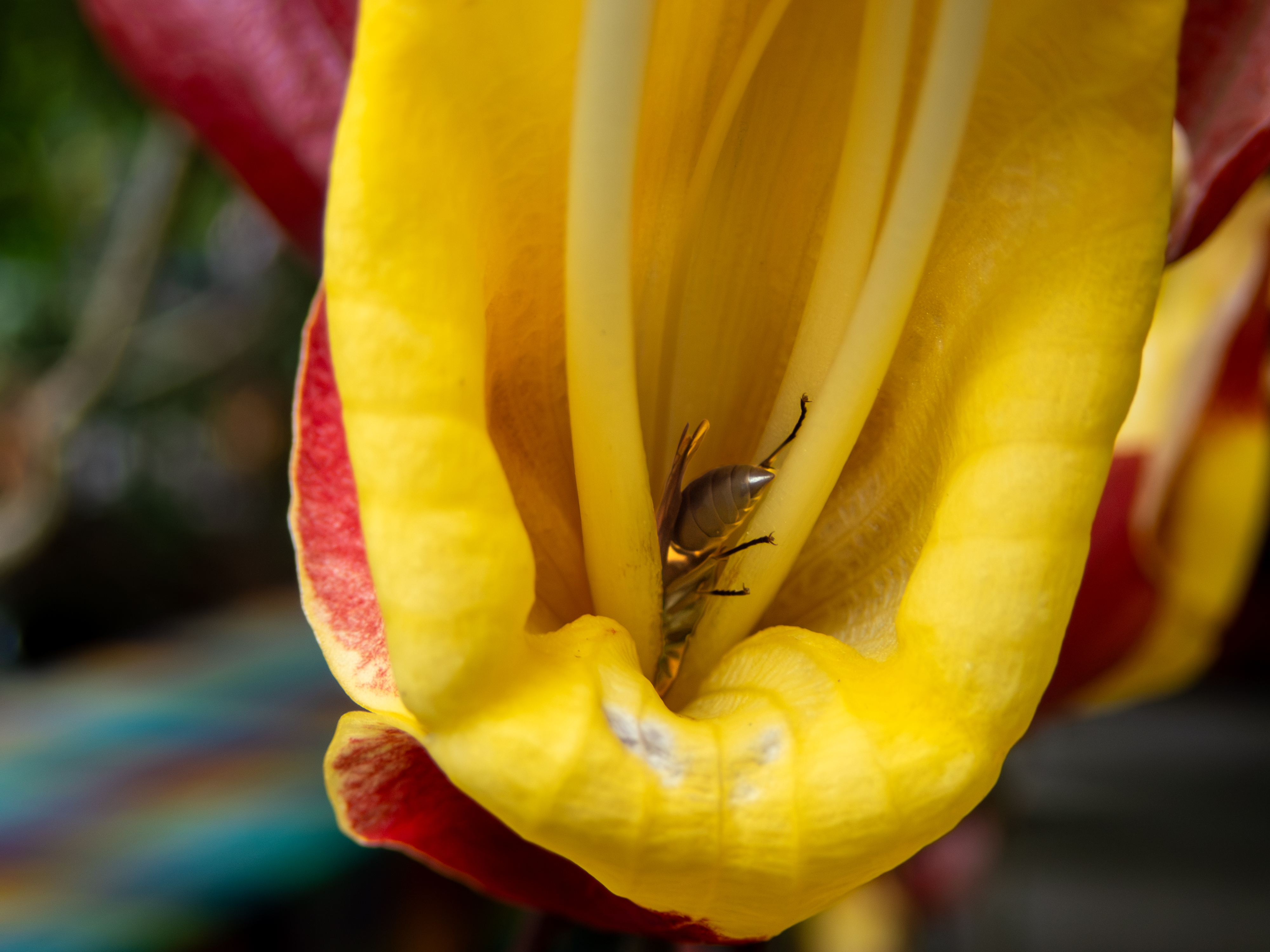
Leaving Medellín for the jungle-meets-the sea Pacific coast, I found myself in another past history meets present travel experience. Not the Virunga mountains, but the dense vegetation, twisting rivers and heat and humidity of 1968 and 1969 Vietnam.
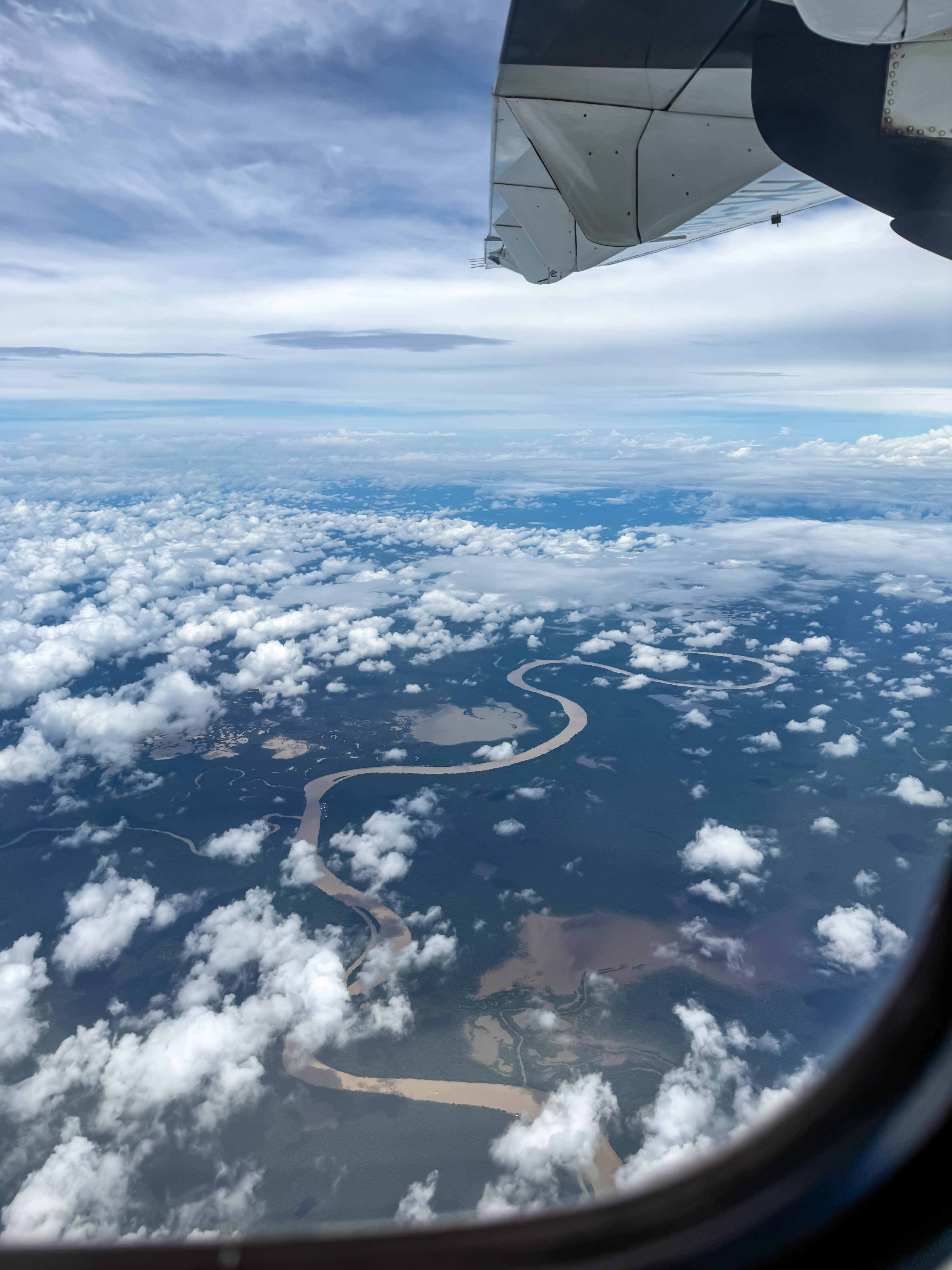
The Clic Air ATR 42 delivered us into Bahia Solano’s José Celestino Mutis aerodrome redolent of SE Asia’s mission mindset. Note the clouds topping the ridges of hills either side of the short final approach course and the downwind landing rollout in robust rain. Welcome back, grunt.
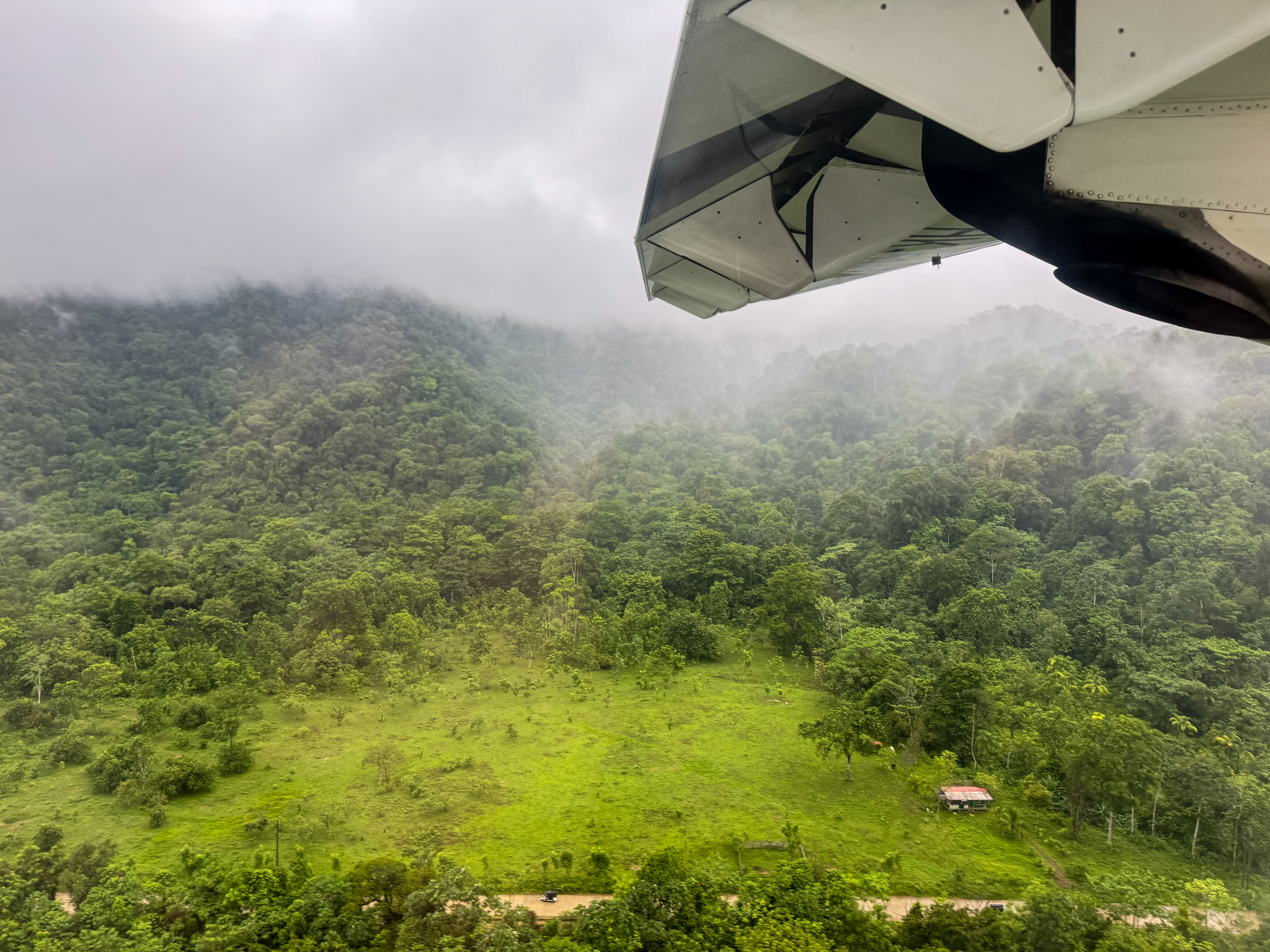
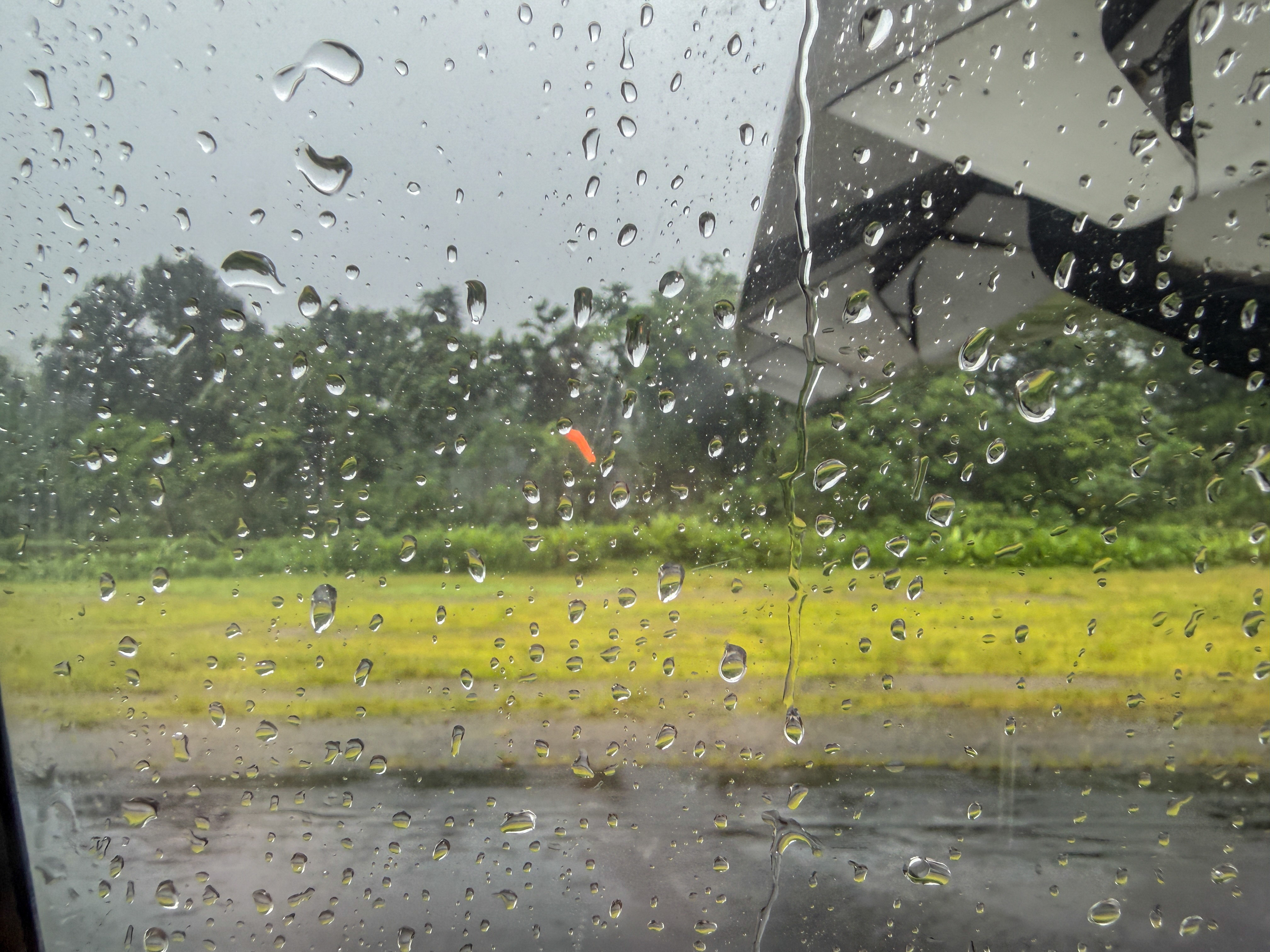
Our reason for going to this stretch of Pacific coast was its visceral natural offerings, and it was definitely unvarnished. After our turboprop landed, and turned around at the end of the runway, the small parking ramp became available only after another turboprop taxied out from that one-in, one-out pad. We swung into the ramp, did a 180 turn, then taxied backwards to reach our shutdown spot. Fortunately I had looked up the weather at the Bahia Solano aerodrome and both of us had our umbrellas ready for the dash across the ramp into the “arrivals area”—a tin roofed, open sided passageway about 15 feet wide and 100 feet long. Bags collected, while trying to make our way to a vehicle with the name of our Kurrulau lodging affixed to the side, I was stopped while still under the tin roof by our assigned guide. Melana, who having deduced that we didn’t look “local,” introduced herself and shared that we were waiting for two more passengers on another inbound flight. Which meant that our plane had to first leave.
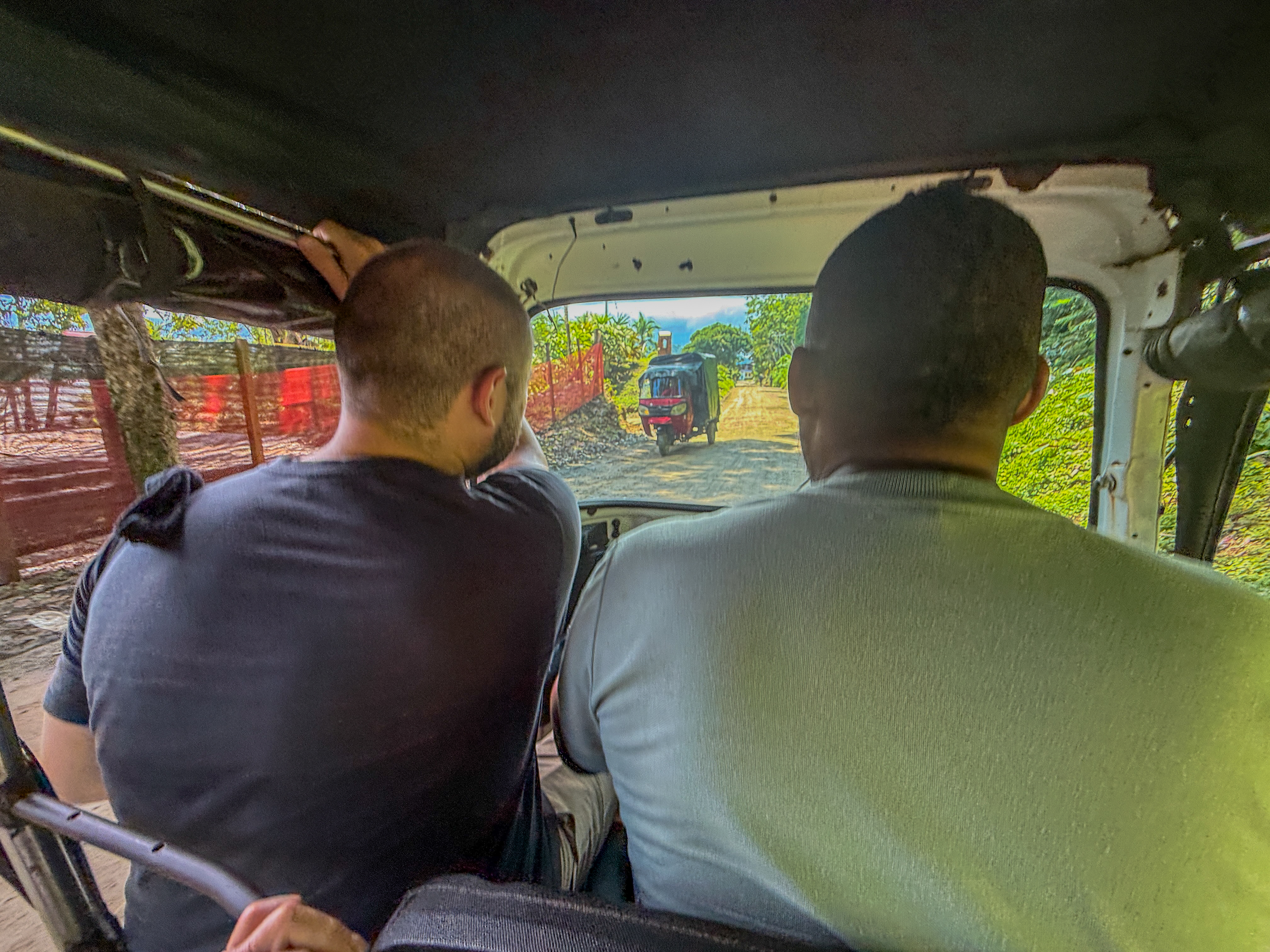
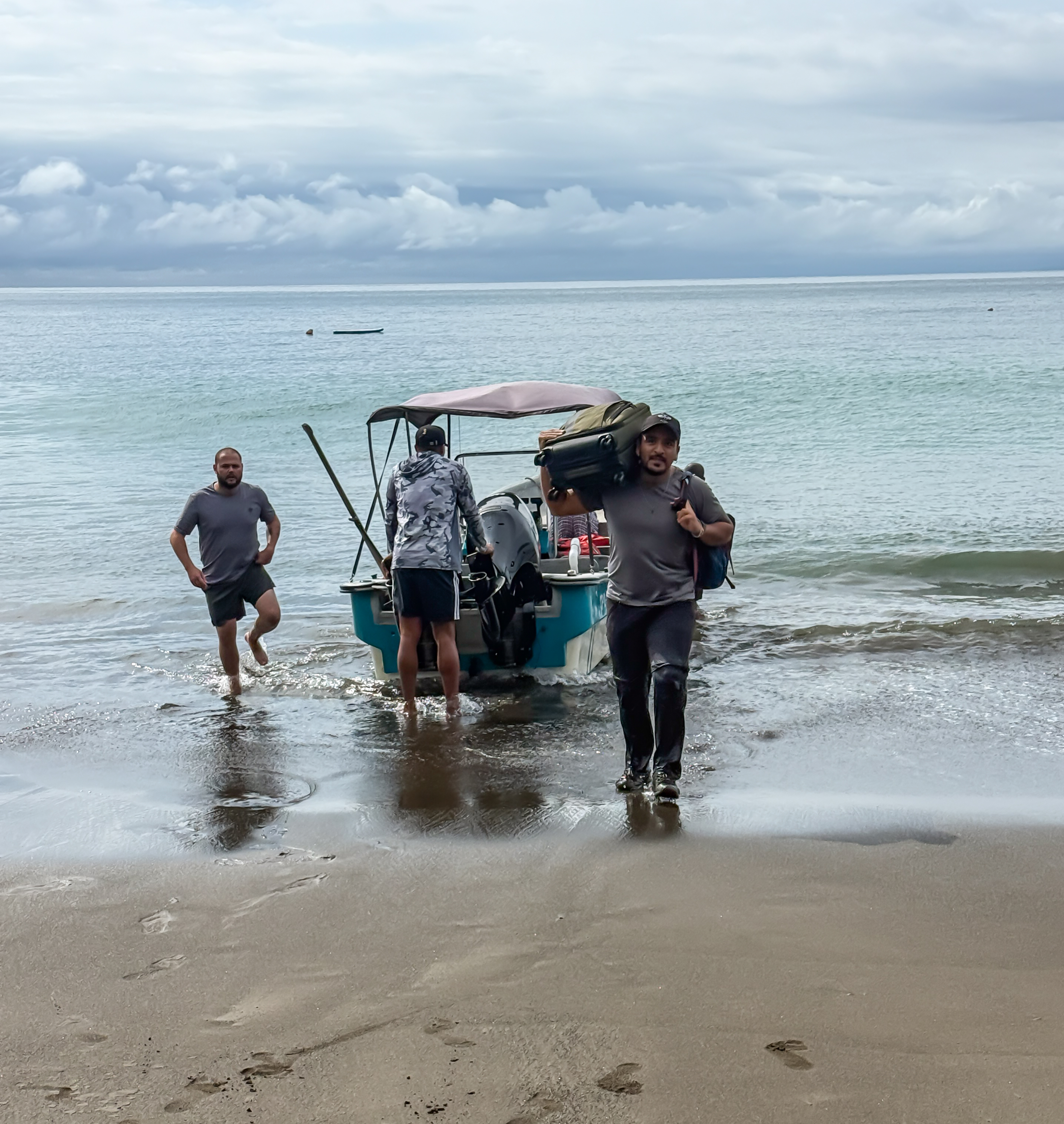
A common form of Colombian remote transport—the local Tuk-Tuk take on the rickshaws of yore. Once we collected the inbound passengers, it was off to a small harbor so as to wade from the shore into your basic 20 foot-long panga for our :30 transit by sea to the Kurrulau Hotel Playa Pacifica. https://www.kurrulau.com/. Yep, wade to the boat, then at our destination, wade from the boat. A Carnival cruise of a different sort.
The lodge consisted of multiple stilt-elevated walkways to small groups of likewise elevated single-walled, tin-roofed rooms, each with “en-suite bath”, including cold water shower, and comfortable beds under mosquito netting. Overhead fans. The U.S. CDC labeled the area as one of severe malaria risk. We took prophylactic pills, but the bug annoyance was very modest to nonexistent. There was electricity and lights when the generator functioned, which was most of the time. Ditto Wi-Fi when the electricity was available. Which was most of the time. The hotel had begun only about three years previously as a sort of outward-bound camp for Colombian teenagers. It’s in the midst of growing pains for adult vacationers. But it lived up to its offering the immediacy of raw nature. On our first two evenings we were treated to hours of thunderstorms, lightning with tympanic accompaniment, and rain coming down like a cow peeing on a flat rock. The noise on the tin roof was as deafening as it had been outside Chu Lai. And in fact, here’s an opportunity to show their proactive effort to serve their guests. On the first night as we were about to head to the dining and common room, the rain began first. Melana took it upon herself to scamper the 150-200 yards to our hooch and bring us umbrellas, her impish smile a reflection of an ever solicitous shy nature.
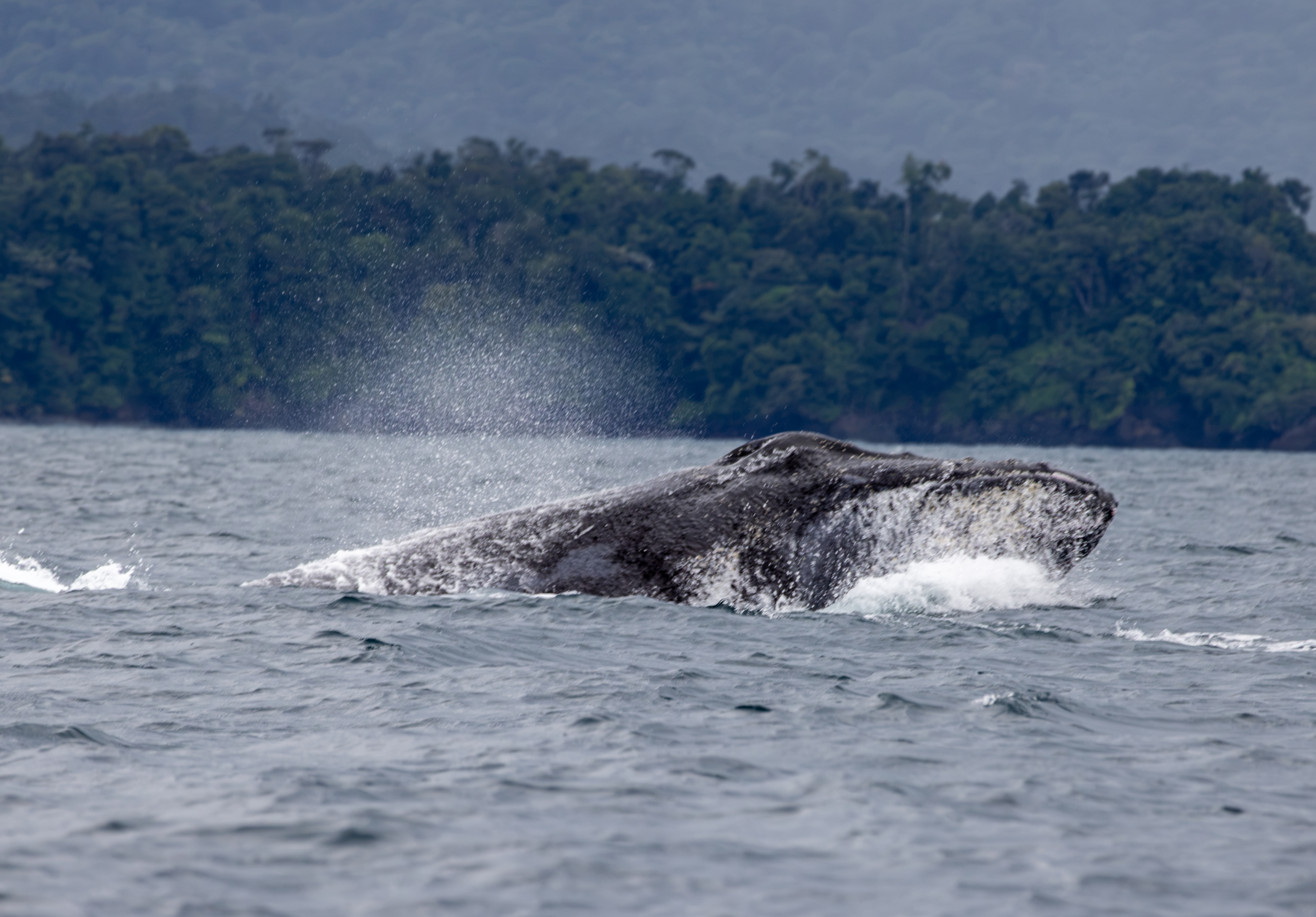
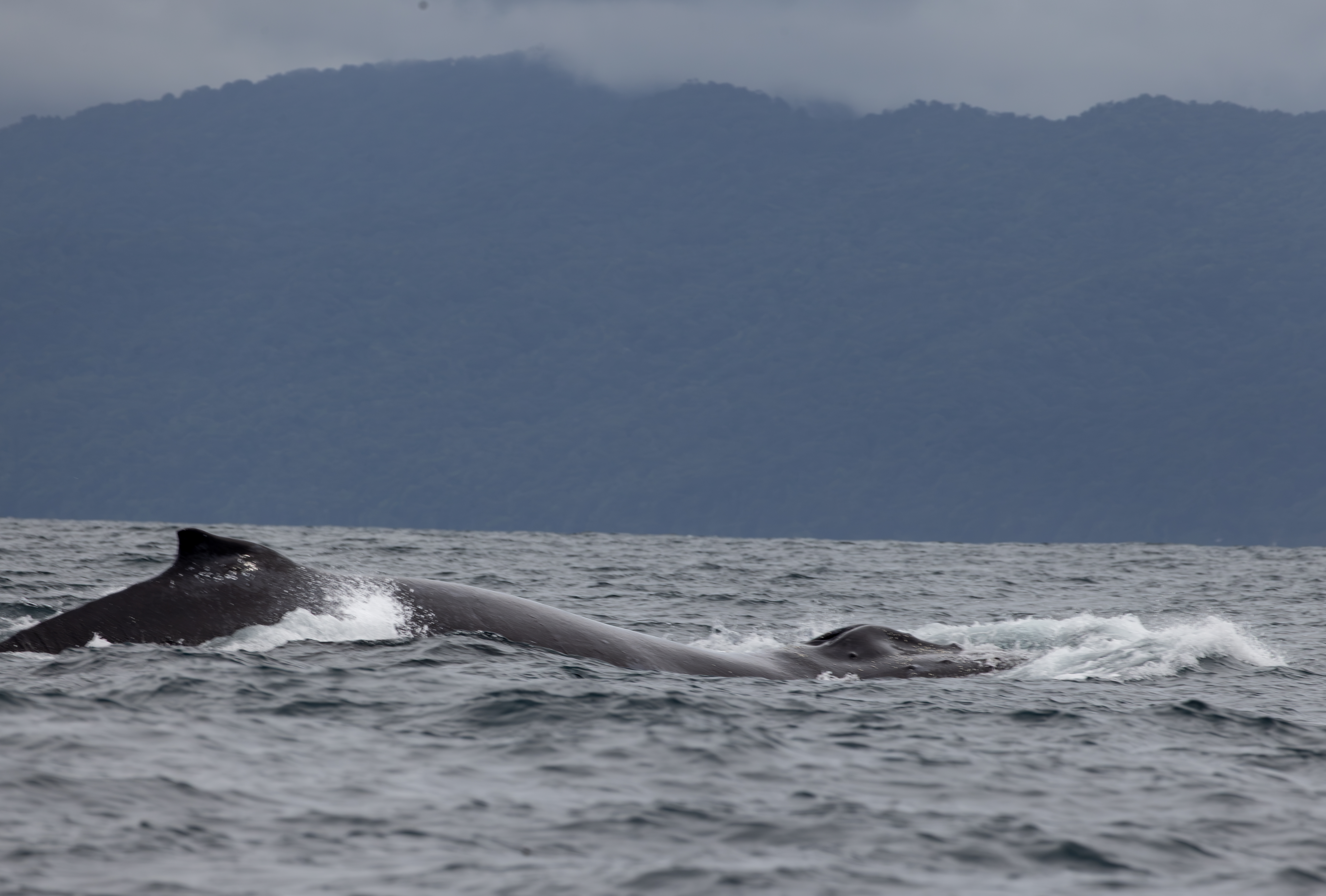
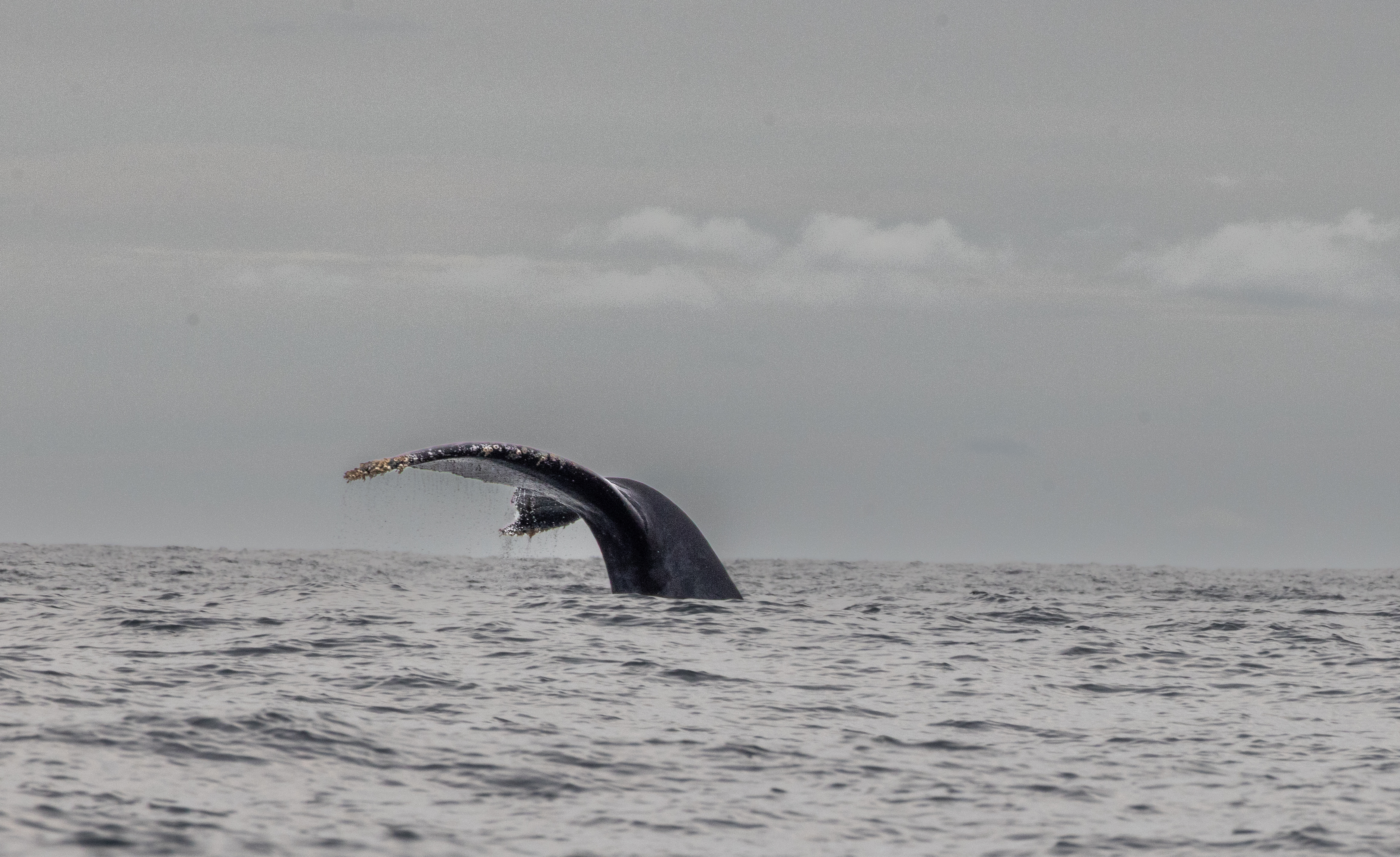
A principal hope of ours was that our timing there would align with the annual migration of humpback whales from Antarctica for calving and mating at this miles-broad bahia. We scored during afternoon whale searches in the same all-purpose panga. Note the multi-canopy jungle overhanging the shore.
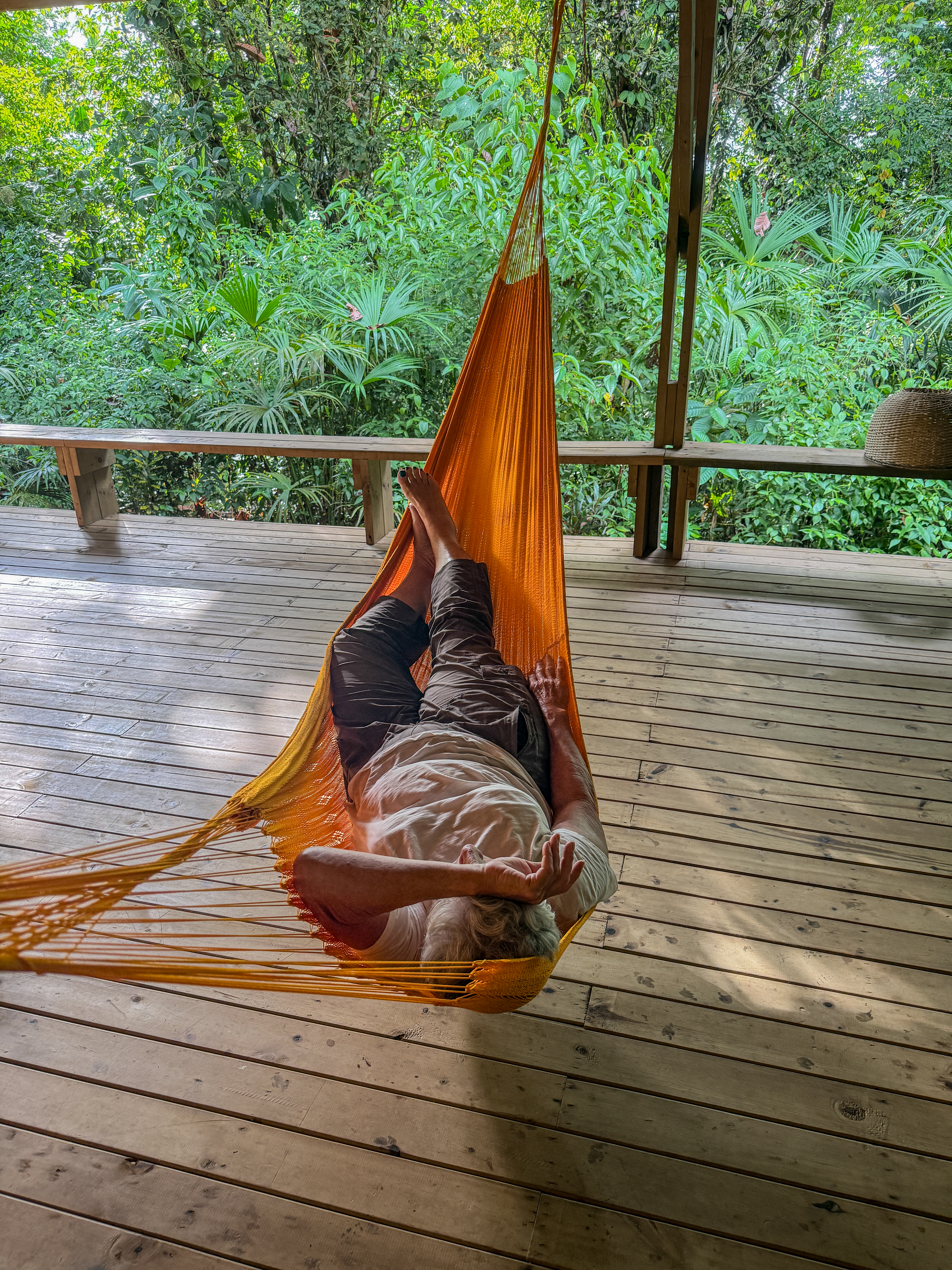
All that panga crashing about can be fatiguing. Cathy, resting on her laurels.
Jungle hikes to waterfalls were also offered. Nice in their own right, serendipitous in the bargain.
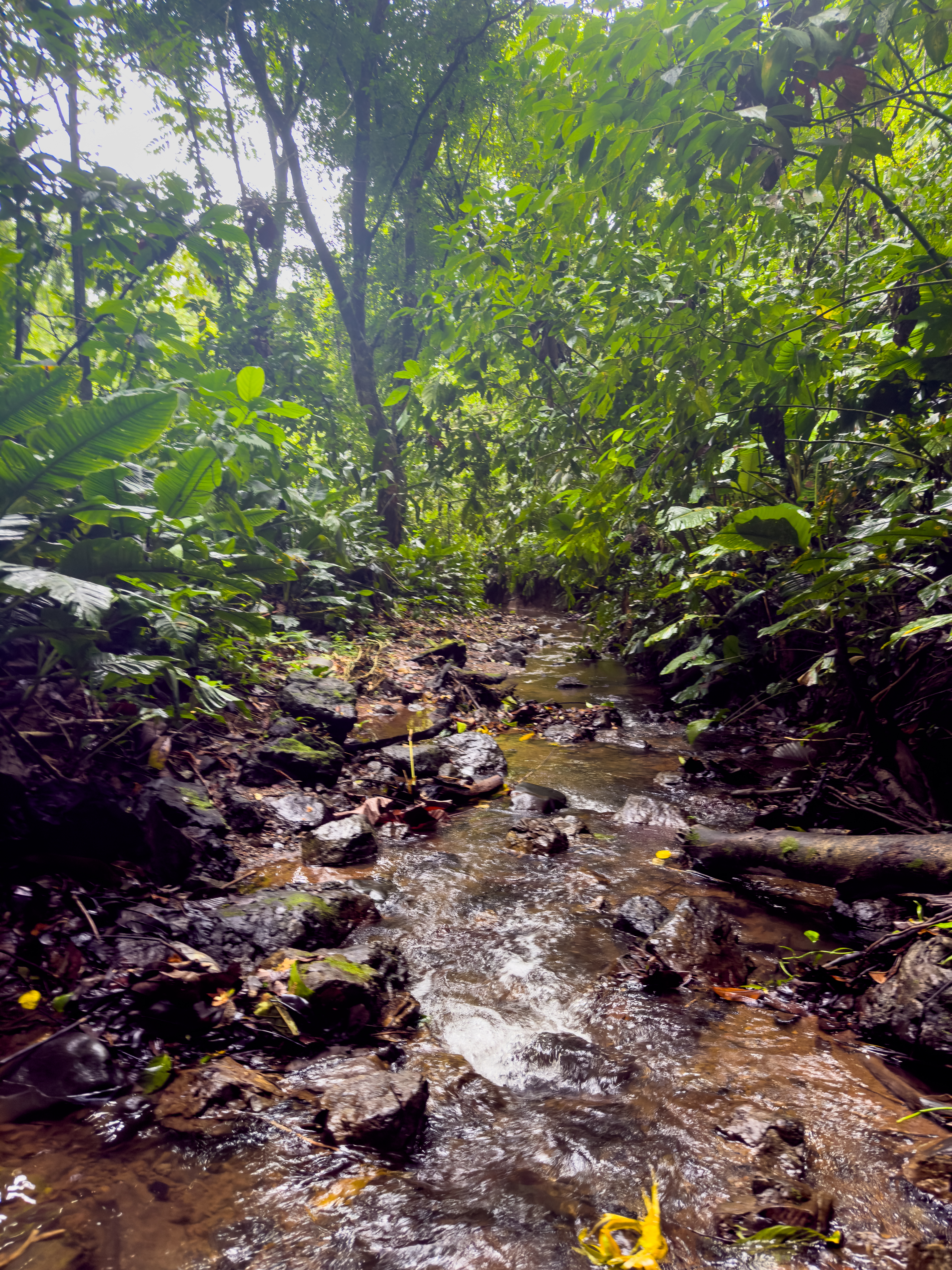
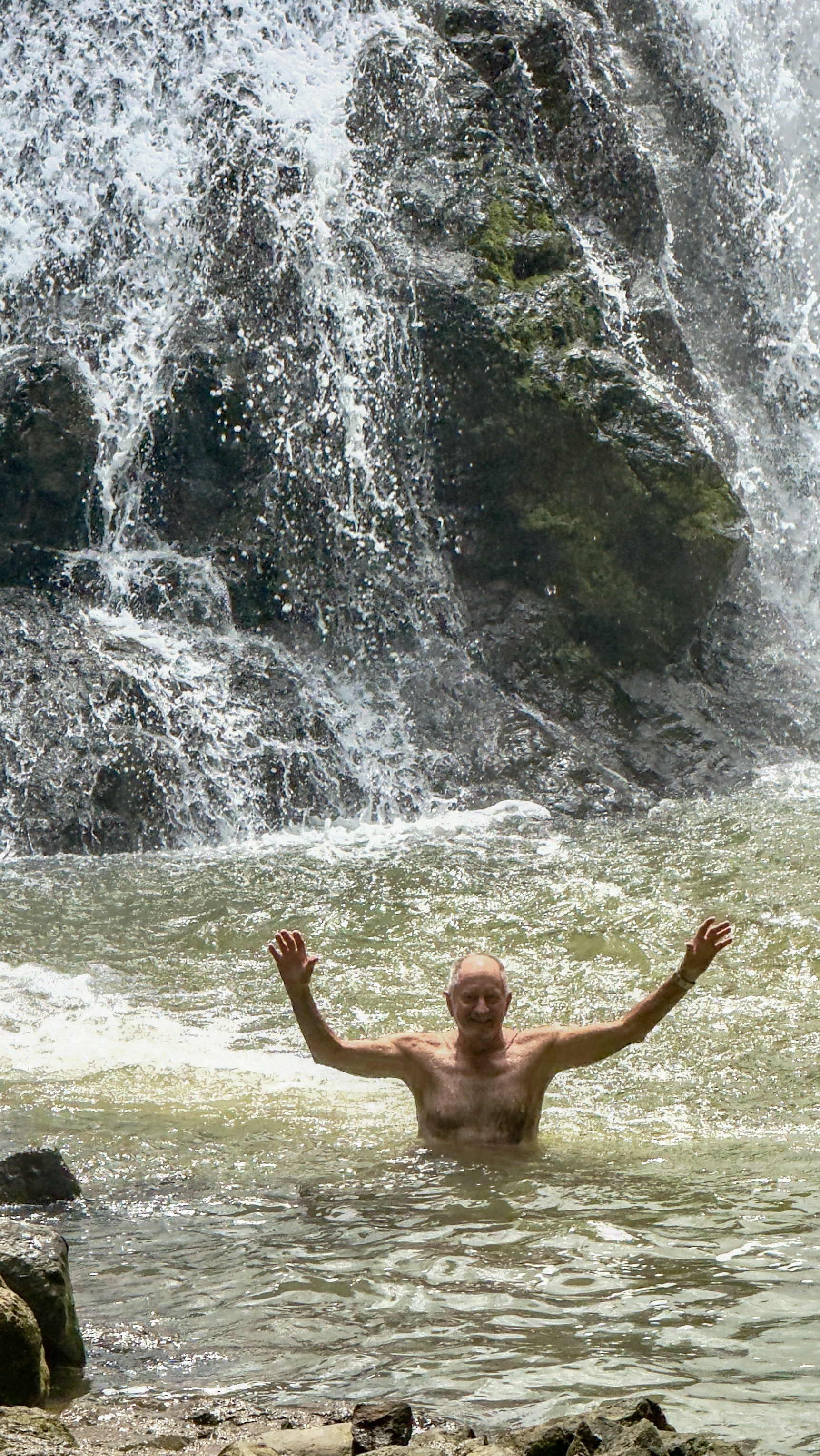
The trail destination, and His Geezerness deftly avoiding being swept downstream.
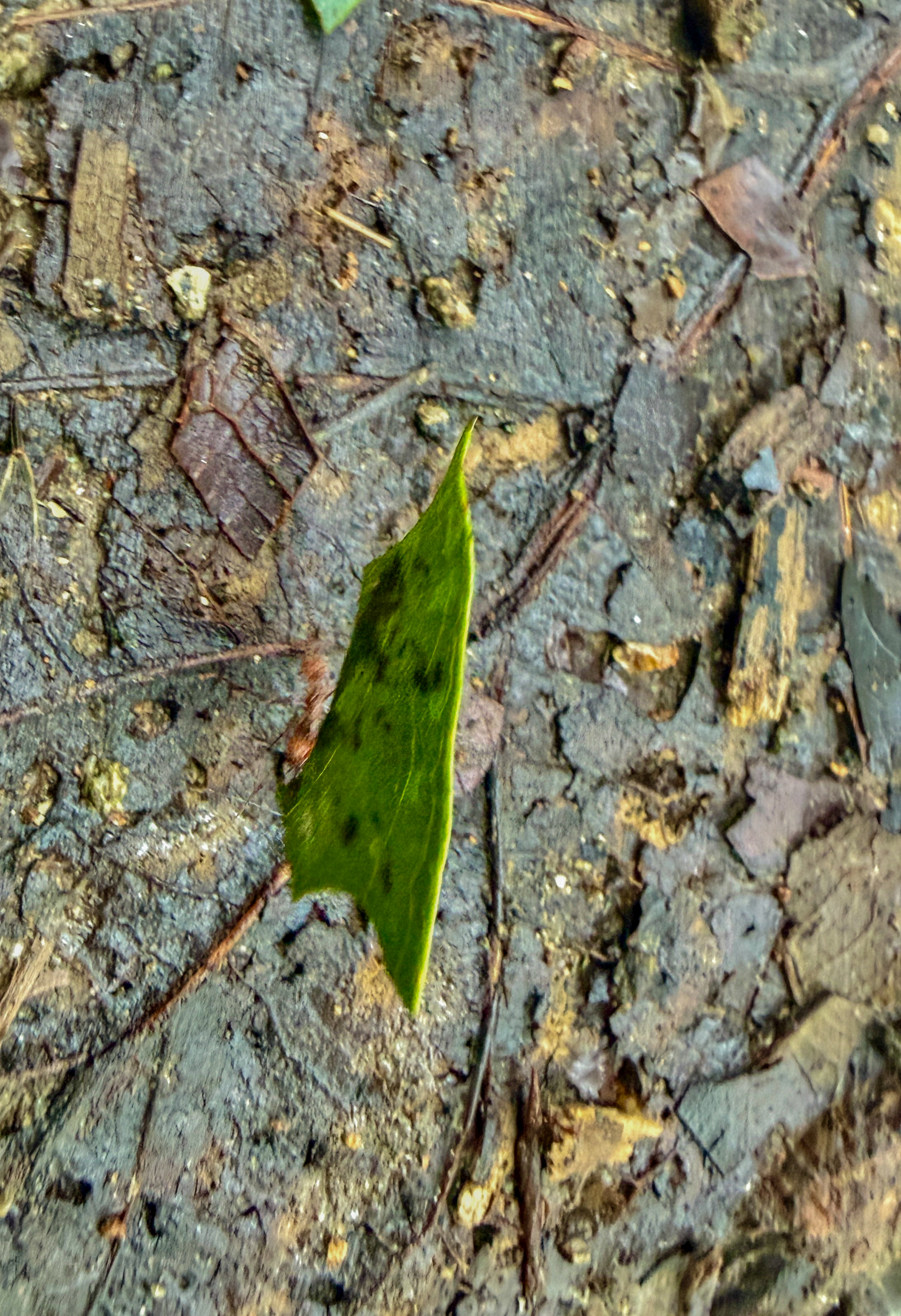
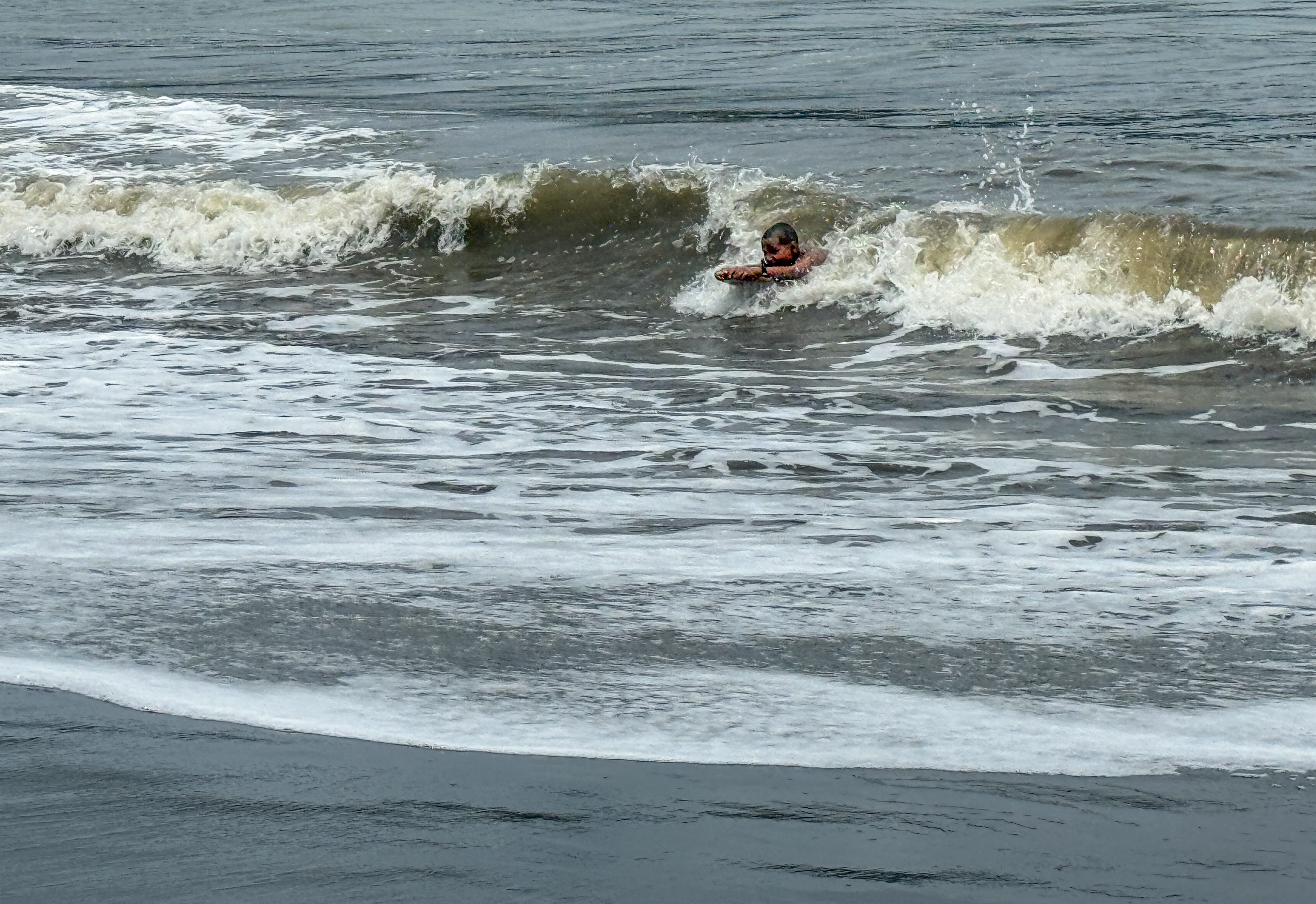
Serendipity knocked twice. First, the leaf-cutter. Then returning to the shore, two indigeño youngsters paipo-boarding in the shore break. Small prone-ridden leftovers from something in their tiny village. Where Tom Morey got his Boogie-board inspiration. I couldn’t resist, doffing my sandals and shirt, I waded in and joined them. I was offered their boards, but gestured that I’d stick to body surfing. I can only imagine what they thought of me. Worth the whole trip.
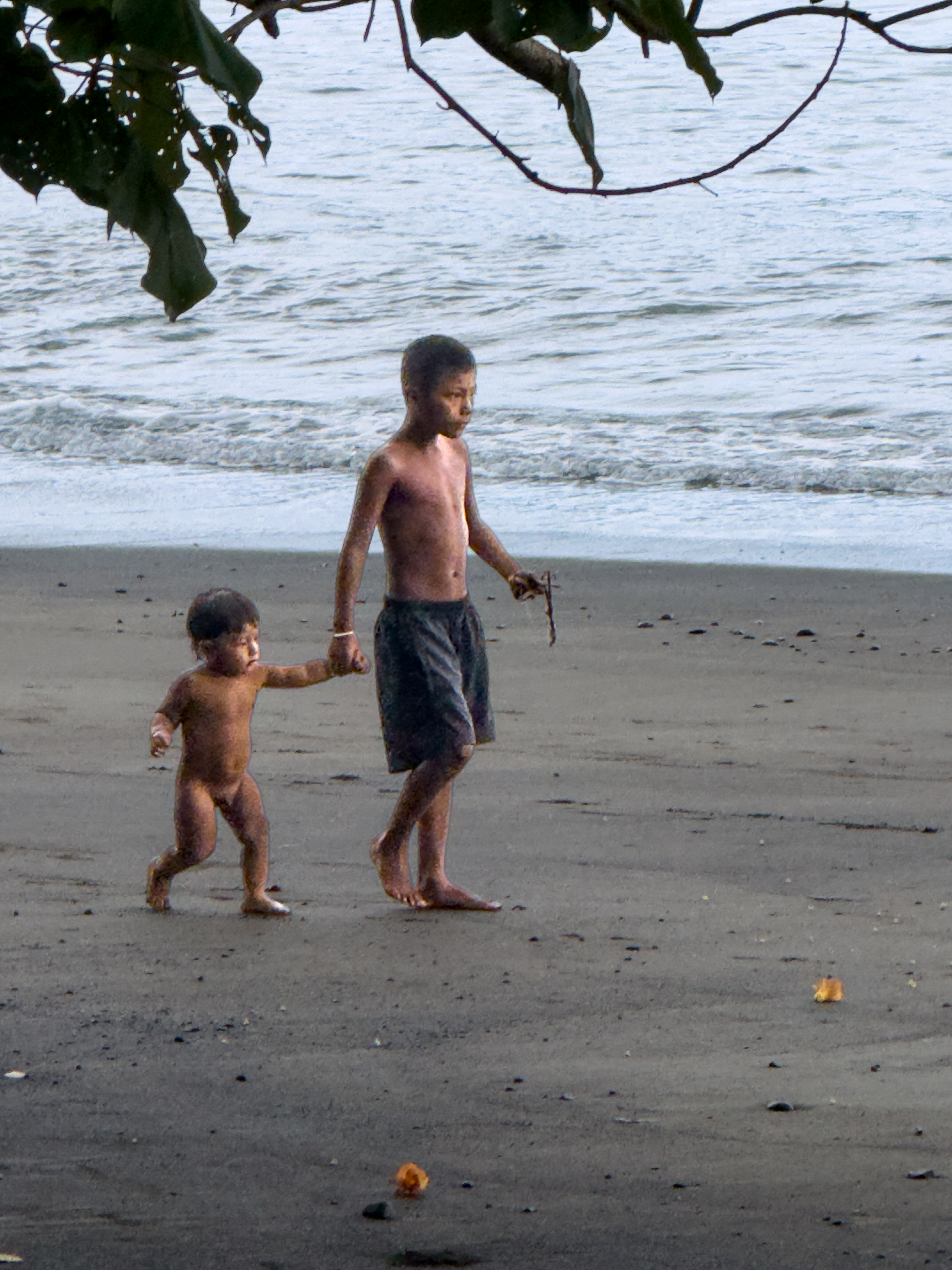
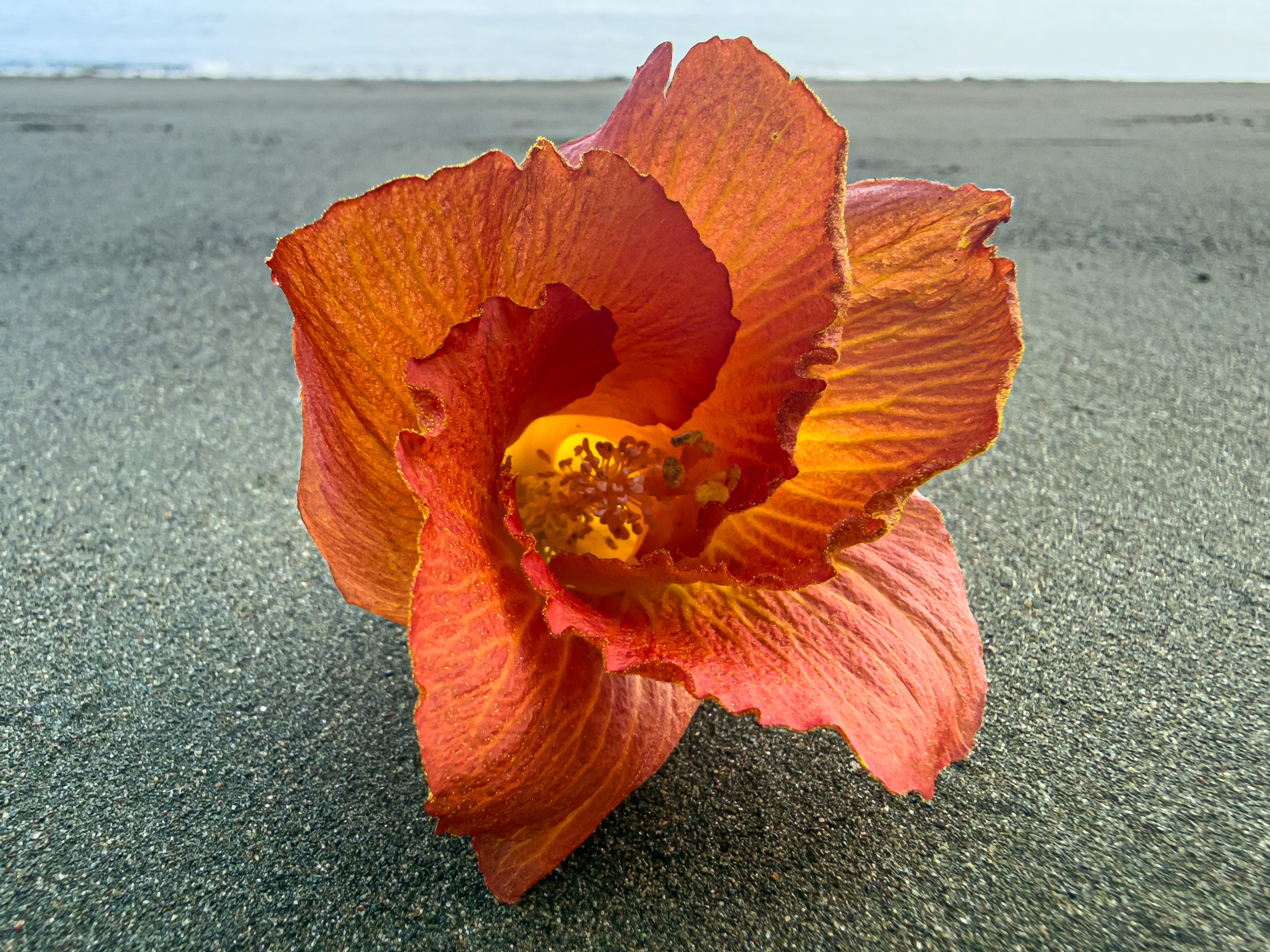
After depleting vim and vigor it was time to chill and recharge. The beach view as big brother undertakes mom’s necessaries. Infinitely preferable to the U.S. daily news. Note the fallen flowers scattered by the breeze.
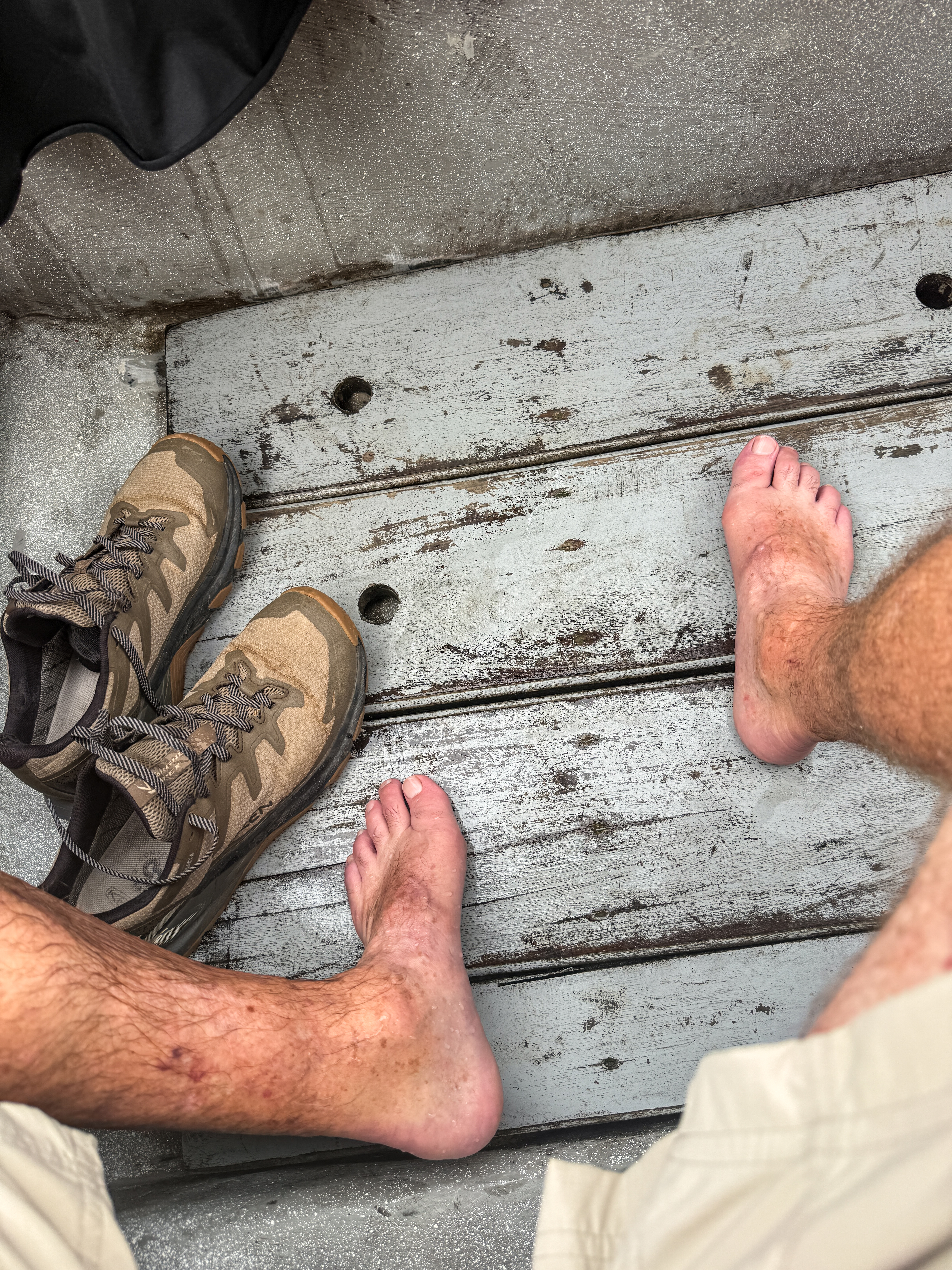
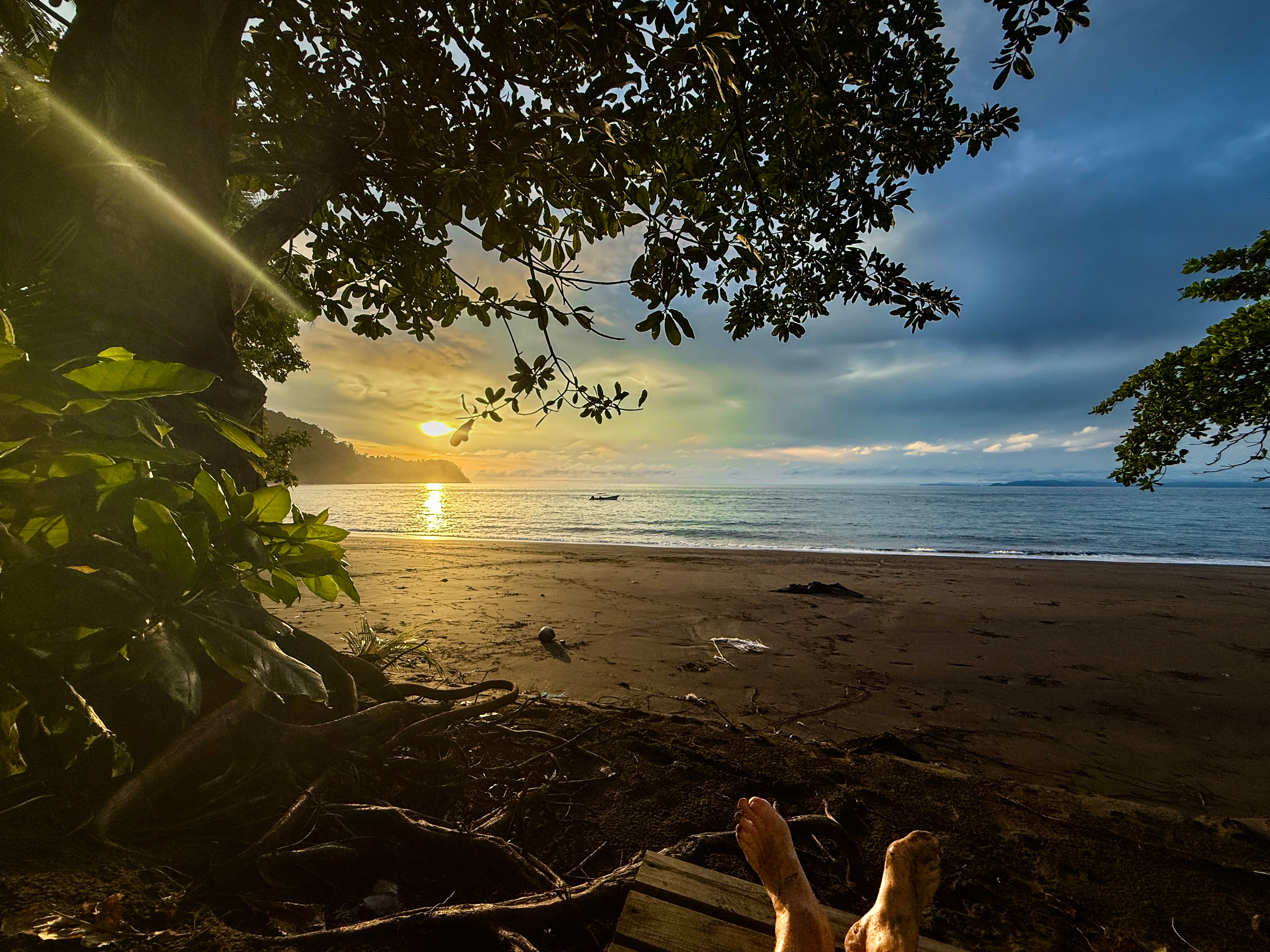
Afternoon becomes sundown. A cold brewski denouement to the day. Shameless posing of my feet.
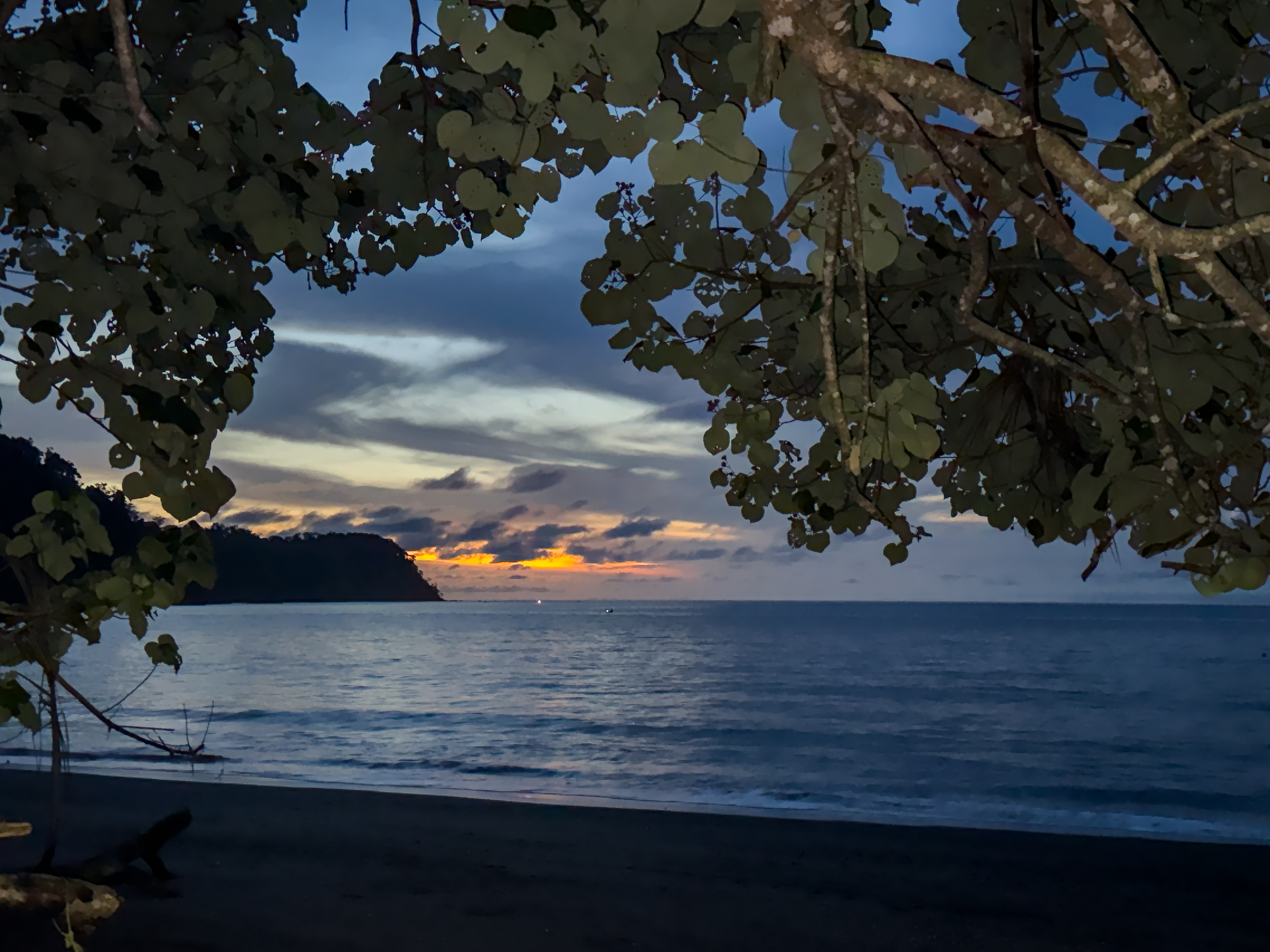
Early the next morning I Robinson Crusoed the beach, scattering away countless one-(left) armed crabs, nature yet again validating Colombia’s robust colorfulness. This, just fallen from an overhanging tree.
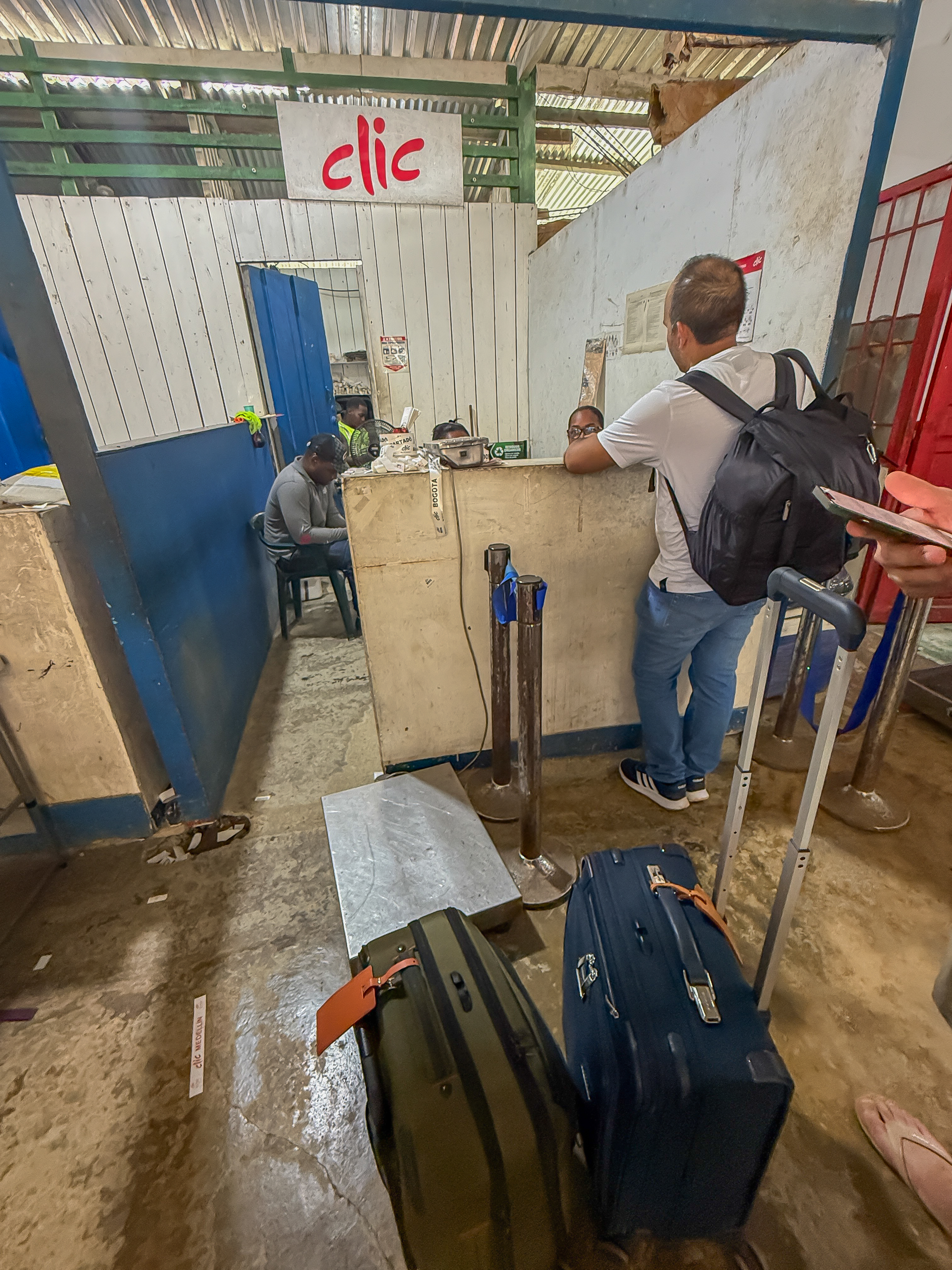
The beach, combed. The desayuno consumed. The water-taxi panga delivered us to the Bahia harbor beach, and the Tuk-Tuk presented us at the airport check-in counter. Our bags waiting to be weighed, about 12 kg, each. Followed by an on-time flight to Medellín and an overnight back at the Diez Hotel before our next morning’s return to the U.S.
I’ll close with another glimpse of the simpatico nature of every local we encountered on this journey. We left Medellín’s Hotel Diez the first time to go to Bahia Solano, from which we returned four days later. We chose to leave some of our non jungle goodies with the Diez staff for pickup on our return. At our return check-in I sought to mention this to the counter staff, but before I could utter the request, Einer, the same bellboy who took our leave-it stuff, seeing us arrive, was already settling in behind me with it and greeting us by name in the bargain. That’s first rate service.
But why Colombia? A beautiful multi-faceted country with a gracious simpatico gente. And they were very pleased to share it all with these Americanos. Could be you, too…….
Tomás y Catalina
Norway, north to south
Posted on October 1, 2025
Never having visited anyplace in Scandinavia was reason enough to explore Norway, a land of stunning topography drawn from a history of plate tectonics and ice-age glaciers, as ocean-centric now as in the time of its Vikings. The straight line coast of Norway is over 1600 miles long, but taking in the undulations of fjords and the circumference of its over 300,000 islands, its actual coastline is 17,991 miles in length. This is a hint at what to expect, and how necessary sea vessels are for getting about. Ours was a curated, self-guided passage built on a suggested itinerary by Inntravel, an outfitter in the UK we have used over the years for less-beaten-path adventures. Getting there and back is not easy from SoCal—San Diego-Montreal-Copenhagen-Bodø, Norway-Svolvaer, Norway…above the Arctic Circle at 68 degrees north and 14 degrees East. The return was Oslo-Copenhagen-Munich-San Diego. Upper Norway is a land of summertime midnight sun and winter perpetual darkness. In September the days were of similar duration to Del Mar, but the celestial bodies favored shallower arcs drifting more purposefully above the southern horizon.
Our outfitter put to rest any worries about conversing in a country whose native tongue has its quirks, including three versions of the “O” vowel of English. And the only one that is pronounced like our “O” is the one spelled as “Å” with a tiny “o” above it, the last letter in their alphabet, btw. English is so widespread and its syntax and pronunciation on a par with right here in Del Mar, that all conversations began with it naturally. We found the citizenry outgoing, friendly and hearty. This is a place of robust elements and the population to go with them.

Our Svolvaer lodging, a two bedroom apartment, was on a small peninsula jutting out from the town, proper—the largest “city” in the archipelago of the Lofoten Islands, population 4700. The view, looking south from the balcony of our rooms at 3 AM. The moon never got overhead, staying low to the southern horizon. I was up at this hour in hopes of getting a Time-Lapse and stills of the Aurora Borealis, its green wispy color reflecting in the seawater near at hand, in the above time-exposure.
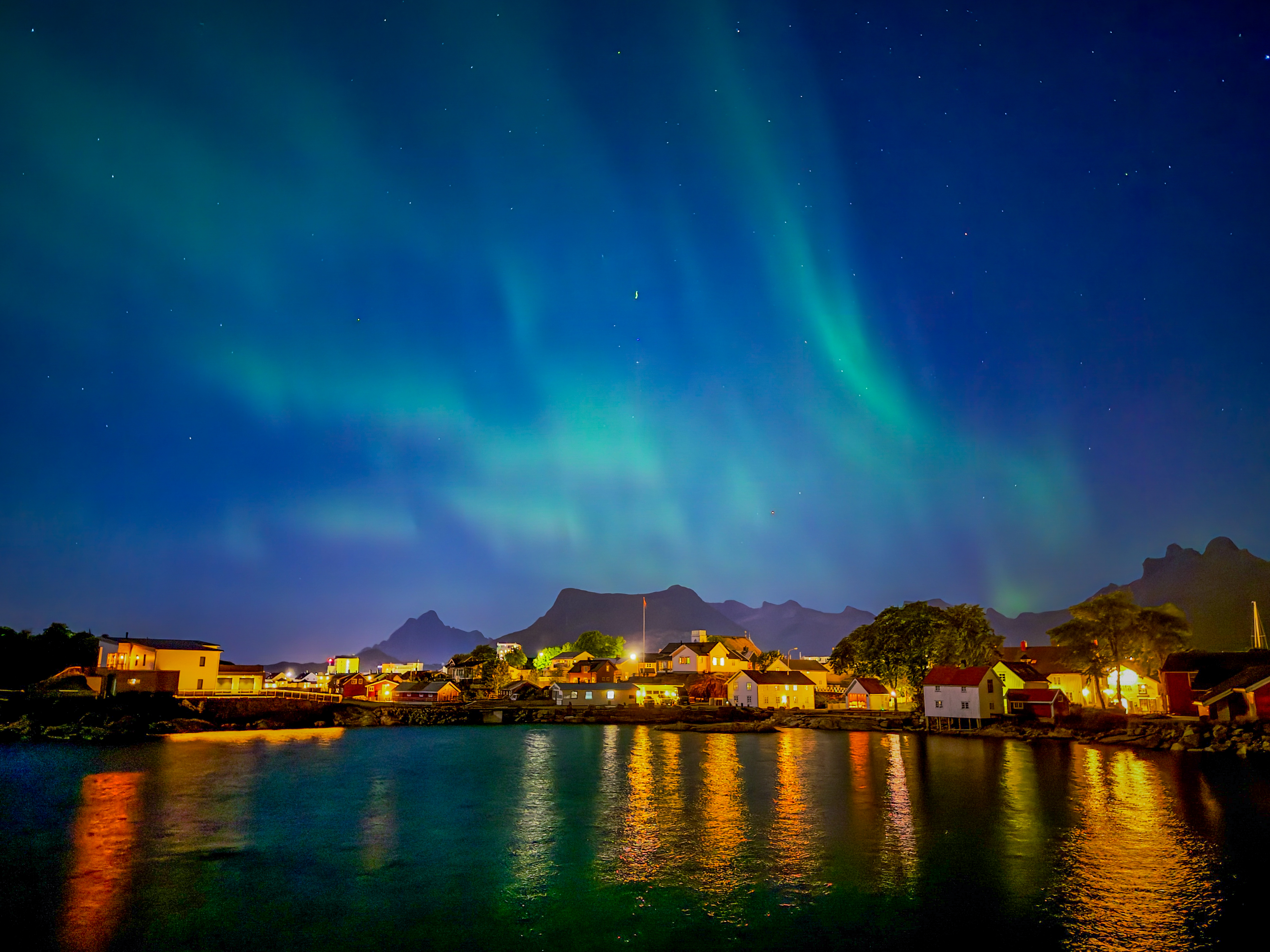
Turning 90 degrees to the right, the Northern Lights, in full swagger, an ever-wafting dance of the veils above the community’s reflections.
The Lofoten archipelago is comprised of six main islands and countless smaller bumps above sea level. Pretty much everywhere one gets used to jaw-dropping scenery.
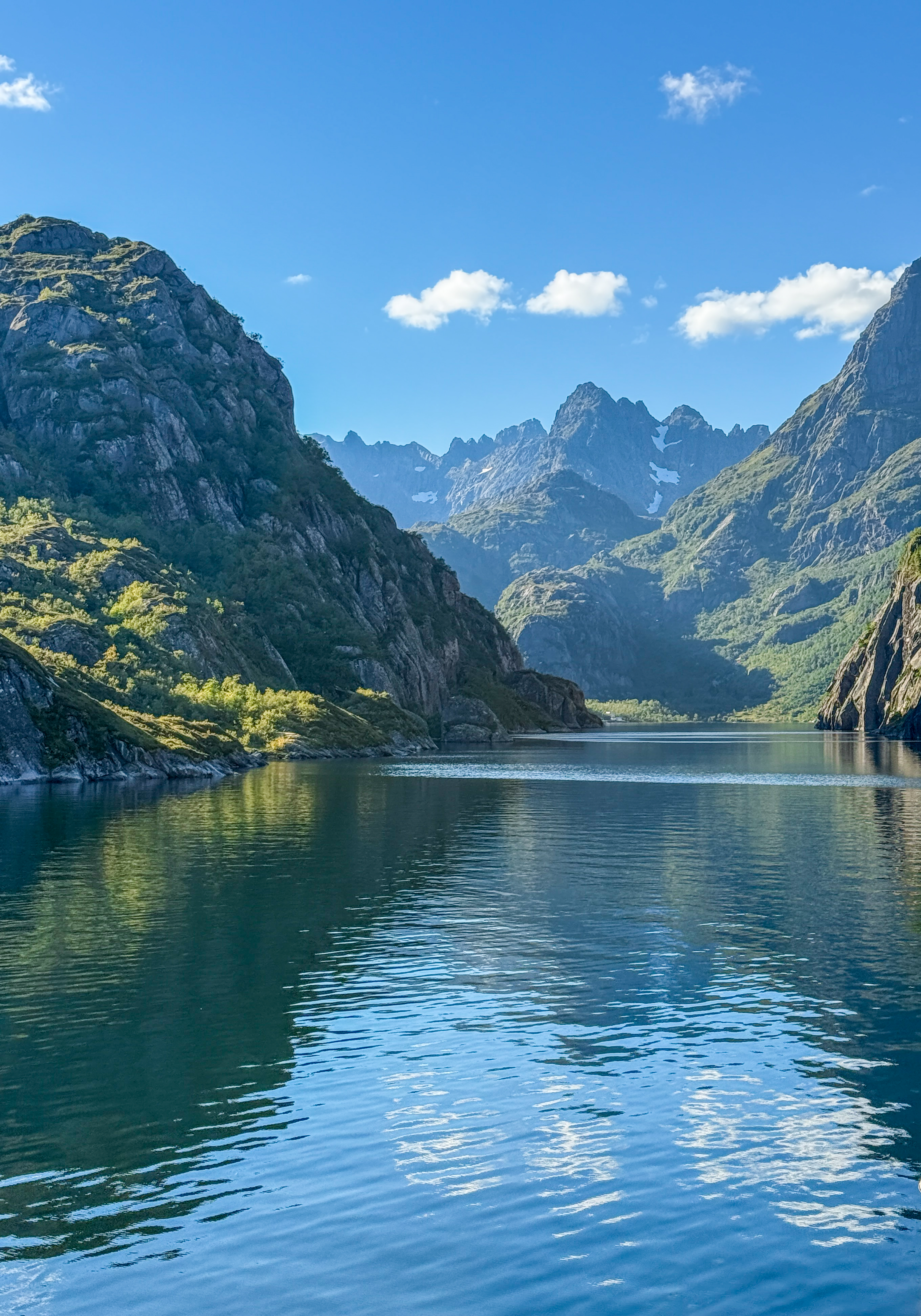
Norway’s west coast is strewn with fjords, like Trollfjord, above. And yes, trolls are part and parcel with Nordic mythology. That Viking thing in another guise.

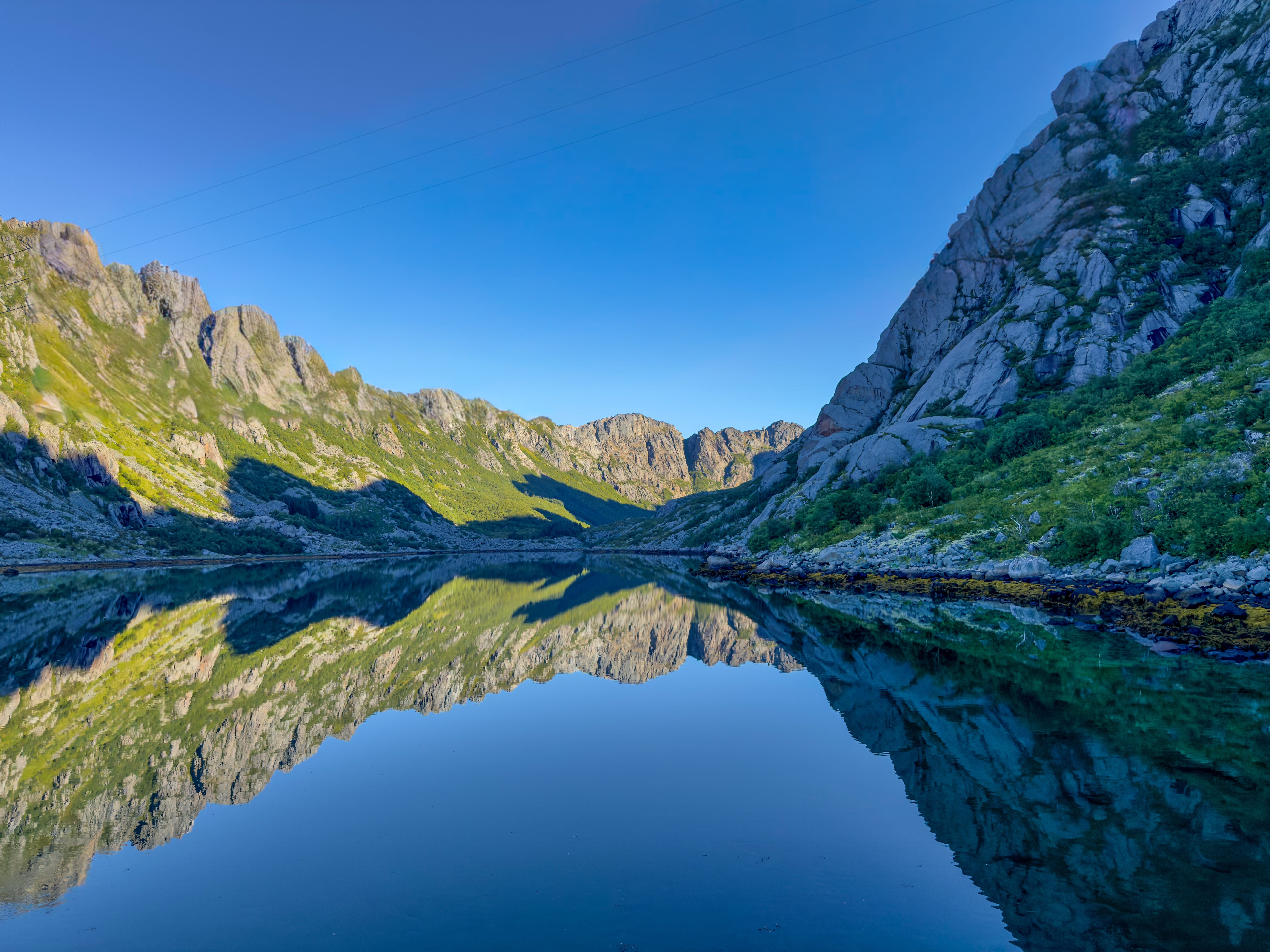
There are other quaint habitations, like Henningsvaer, above, or this inlet a few kilometers away, below. The reflections were so surreal that walking up to get this picture it was actually disorienting—what was rock, and what was reflection? A natural house of mirrors. It’s worth remembering that all of this is seawater, and because the Gulf Stream points right at Noway’s coast, the water temperature felt about like here . I just looked, and as I write, it is 55F in Svolvaer, a bit above our Del Mar winter low.
Above, our last sundown in Svolvaer, before boarding the Havila Polaris, a 179-cabin steam ship running on LNG and electric power, departing at 8:30 PM for a three night/four day passage to Bergen. Not knowing any better, I thought of this as a tramp steamer, given that it made fifteen stops along the way in small coastal and fjord-ensconced villages, the exceptions to “small” being Trondheim and Bergen—Norway’s third and second most populous cities after Oslo. And while I stand by that term, it doesn’t do justice to the refined nature of the Havila Polaris. Neither Cathy or I have ever done any sort of cruise, so I have little to compare with, but this voyage was a mellow passage, always close at hand to jutting headlands, islands and fjords. The views were stunning. The food and drink, and turns around the deck all fine accompaniments.

There are multiple observations to be made here. Norway is a seafaring nation, and has been since the Vikings. That red-hulled ship is a purpose-built vessel serving the oil capture business offshore in the North Sea. Well offshore (pun intended), never seen from our route heading to Bergen. Norway is a highly electrified country, and it gets its electrical energy hydraulically. See pictures of waterfalls, below. The petrochemical take from the sea bottom is sold on the world market to fund the “Government Pension Fund of Norway,” the largest sovereign wealth fund in the world. It is actually two funds, one named as above, and the other, called the “Government Pension Fund Global” where the “global” is a clue to its world-wide investment strategy. Norway, with a population of only 5.6 million, earns money from the oil, and invests that to generate the funds used to run the government and help provide the socially enhanced lifestyle common in Scandinavia. The Krone to dollar math is quite simple for travelers—move the decimal point one space to the left to turn Krone into dollars, e.g. 1,000 NOK more or less equals $100. But sticker shock lurks at the cost of living in Norway for both its citizens and its tourists. A second worthy point to share is the fantastic cloud panoply to which we were treated daily. Unlike our May Gray/June Gloom marine layer blanket, I found the skies routinely showing off four or five layers of clouds, each sufficiently un-overcast to reveal them all. It’s a sky show guaranteed to capture a pilot’s or photographer’s eye.
Below, the wharf area in Kristiansund where we made a one-hour port call. Notice the red forklift which has come out of the red building (a common color theme throughout Norway) and is heading up the ramp to retrieve cargo or to send cargo for on-shipment. Ditto passengers via a separate ramp. The dark-hulled and white superstructure vessel is an auto ferry. They are all over the place along the coast because the fjord-gouged terrain does not lend itself to N-S roads. Anyway, this is supporting evidence to that tramp steamer title to which I default.

Under the heading of “Pilots and Skyscapes” this is one which training teaches aviators to avoid. That is a definitively robust downburst going off just beyond the headland. We rounded the point and took up a courses to the left of the rain shaft. This was a day when there was a shore excursion offered, but which was already full two days ahead of time when we heard of it on boarding the ship in Svolvaer. The excursion was a bike ride to someplace south of Kristiansund, and then transfer to a speedboat to race at high speed to the Havila Polaris as it trundled south at a less clamorous pace. From this, I’ve learned that seasoned cruise passengers select cruise excursions online once one’s bookings are completed, and in this specific case, I take pleasure in not being one of the fool-hearty cruise excursion cognoscenti. Their attire probably needed laundering by the Polaris’ crew that very evening.

Someplace along the west coast of Norway, I haven’t a clue where. Nice sky?

Torghatten mountain, pretty much comprising the entire island of Torget at which we gawked outbound from Brønnøysund. From the backside, it’s just your run of the mill massive rock peak, but from this side, that shadow on the vertical face is a gigantic cleavage in the peak, and at dead center, you can see through to the other side via the natural tunnel that is 35 meters high and 160 meters long. It is a common hiking site in the area, presumably accessed by boat. Given our rocky proximity, perhaps this is a clue as to the importance of careful oceanic navigation, and how abruptly the seashore drops into the depths?

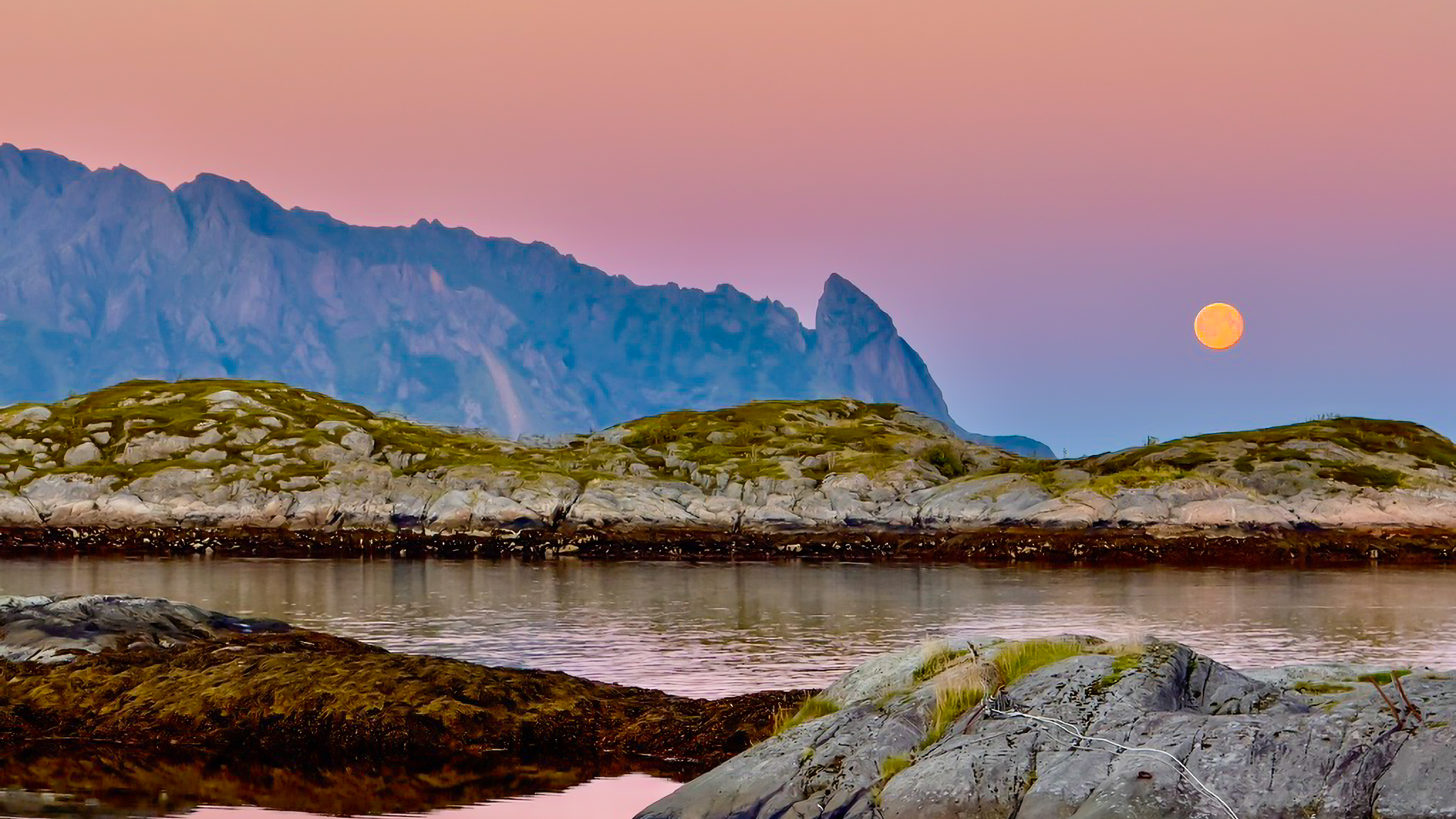
Later that same evening we were treated to yet another near-full moon moonrise, three o’clock in the frame. There’s another of those North Sea platform-service ships. In Bergen I spoke with a crew member of such a ship and learned that they are actually capable of pulling up a drilling platform after closing down the underwater well base, and carting it all to another drilling location to start a new well. Ingenuity.

We arrived early in the morning in Trondheim, founded as the capital of Norway in the Viking times of 997 by the first of two King Olafs, both of whom were instrumental in advancing Christianity in the country.

Trondheim was originally called Nidaros, still the name of its beautiful Cathedral, with its vaulted ceilings and three organs, the largest of which has 30 stops for its 1809 pipes. Herewith, a segue to a further sharing of my ill-fit for cruising. When we arrived at those port destinations during civil daytime hours there was sometimes the opportunity to join an organized exploration program, but also we were free to follow our noses to whatever looked promising . The latter generally comports more closely with Cathy’s and my inclinations, but nonetheless runs up against my “there goes the neighborhood” concern. Passengers raced to be first off the ship. I’m ill disposed to join that stampede, but even hanging back and walking slowly, there was no escaping the feeling that we were sullying the ports. Sigh.

Our steamer transport concluded at Bergen, a World Heritage site, and taking over as Norway’s capital in 1299. Its inner harbor demonstrates multiple lighting moods, all of them luscious. A little gastronomy and history. No surprise that fish are an important part of Norway’s diet. A local delicacy is referred to as stockfish—actually cod, fished in Lofoten waters and then dried, hanging on large outdoors open-framed hjell racks during the winter months. In pre-refrigeration days this avoided salting as a means of preservation. An important source of protein, especially in regions where Catholicism meant Friday and festival fasting on terra firma meats. The dried stockfish was vessel-shipped to Bergen, a vital port for commerce throughout Western Europe and the British Isles. Its inner harbor, seen in the next frames, is actually called Bryggen, a bustling area in the Middle Ages with its various trades being plied by the German-derived Hanseatic League. Bryggen’s etymology is from the Norwegian word for “wharf,” and those colorful structures are built to the edge of the water, and beyond, as successful commerce spawned expansion.


Yes, I’m fond of lunar overwatch scenes, as with William Blake’s “the moon, like a flower in heaven’s high bower, with silent delight, sits and smiles on the night.”

We had two nights and three days to putter about Bergen before slipping aboard a high speed catamaran to take us some four hours up the Sognefjord, Norway’s longest, second longest on earth, at 205 km in length and over 4200 feet in depth.

Destination Balestrand. The view from our room at Kvikne’s Hotel, a lodging from the 19th century and thus reminding me of the Hotel del Coronado.

The Del Mar geezer taking in the scene with King Bele of the early fourteenth century. Picture by Cathy. I’m sitting on the bench back (not the UK Parliament’s back bench) because the seat bottom is rain-wet. Staying fanny dry while taking in his view.

Nice scene, your highness. Sognefjord, a local auto ferry finding a pot of gold.
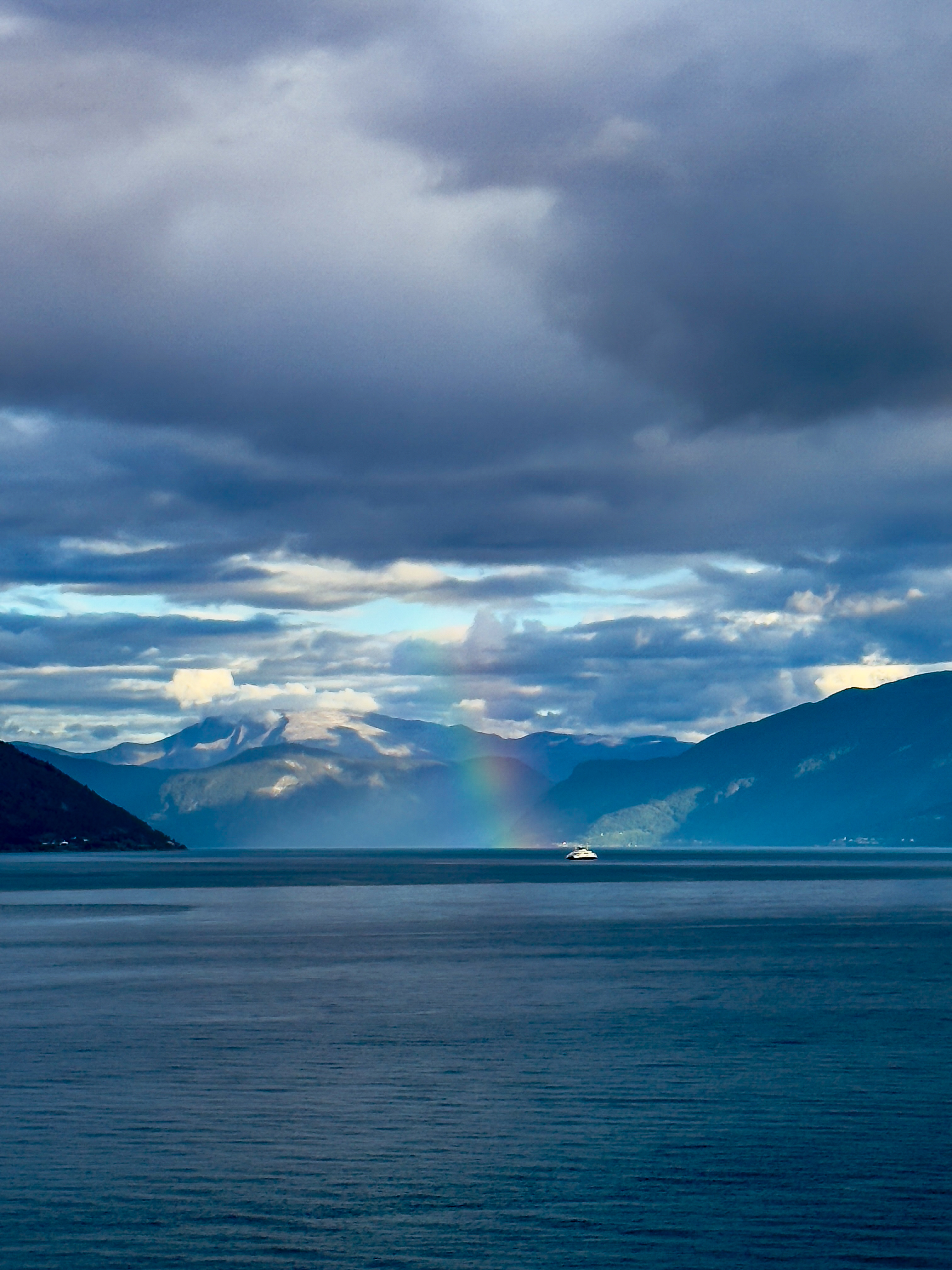
Balestrand is gorgeous, but small. What to do? Hike that ridge to the right in the destination picture above. I’m getting long in the tooth, but I did successfully climb the 1500 feet in some 4 km of up trail, leading, gasping and sweating, with only modest sotto voce grousing….
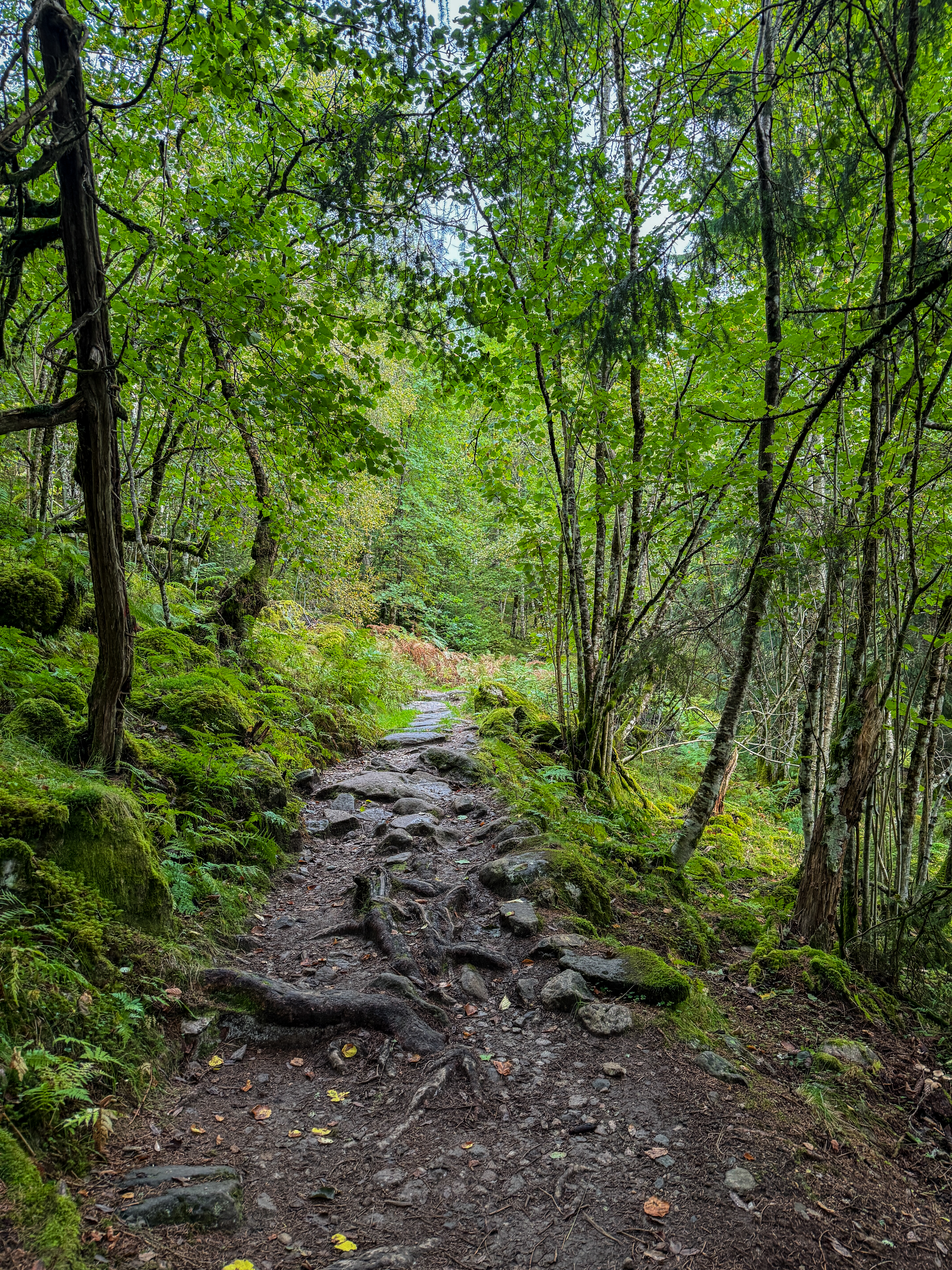
…to this exemplary view of the upper reaches of the fjord. Waay down there at about 7 o’clock in the frame, the tiny rectangular bump at the shore is our lodging—Kvikne’s Hotel. Looks eensy-weensy from up here.

The same vantage point, except from fjord water level the next day. Looking directly up the Aurlandsfjord, an extension of Sognefjord, leading to Flåm, our next destination.

When in Rome, do as the Balestranders do. This is apple growing country, and the delicious fruit was literally falling off the trees, and then in-town processed into cider.
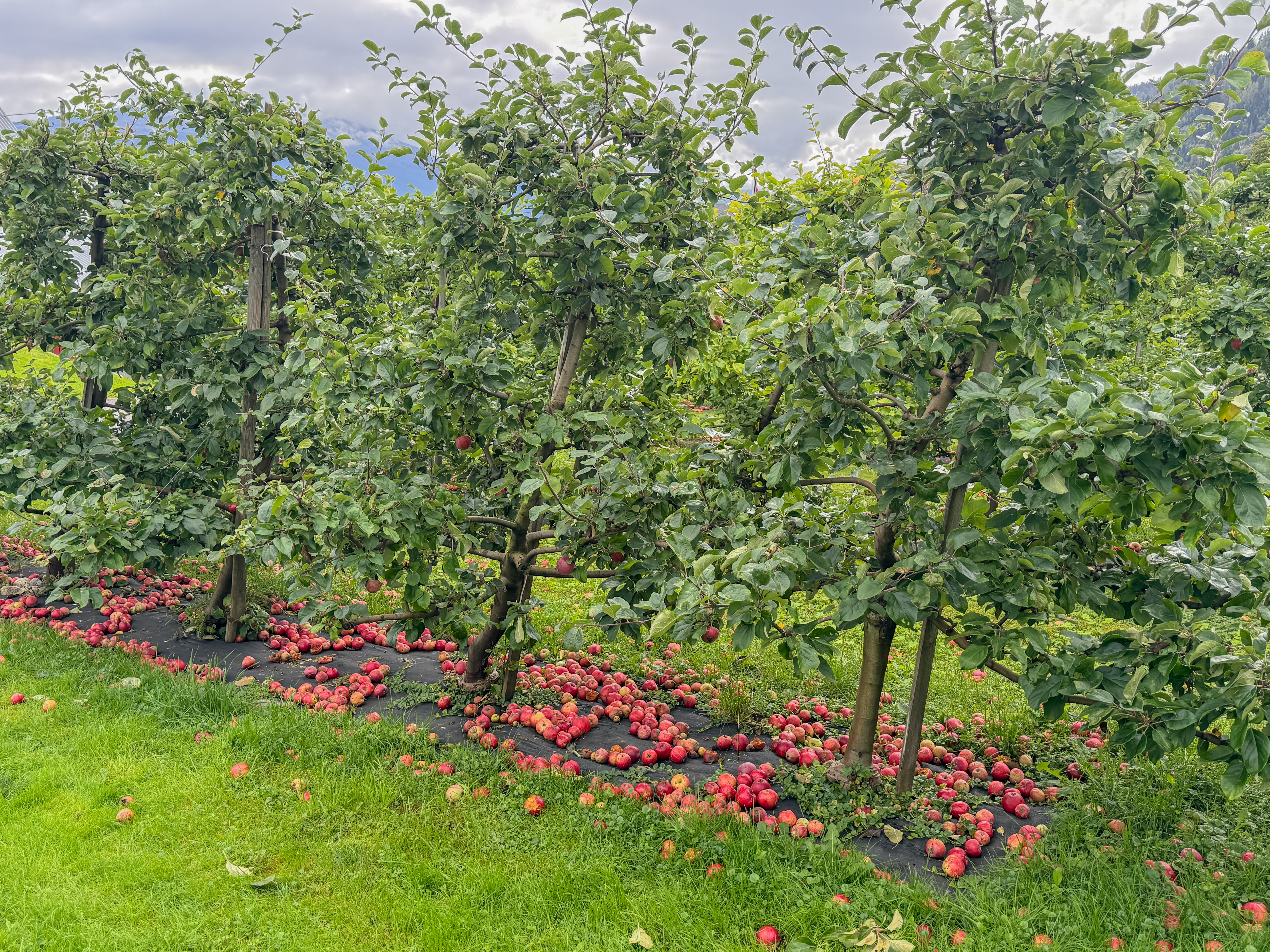
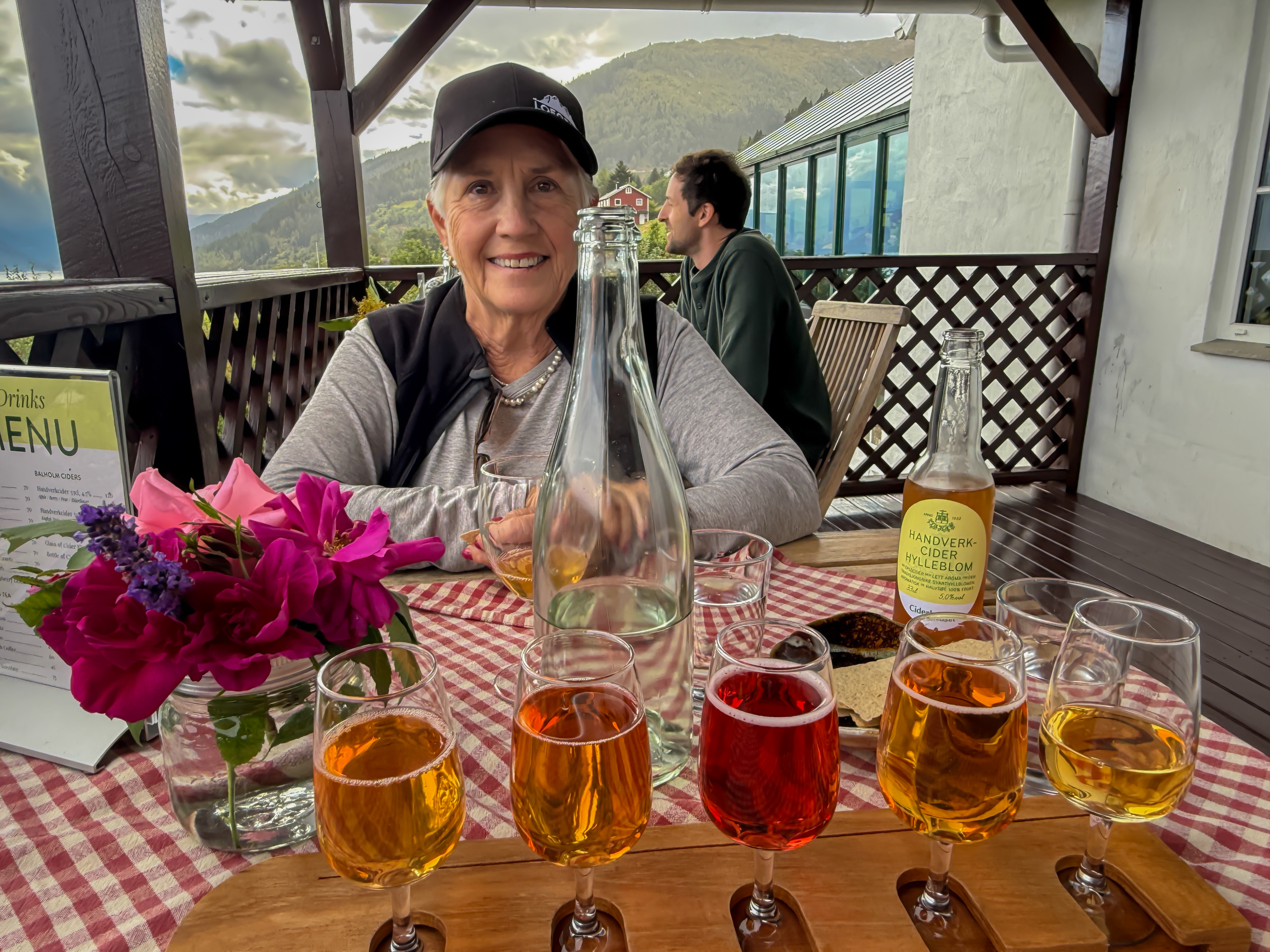
Following our 1500 foot climb, the trail back emptied into a quiet street on which was Ciderhuset, Cider House in English. Cathy chose a tall cider, and I opted for a cider flight to go with our lunch. Mildly alcoholic according to the chemical analysis, but without perceived effect on the body. Well, okay—after lunch and the final one mile stagger back to Kivikne’s, we availed ourselves of an afternoon siesta. But only because of the hike, surely not enhanced by the cider?
Decamping from Balestrand we took one of the high speed catamarans up the Aurlandsfjord to Flåm, the ship slowing for all of us to marvel at Brekkefossen waterfall. A fine example of how Norway has the means to meet its electrical generation needs with moving water.
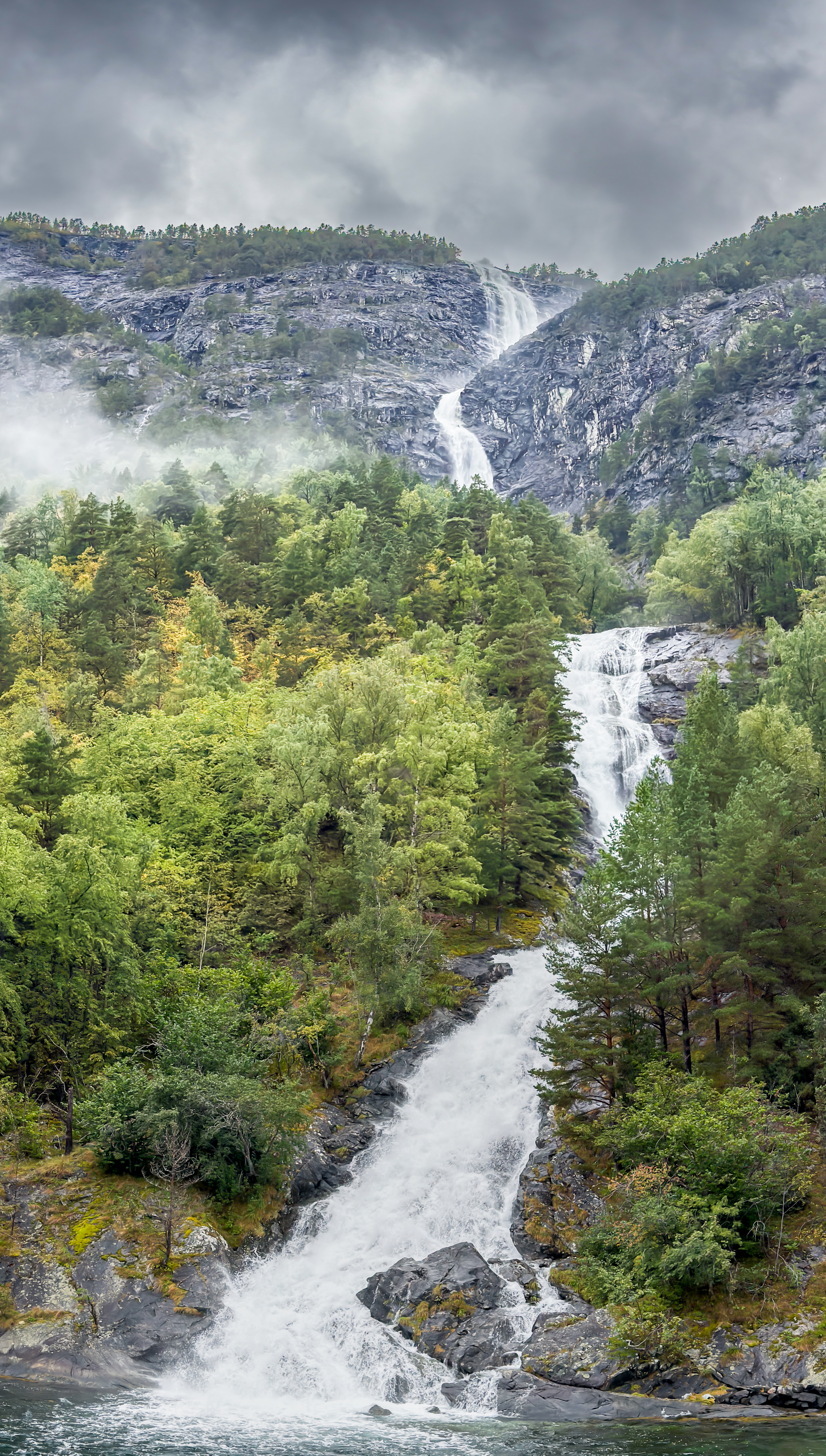
Flåm is another outdoors activity haven. We chose to take the Flåmsbana railway the 20 km up valley to Myrdal for an out-in-the-elements return to Flåm. The electrical train stops a short distance from Myrdal to let us passengers stare wide-eyed for :10 at the power of Kjosfossen waterfall with its 305 foot free fall, its deafening roar matched only by the water-strewn air quickly soaking clothing and misting camera lenses. In a nod to tourism sensibilities during this stop the air suddenly comes alive with the tie-me-to-the-mast siren song of Huldra, a forest spirit from Norse mythology whose intention is to lure men into the woods and seduce them. Alongside the tracks, she is portrayed by a woman in red, very near the center of the frame at 3 o’clock in red. Quite the showstopper. I volunteered to join her in the spirit of the production, but Cathy nixed the idea…

The valley views from the train are hard to beat…

…but are nonetheless eclipsed by the views on foot and by bicycle. Near at hand, the steep switchbacks we hiked after disembarking. The train tracks rise 1 foot for every 18 feet, this descent is steeper yet, hence the switchbacks. We had to mince along being careful of our footing to keep from sliding downhill on our bums.

Another of our luck-outs was being there as the fall colors began showing off. Nice trail hike.
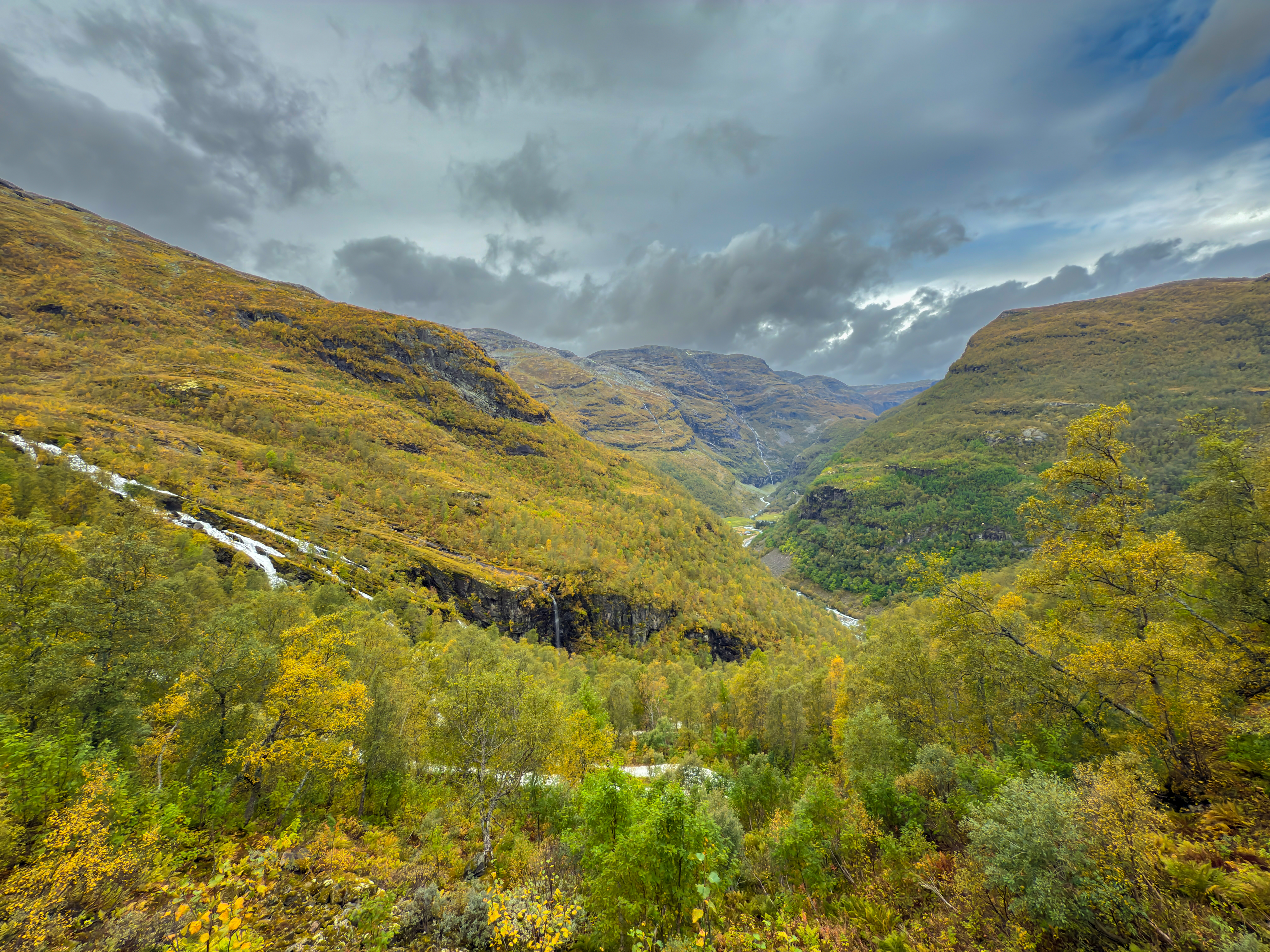
After nearly 5 km of downhill hiking we switched to our rental bikes awaiting us at a farmhouse for the 15 or so klicks back to Flåm. The views continued, unabated. Ye olde bike path.

Resting on our laurels to suck up some splendid mountain air. Waterfalls everywhere.

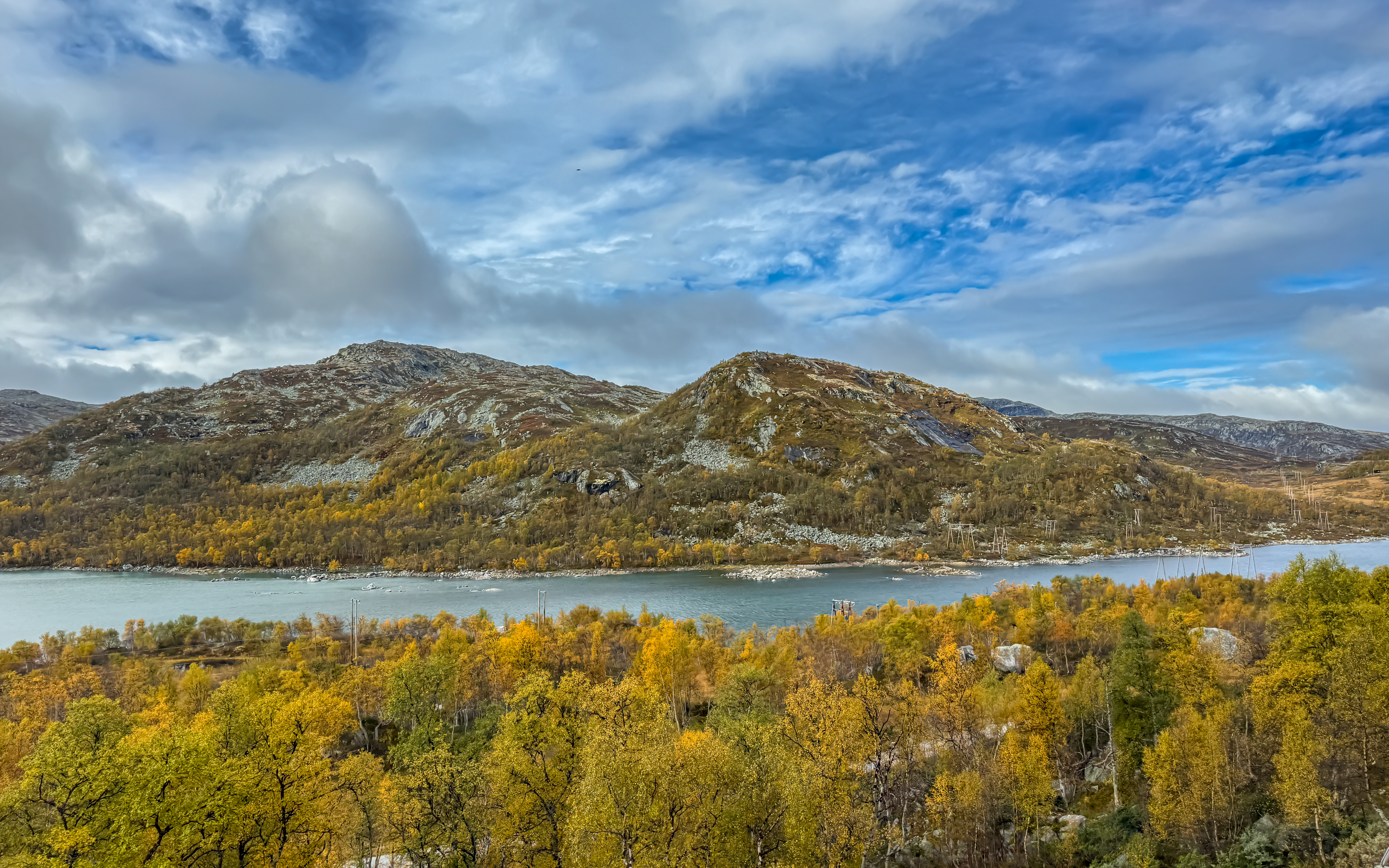
The next day we returned to Myrdal on the Flåmsbana, but now to connect with the Bergen to Oslo train, some five hours duration along an elevated plateau, with its own attention-grabbing views. Just a few km beyond this scene we passed Finse, with its Hardangerjøkulen glacier. Good thing the Norwegians speak English!
Following our afternoon arrival in Oslo Sentralstasjon we used our phone maps (let’s hear it for T-Mobile devices connecting seamlessly in over 200 countries world-wide) to walk to our Thon Hotel Rosenkrantz, then back out the door to explore. We mostly confined ourselves to the mid city and the area near the harbor, including the Nobel Peace Center,

…and the busy waterfront…

…including the Akershus Fortress, with its splendid Resistance Museum, detailing the many small and large resistance and sabotage efforts of the Norse patriots between 1940 and 1945 including their commando destruction of the German heavy water program seeking to develop a nuclear weapon—patriotism and courage worthy of salute.

Later that afternoon, we puzzled out a local train option to the airport, where we caught our flight to Copenhagen in readiness of the next morning’s early flight to Munich and on to Lindbergh Field. Yes, I know it is formally called San Diego International, but it is also where Charles Lindbergh’s Spirit of Saint Louis was made and is still an official name of the aerodrome. When you’ve got it, why not flaunt it?
Torrey, who had held the home front together in our absence, arrived curbside just as we came out of Customs and Immigration. Bogart promptly went bonkers at having us back home. It was reciprocal.
A Moveable feast
Posted on June 6, 2024

Apologies to Ernest Hemingway. The title refers not to struggling Parisian expatriate journalism, nor any unfixed holy date. No, I’m using the term literally. See, we Del Martians have just returned from two weeks of inn-to-inn hiking in Salento, the heel of Italy’s boot. Italy, where fine dining is a way of life. ‘Tis a several miles of walking each day, batteries needing recharge with gustatory abandon, a When in Italy, Do as Italians Do sort of thing.
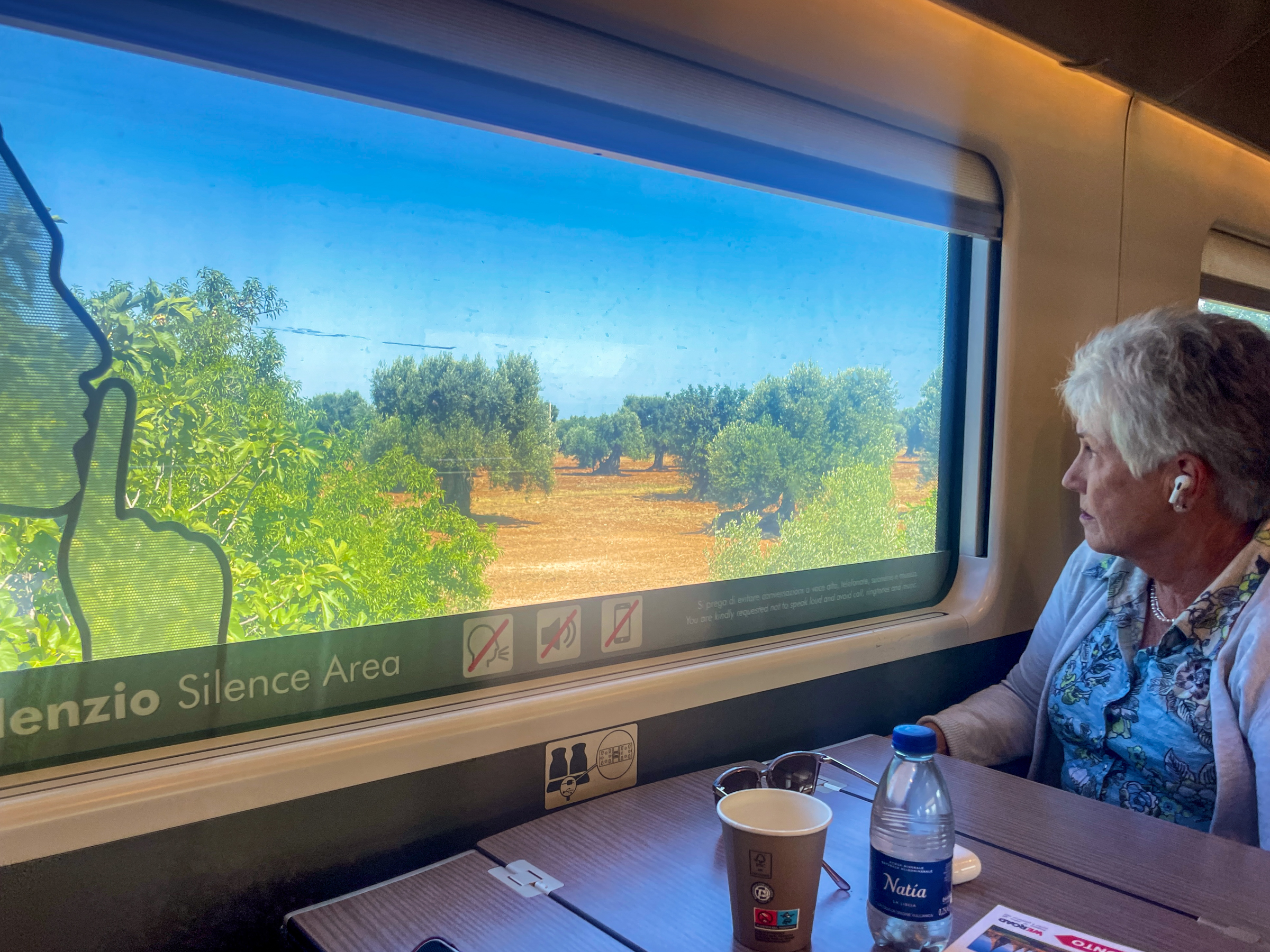
United to Rome Fiumicino/Leonardo da Vinci International Airport. If you’ve got it, why not flaunt it? Airport shuttle line to Rome Termini, and then distance train to Lecce, Puglia, along the way enjoying olive groves rushing silently by. That day’s destination pronounced “Leh Che, Pooliah.” Salento is the southern half of the Puglia region. In Italian, be sure to pronounce all those vowels, and they are more or less every other letter. This produces a lilting sing-song up and down bouncing ball pitch of the spoken voice, and a MLB change-up cadence in keeping with fine opera, no doubt why we love Puccini and Verdi?. Try it now. Say Leonardo… “Leh Oh Nar Dough” and don’t you just feel like Pavarotti in the shower? Puglia is agrarian, producing 70% of Italy’s fruit and vegetables, a third of its olives and olive oils, and a significant portion of its wine, including Negroamaro, a regional varietal, and quickly a favorite or ours. Considered the Florence of the south, Lecce has been inhabited since at least the Fourth Century BC. And I should mention that Lecce is the southeastern terminus of the original Apian Way. All roads lead to, or from Rome.
That train ride, a milk-run to Lecce was nearly six jet-lagged hours, of olive groves and tiny towns, then a walk of a quarter hour through the labyrinth of narrow stone-paved lanes to reach our first lodging, Palazzo Rollo, its arched opening on the right just shy of the bougainvillea. Torrey, Cathy and I shared a two-bedroom suite with living room and kitchen. Our outfitter—Inntravel, from the UK, listed this curated, unaccompanied trip as Pathways of Puglia, and this narrow lane fits the bill as a tasty appetizer of things to come. https://www.inntravel.co.uk/walking-holidays/italy/the-south/puglia. Throughout Salento, streets and walkways were without wafting trash and dog logs, absent of graffiti except near train stations, and restrooms in even the tiniest trailside hamlets were clean and equipped with all the niceties. Civilized.
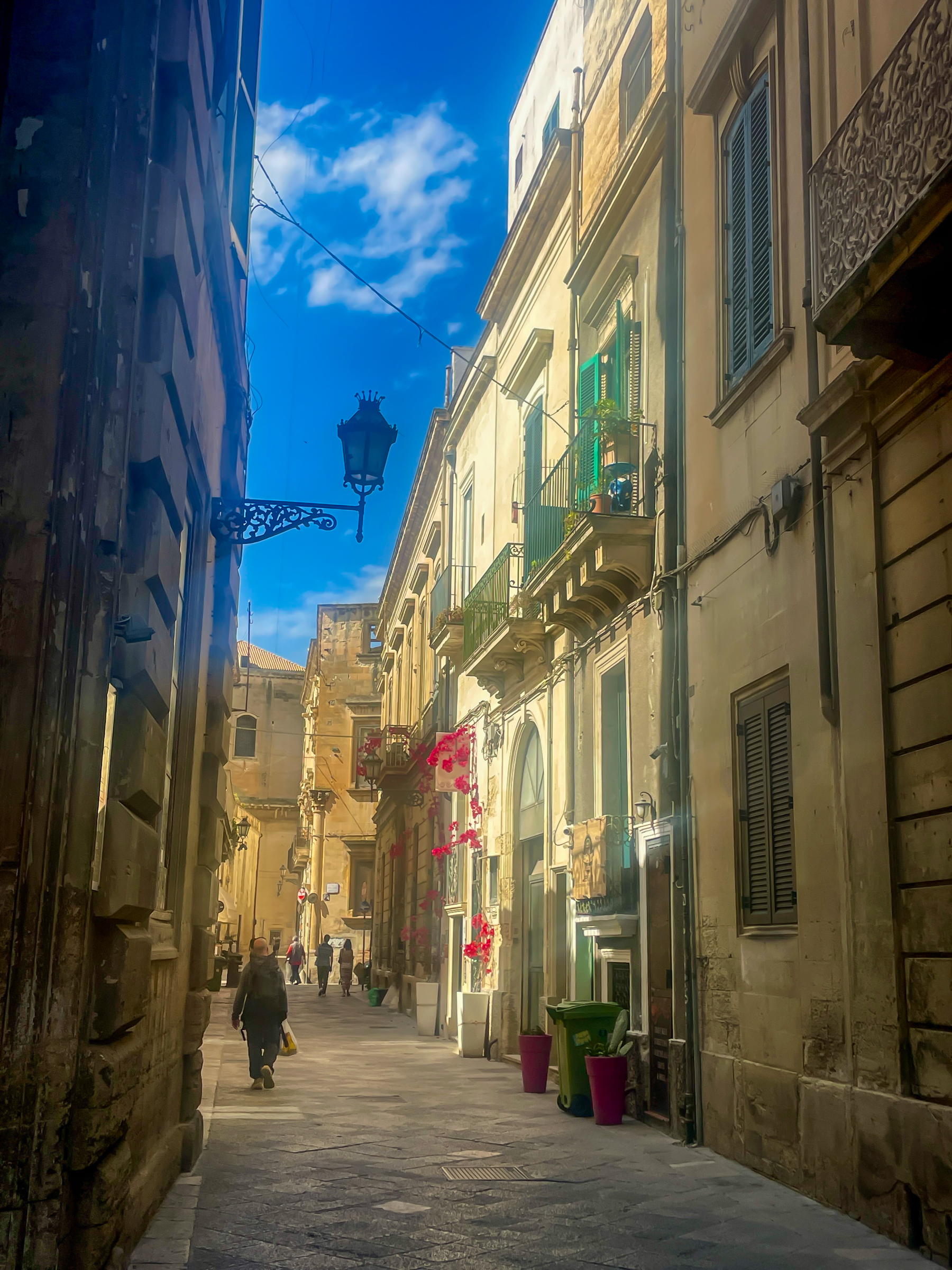
Palazzo roughly translates as palace, apt in this case. The entrance, a calm haven in the midday sun. Lecce has many guided walking tours, and the Rollo was a routine stop, crowds held discretely back by that rope.

With lovely views from our room of the neighboring Campanile at Piazza Duomo both during the day…
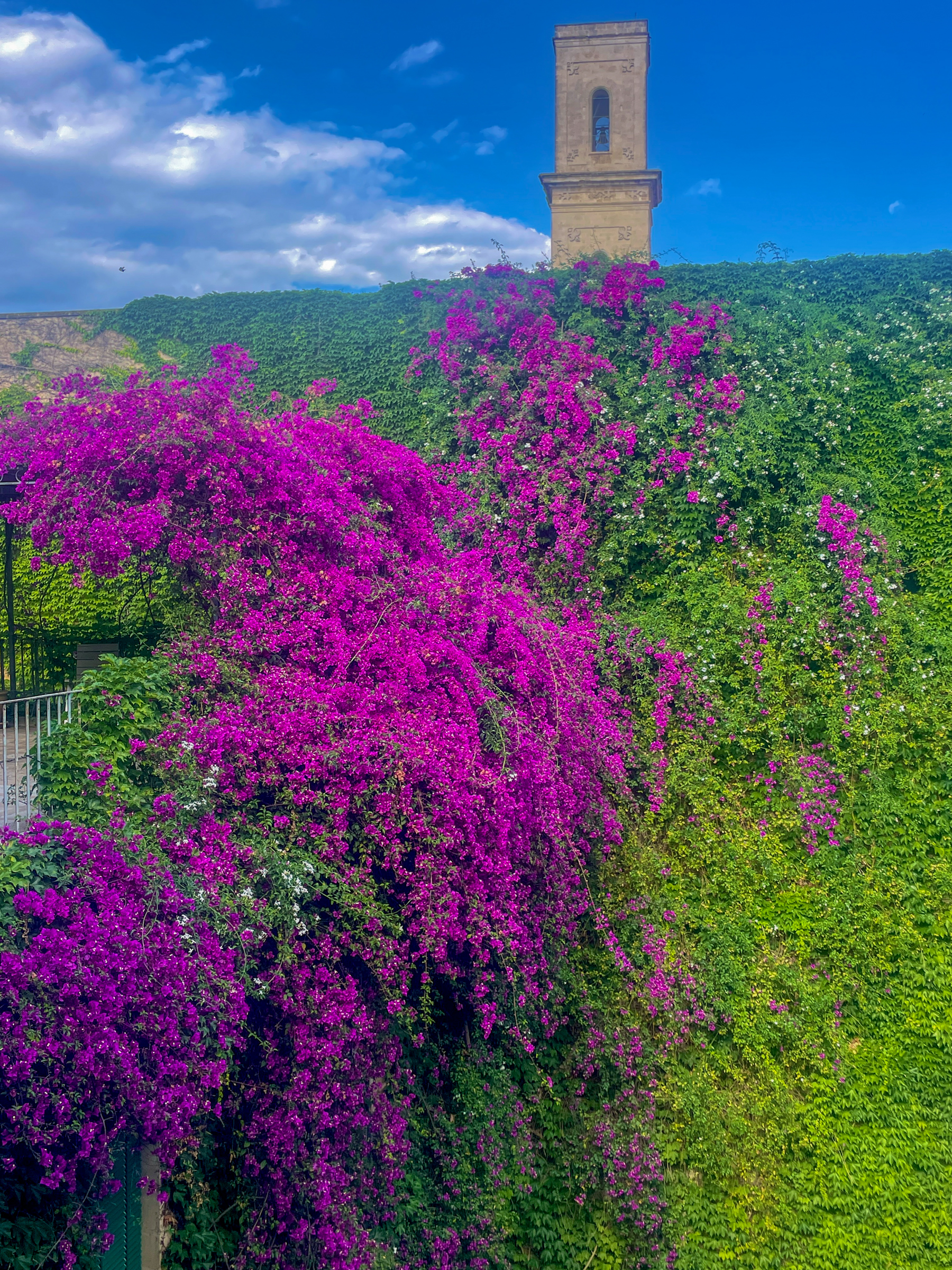
…and at night…full moon rising on the left, seen from the two- floors-up rooftop bar and lounge area.

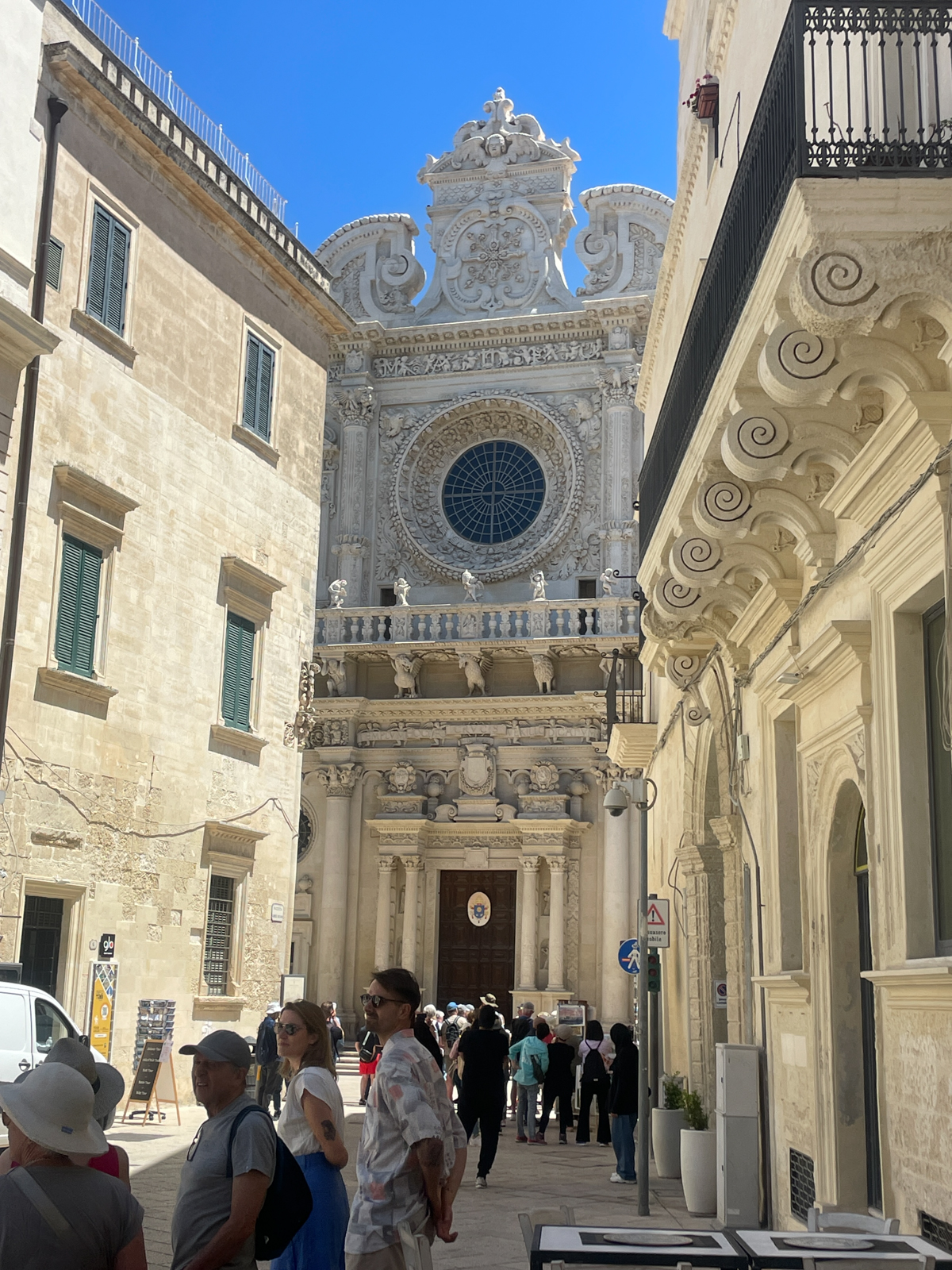


If you’re reading this, you know me well enough to acknowledge that my Del Mar roomies are foodies? Italy. Food? So, of course, one would expect the ladies have researched and reserved a cooking class. “The Awaiting Table” conducted by acclaimed chef, sommelier del vino, teacher and raconteur Dottor Silvestro Silvestori. We rendezvoused by the amphitheater for a day-long cooking and dining and wining extravaganza, regaled with stories and facts from a unique Puglian perspective. Then a saunter through the old quarter to the green grocer, and next the fish monger before repairing to his school. Everything for today’s class was growing or swimming just hours ago. That movable feast thing.
Today’s class was on making fresh Puglian regional orecchiette (sing it aloud, Luciano) pasta—semolina and barley shaped into little cups and strings—to which will be added for simmering, eggplant, muscles, fish, calamari, and spices. All of it accompanied by aciete de olive. Very virgin aciete de olive.
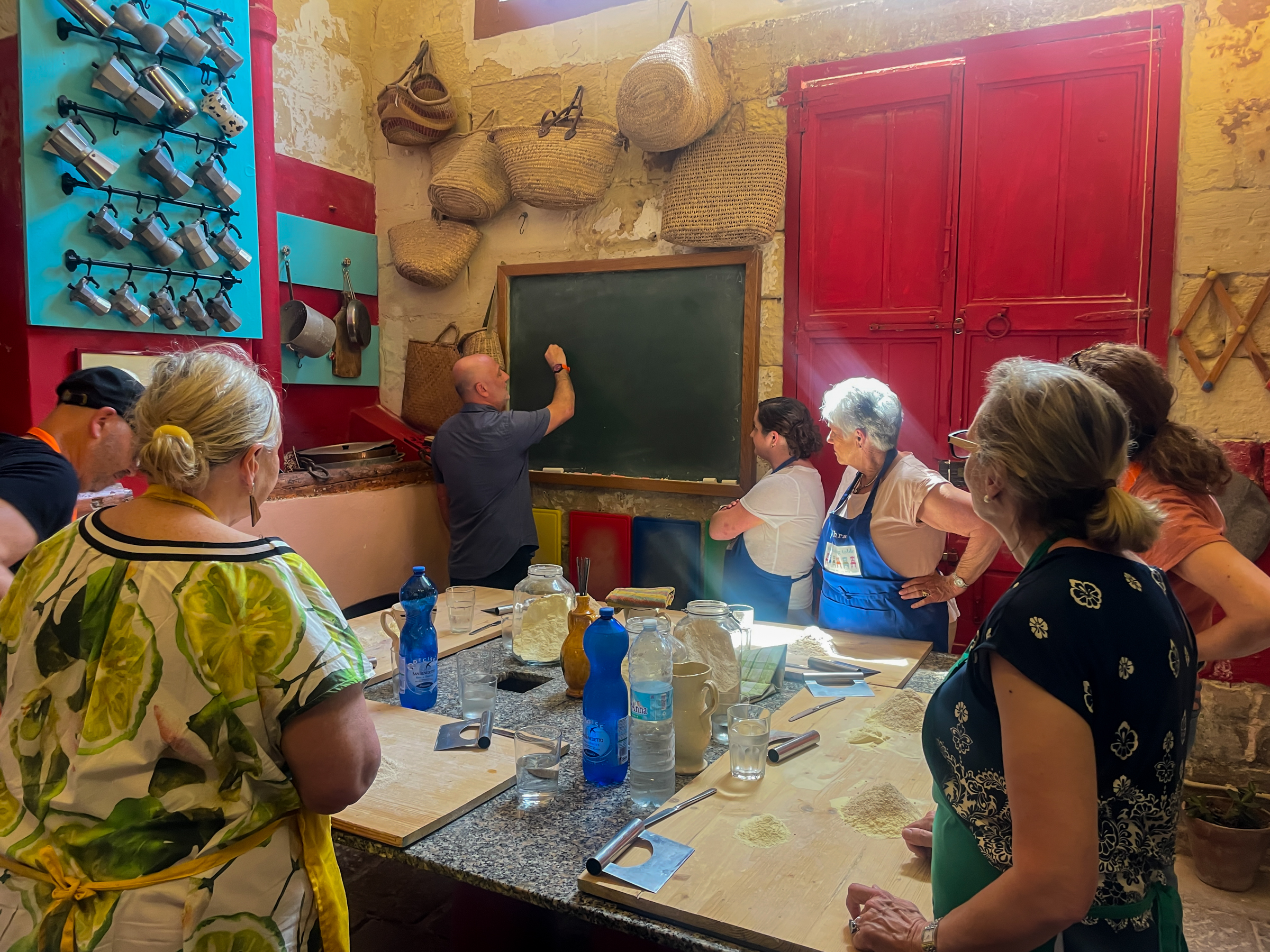
As the meal preparation ended, the serving dishes were taken from the kitchen to the proof of the pudding is in the tasting room for a sumptuous mid afternoon multi-course lunch accompanied with yet more olive oil, and of course fine wines, Rosé being a local favorite. Today’s seven students broke into subgroups to share with one and all each of the many preparatory steps. A little more vino, perhaps? Fueling up for the next day’s commencement of actual inn-to-inn, community-to-community walking.

Of course you know of my inexperience with any cooking involving more than three steps? So what did I do besides observing from the periphery and snatching the occasional photo? I frequently repaired to a handy sofa joined by Dottor Silvestro’s dachshund, Salciccia (Italian for Little Sausage) who took sufficient liking of me as reason to invite herself up for schmoozing. Which reminds me of a dachshund my sister used to have and named Johann Sebastian Bark. I can’t help how my mind works. A blessing. A cross.

The next day after breakfast at the Rollo, we walked back to the Lecce station and boarded a train for Gagliano del Capo, transferring there to an Inntravel pre-arranged cab which delivered us to Santa Maria di Leuca, literally Fine Della Terra—Land’s End. The sole of the boot heel. Where the Ionian Sea to the west abuts the Adriatic Sea to the east. Politely ensconced along the quay with our daypacks by our non-English-speaking friendly and professional driver, who then proceeded with our roll-aboards to Masseria Alcorico. Those suitcases, always taxied without us, would be waiting at that day’s destination either in reception, or typically in our rooms.
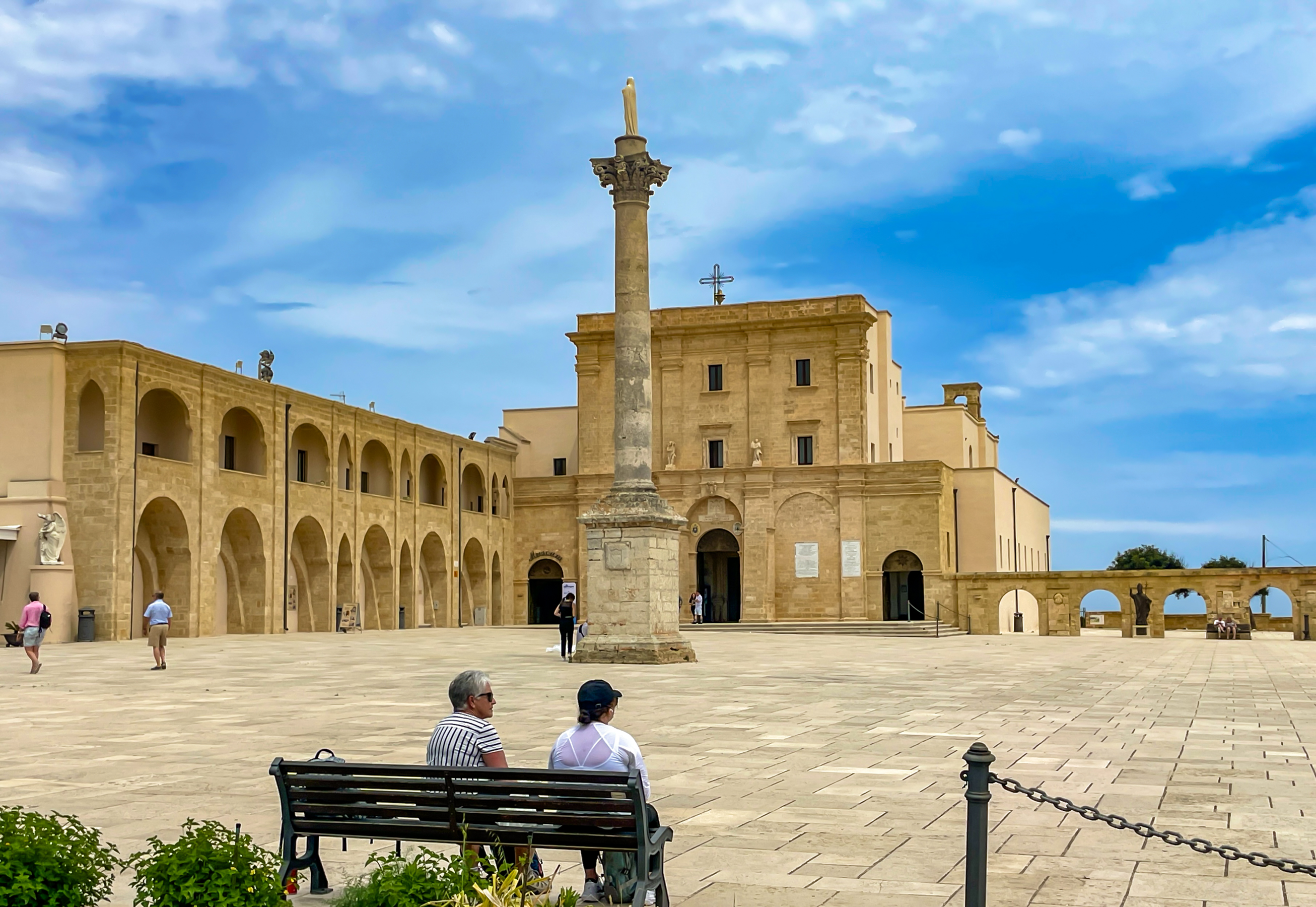
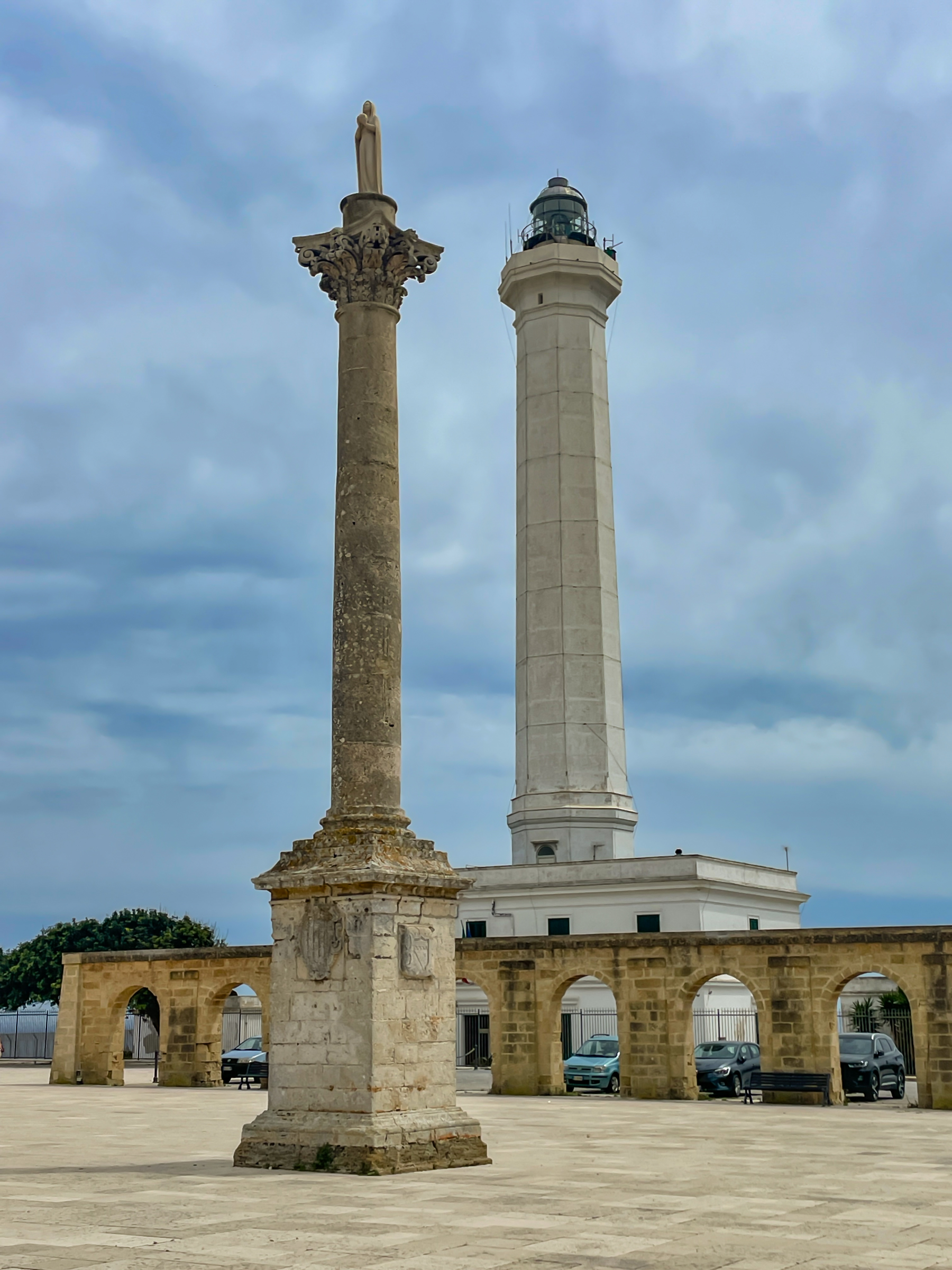
A brief stop at a quayside café for a few add-ons to our Rollo-prepared lunch and then up the steps to the Santuario di Santa Maria for a piazza bench picnic next to the land’s end lighthouse. Crowds? Not so much.
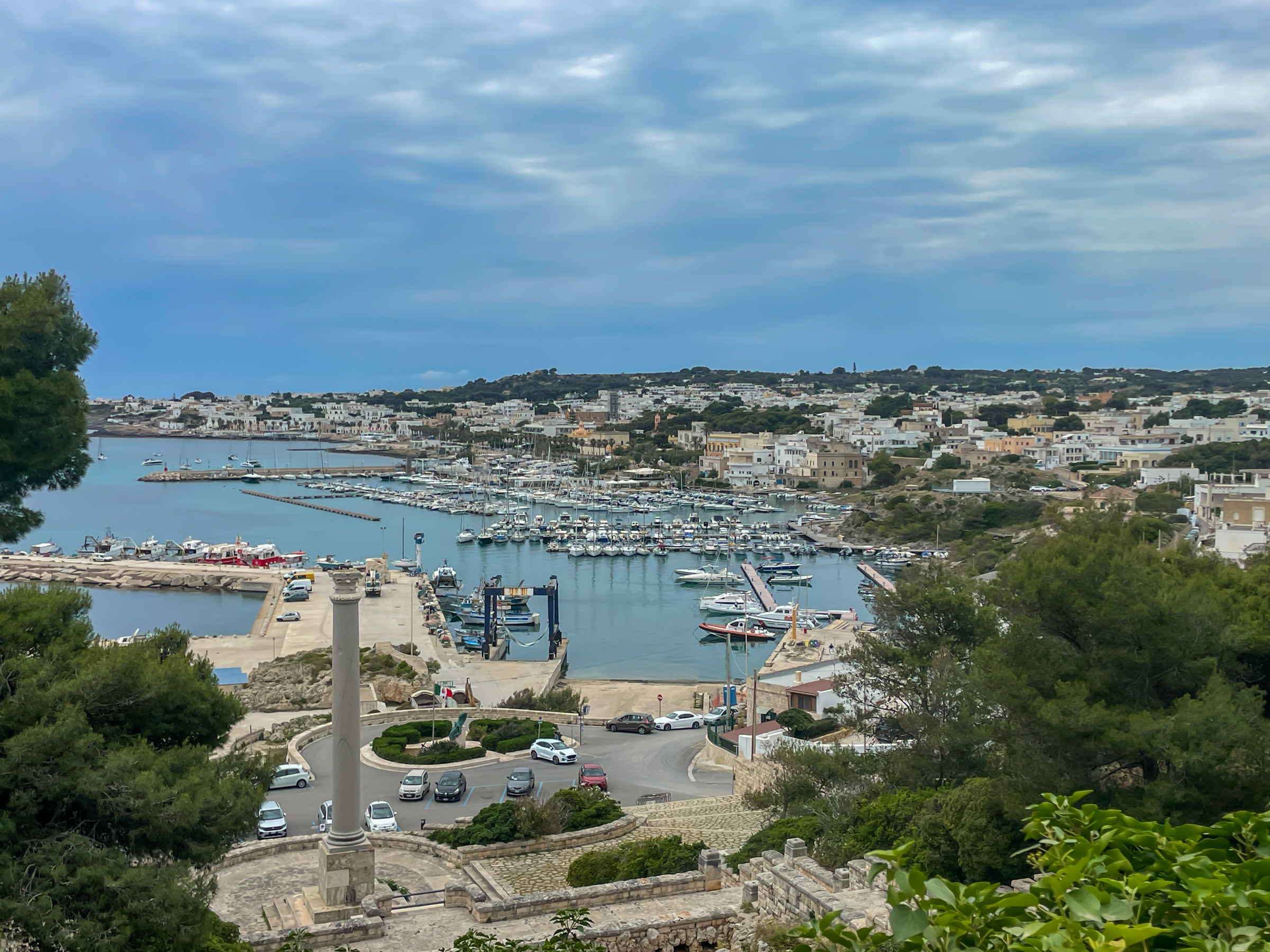
After lunch we continued following the Inntravel written instructions along country pathways on a bluff not unlike the near-the-coast mesas of Del Mar and Torrey Pines. “Along this next stretch (still a surfaced lane) you’ll start to see a number of cone-shaped, but flat on top, stone pajare in the fields…once ancient dwellings and have long been used by field workers…particularly [during] the olive harvest.”

“Follow this country road for 550m to arrive at a X-roads with [a] cycle track sign. Continue SA [straight ahead] here. After a further 300m, pass a road leading off to the R…”
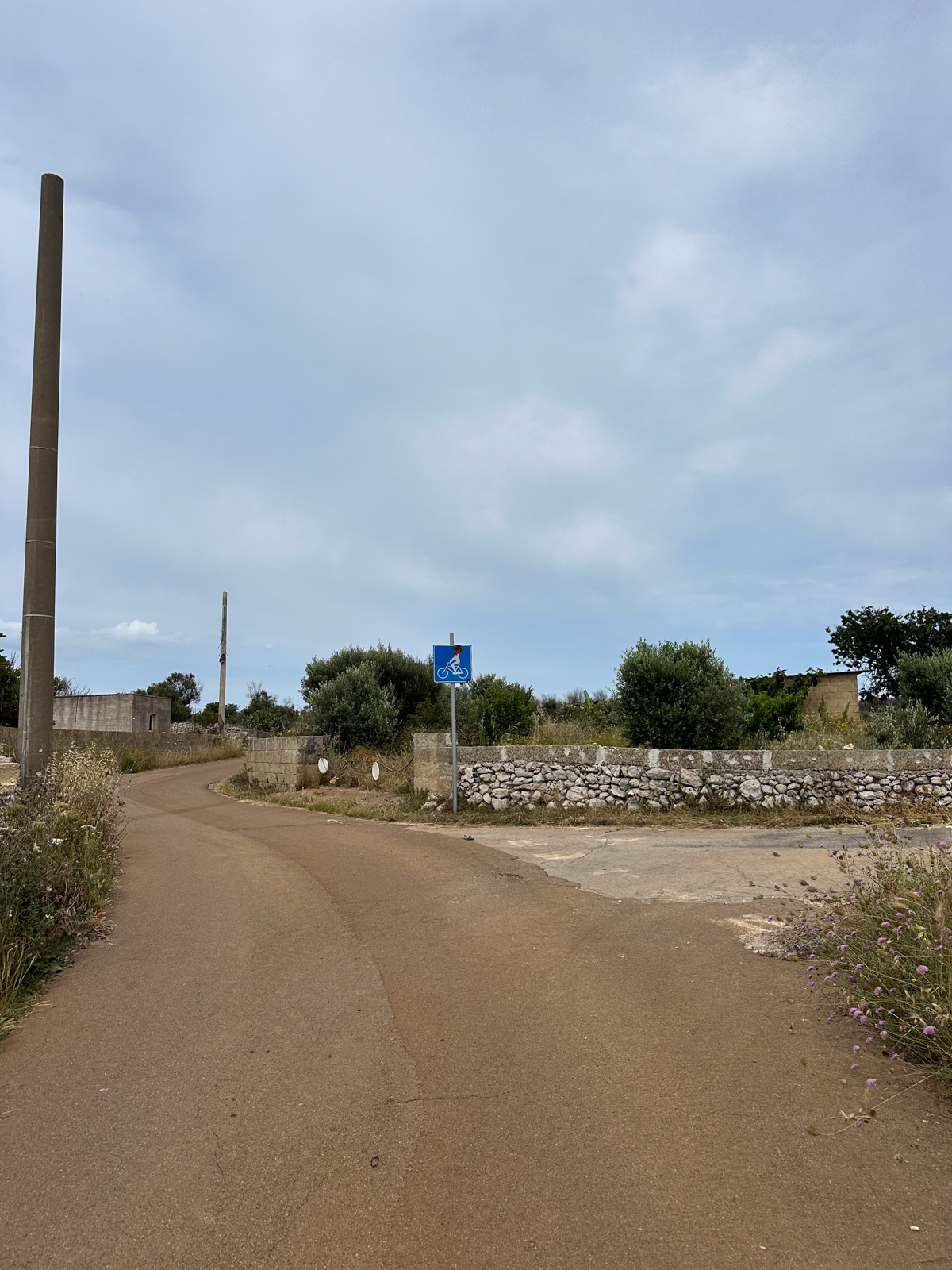
Inntravel specializes in curated unaccompanied walking and biking trips. They arrange for the inns and the taxis…trains and planes, if needed. Their directions are written, and generally quite explicit and up to date. Nowadays they have a GPS program one can download and place into an appropriate mobile device. I’m unfamiliar with the program, and Inntravel reiterates that their written directions are the relevant navigational guide. I’m a Gringo, familiar with English measurements and these are Metric, but I can multiply kilometers by .6 in my head to get miles, then use my octogenarian pace on multi-mile hikes of about :25/mile to calculate a time to the next nav waypoint in the directions. Important when trails are more obscure and trailside overgrowth from Spring rains challenge visibility. A similar technique for distances in meters. A meter is 39.7 inches or about 3 feet. Those 550m mentioned above, multiplied by 3, equate to roughly 1650 feet, or about 0.3 miles when divided into 5250 feet. Multiply 0.3 by :25/mile and you get :07 to :08 from the preceding waypoint to that bicycle track sign. Dead Reckoning is the term in Pilotspeak. Doing it in my head while walking. I had a couple of great audio books in my I-Phone, but didn’t feel I had the mental bandwidth to enjoy the story and not get lost.
“Another 350m brings you to a TJ [T-junction of two pathways] (with sign and Tel no. for Masseria Alcorico here). Turn L to arrive at the Masseria on the RHS [right hand side].”

A few other informative tidbits to share. Masseria is a colloquial for “farm.” Many, like Masseria Alcorico are still a part of the working agrarian regional life in which they are located, but have joined what must be a government-sponsored program known as Agriturismo. You get it, an amalgam of tourism in an agricultural cultural setting. Upscale agricultural, if you get my drift. This day was our shortest, but also possibly our warmest, the temperature somewhere a tad above 25C, or upper 70s F. I made a point of sipping frequently out of my Osprey daypack hydration system, but was still hot, knackered, and thirsty by the time we reached Alcorico in the mid afternoon. Alcorico has a pool. And a full service bar. A quick pitstop in the room, down to my nylon hiking shorts, and off to the pool. Refreshing. “Ana birra, per favore?” Also refreshing, and almost adequate to my trail dust thirst. Almost. I decided vacationing in Italy was authority enough for a second brewski, poolside. I hadn’t yet learned the Italian word for second, which I now know is seconda, quite similar to the Spanish segunda, which I already knew. I gestured like a mute bozo for another and requested “due,” meaning two, as in a second beer. She brought me just what I asked for, of course. Yup, two (due) more beers to go with the first still being consumed from the chilled glass. Along with peanuts and those roasted fava beans that are bar beverage staples in the region. Okay, due (doo eh) means two, seconda means second. Babel translation eat your heart out. I saved the third brew in our room fridge and took it to dinner later. Around 8-ish in Italy. Oh yeah, the second beer quenched my thirst. At least until cena (dinner). Moveable feast.

Breakfast in all of the inns was a variation on the European model. Cappuccinos for the ladies, juice for His Geezerness. Along with bottled acqua minerale—still for the ladies, “fizzante” for me. Tables with cheeses, meats, cereals, granola, yogurt (a particularly delicious and creamy local version somehow mixed with honey), and several varieties of breads, rolls and pastries. I fell, tastebud over tastebud, for a local delicacy, the pasticciotto, an oval shaped semi-soft outer surrounding a custard filled inside. Mouth watering. And thence, submarine sandwiches and fruit loaded in our daypacks, to commence the next 7 to 9 miles of penance from last evening’s feast and self-flagellation preparation for this evening’s feast.
The picture at the outset of this missive is from this next day of hiking. First, a hike along the rural mesa so we could navigate the narrow byways of ancient Gagliano del Capo to exit eastward toward the Adriatic, and down the gorge conveyed in that image sometimes with handrail protection, sometimes not, leading first to glimpses of the sea, and then a no holds-barred nearness to the water lapping at the typical Salento rugged rocky shore.


This stretch was a footing challenge for the three of us. Very uneven ground, a mixture of rocks and dirt. Quite literally ankle-challenging. A good place for walking sticks, but we’d left ours behind as we journeyed with only on-board luggage. Those pointy sticks not blessed by the TSA for the passenger cabin. It went on for rather a long time, but no complaining as to scenery.

After 7 miles we finished in Corsano with a pre-established 3:30 PM pickup at Piazza Santa Teresa by our friendly taxi driver and driven to our next lodging—Palazzo Mellacqua, in Castiglione di Otranto. Another “palace” unimaginable from outside on the street, demurely revealing its elegant petticoats once through the front door. Husband and wife innkeepers who spoke about as much English as I do Italian, but their comportment said it all. So happy to have us as guests, so polite and solicitous, and justifiably proud of their beautiful inn. A birra (becoming a regular post hike event) as we chatted and planned a sumptuous dinner in their elegant restaurant. All of this in a small town with a population of maybe 2,000?
And here’s another moveable feast glimpse at Italian dining culture. The meals were regularly multi course affairs. Aperitvo time for charcuterie…perhaps a seconda birra for me, Prosecco for the ladies? Decide on the first course and the second. Which wine or wines would please us? Something dolce to finish? The innkeepers’ adult daughter was rumored to run the restaurant, but it sure seemed to be the husband who waited table on us, and his wife in the kitchen. M’ladies chose some sort of fish thing as their seconda course, and I elected beef, which brought a question of how much would I like? Not a question I recall being asked in these parts. Some confusion here, resolved by him bringing me out a slab of beef about three inches thick, fifteen by eight inches in planform. He gestured suggested dimensions of my steak, beginning with nearly half of it. I finally talked him down to maybe a fifth of it. And this is how it came out. My only regret is having only one stomach and set of coronary arteries for my tastebuds. A little more Negroamaro, signore? And their fish, a sea bass if I recall, was every bit as big.

The next morning our cab took us to Piazza della Vittoria, a lovely square in Marittima, from which we headed back to the coast in Castro.
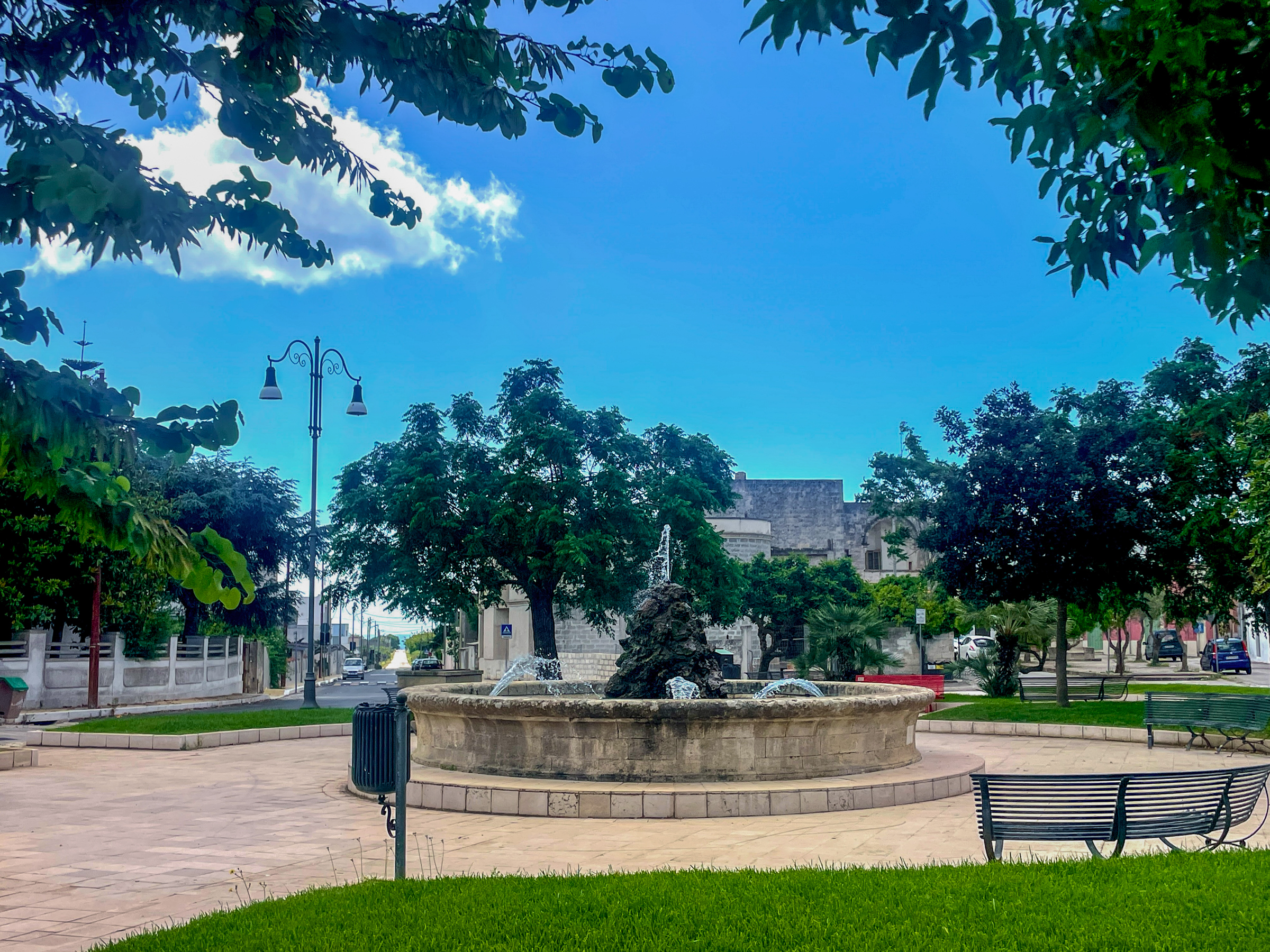
This pathway yielded yet more glimpses of Italy’s quiet side, coming upon another stone-walled lodging with the added flavor of the ubiquitous Vespa scooter…
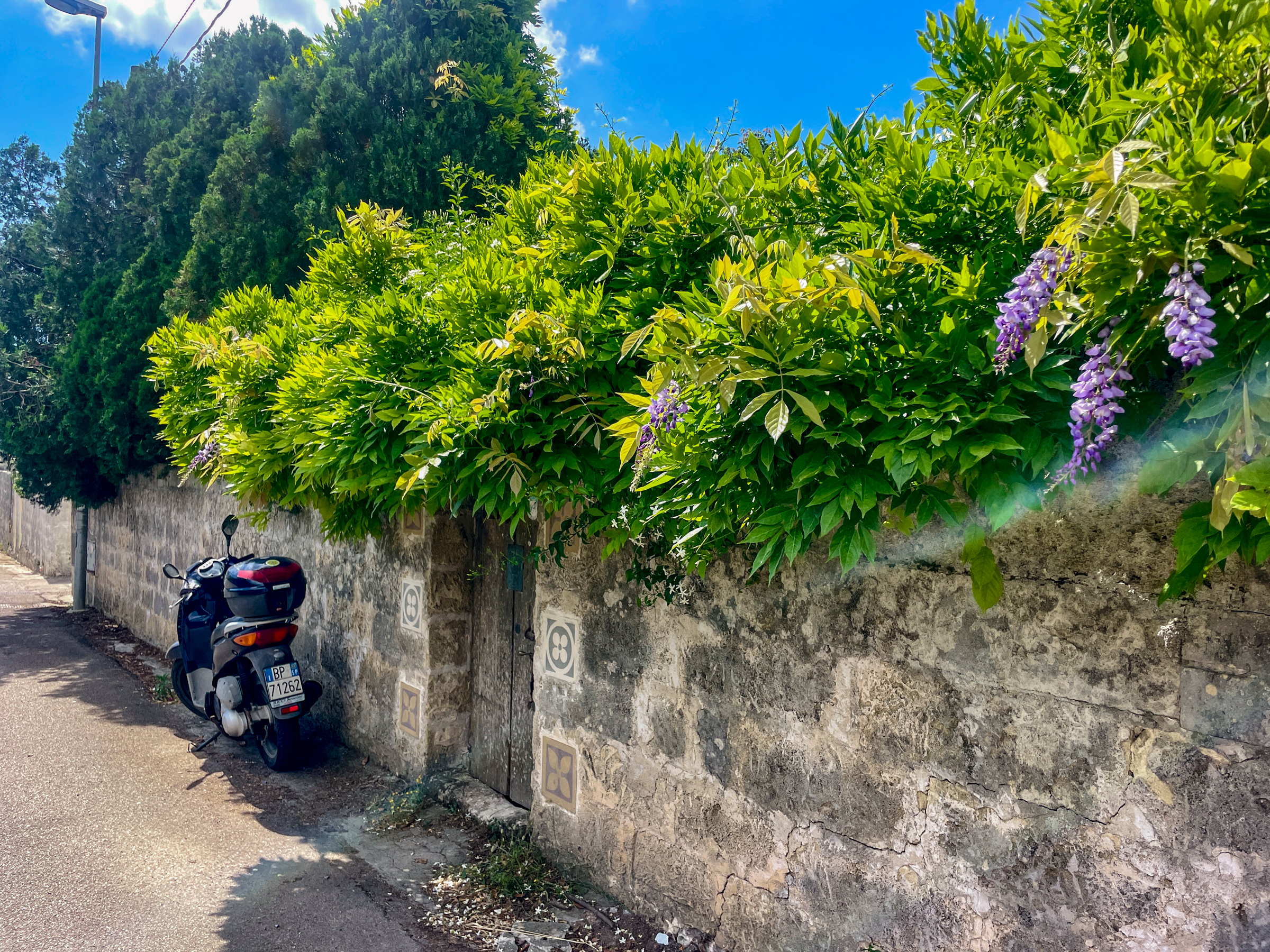
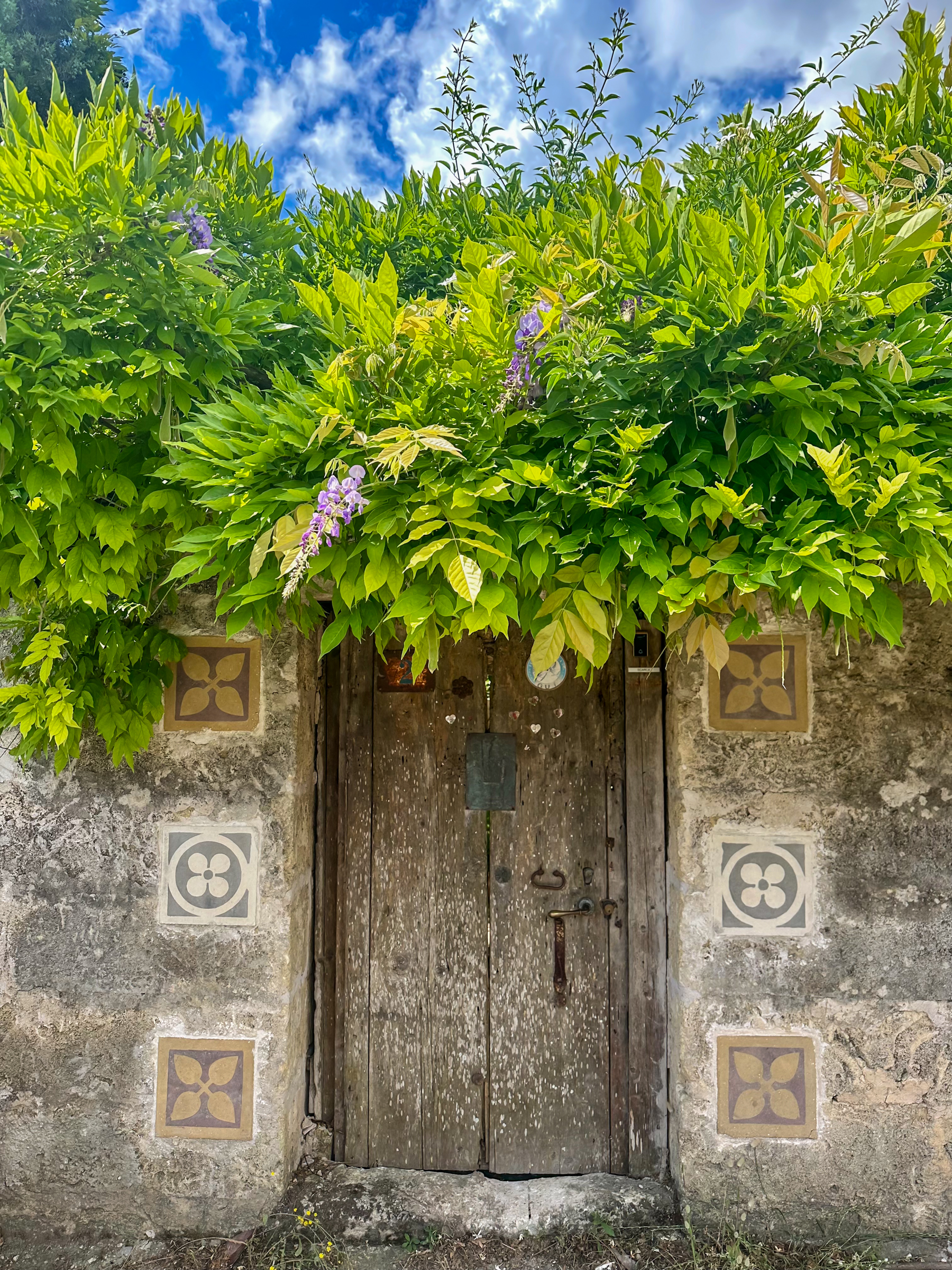
…with such an elegant front door. Photo courtesy of Torrey Close, proving yet again that she has a well-honed target eye.
Glimpses like this are why we choose exploring places culturally divergent from our own. Not to mention glimpses like this one at the bottom of the ravine a kilometer below the walled home. Yes, the water really is colored like this, with the gin-clear water visibility. Ah, you say, but gin is colorless, not aquamarine and blue. Stay tuned for refutation.

This was another 7 mile day, headed first for Castro. with its small sheltered harbor, alongside which we stopped in an outdoor café for cold acqua minerale and a little sit-down time.
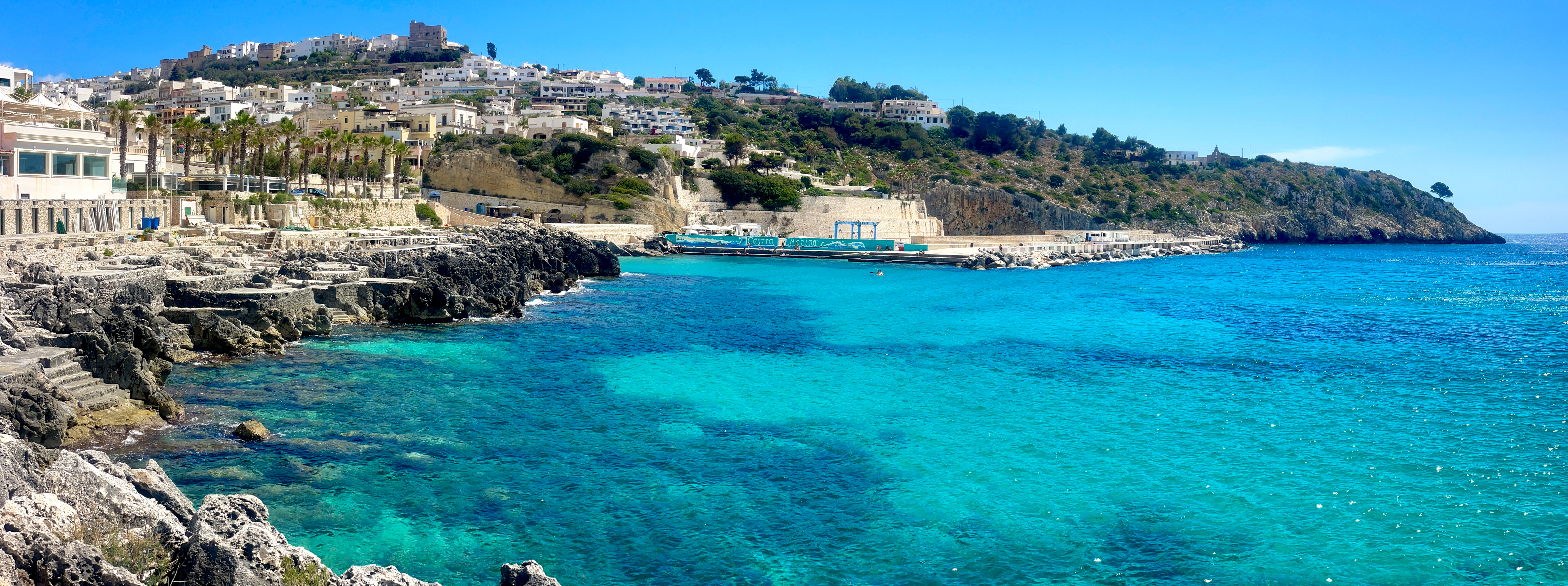
Then working our way steeply back up to the mesa passing this handsome church as we began our climb.

On the climb up to the mesa top leading out of town through the Centro Storico (the old town) we stopped to take in the view from a piazza adjoining its 12th century fortified castle, the white buildings of our destination of Santa Cesarea Terme visible in the distance to the north.
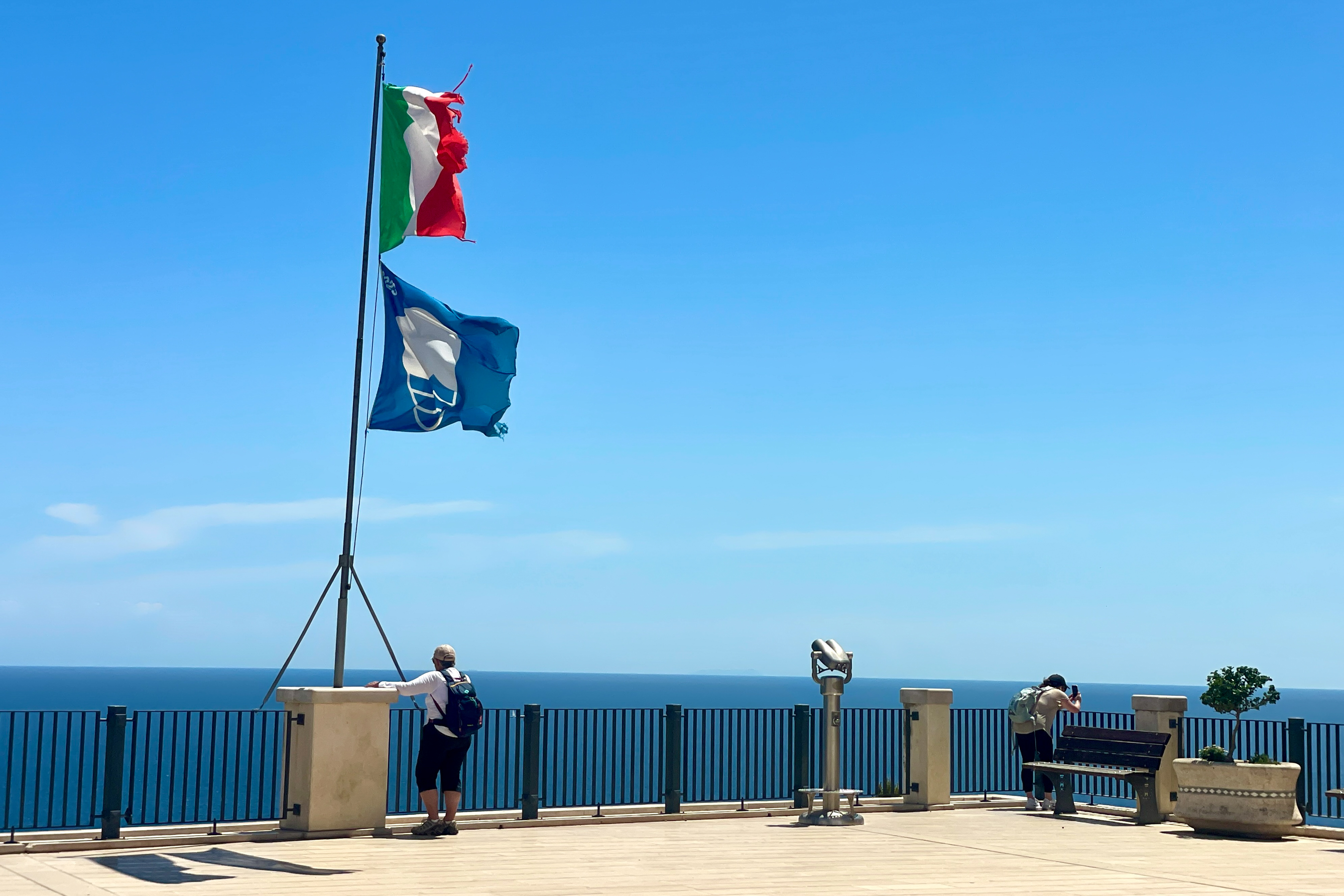
Leaving Castro by this colorful street.

You can make out the road sign showing that S Cesarea Terme is straight ahead. But Inntravel will have none of that busy road, shortcut kind of pathway. Leaving the road at what the directions describe as a car park, and which I think might be more accurately defined as an RV park, we were soon back on our typical alone in the toolies tracks. Yes, nature was everywhere, flowers, pollinators and scooting lizards our constant companions.

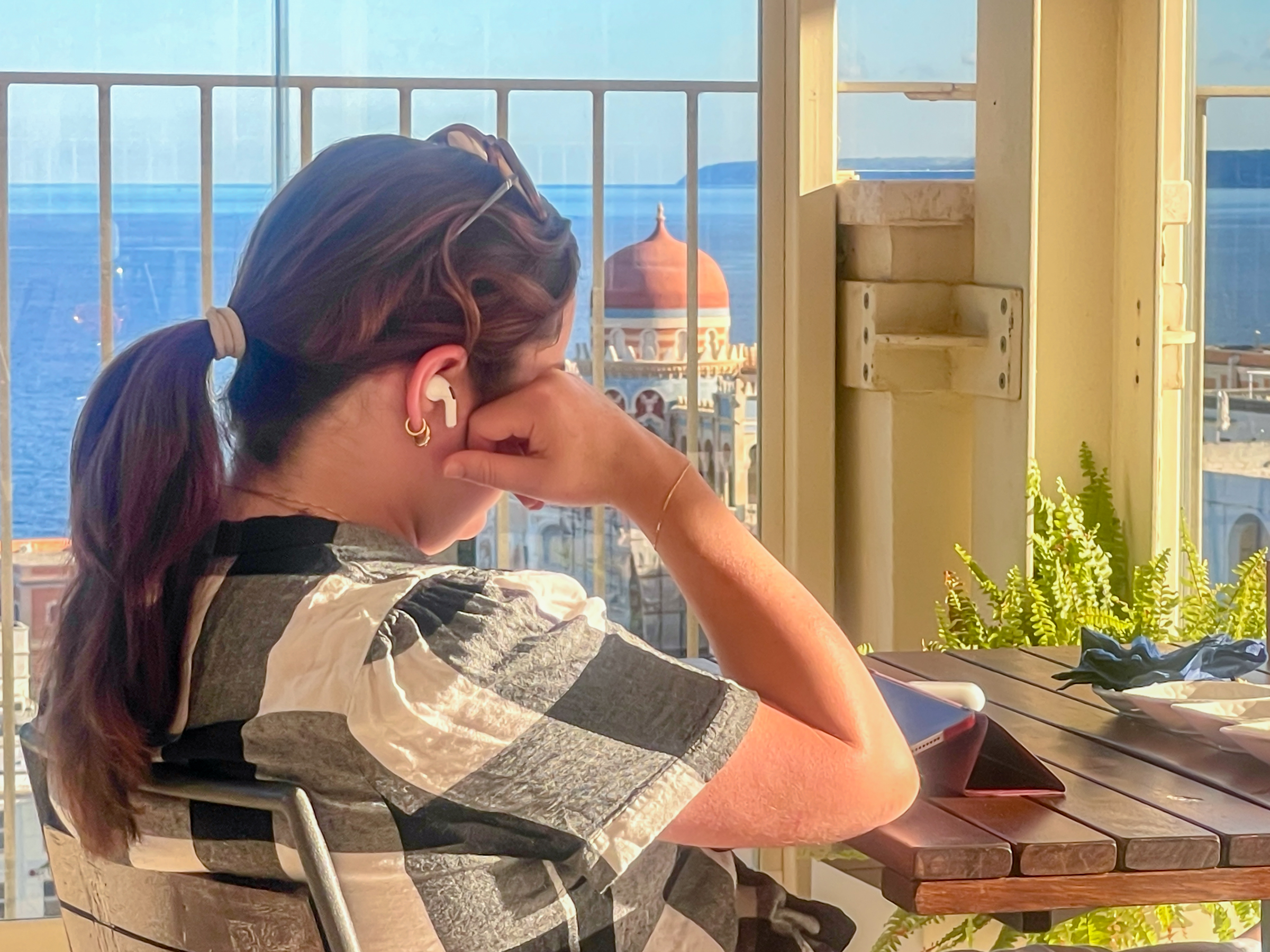
Destination, Est Hotel in Santa Cesarea Terme, and a little lounge-deck downtime after a shower and with a favorite audio book, overlooking the onion dome of an enormous private residence designed with a Moorish mindset when that style was once in vogue there.
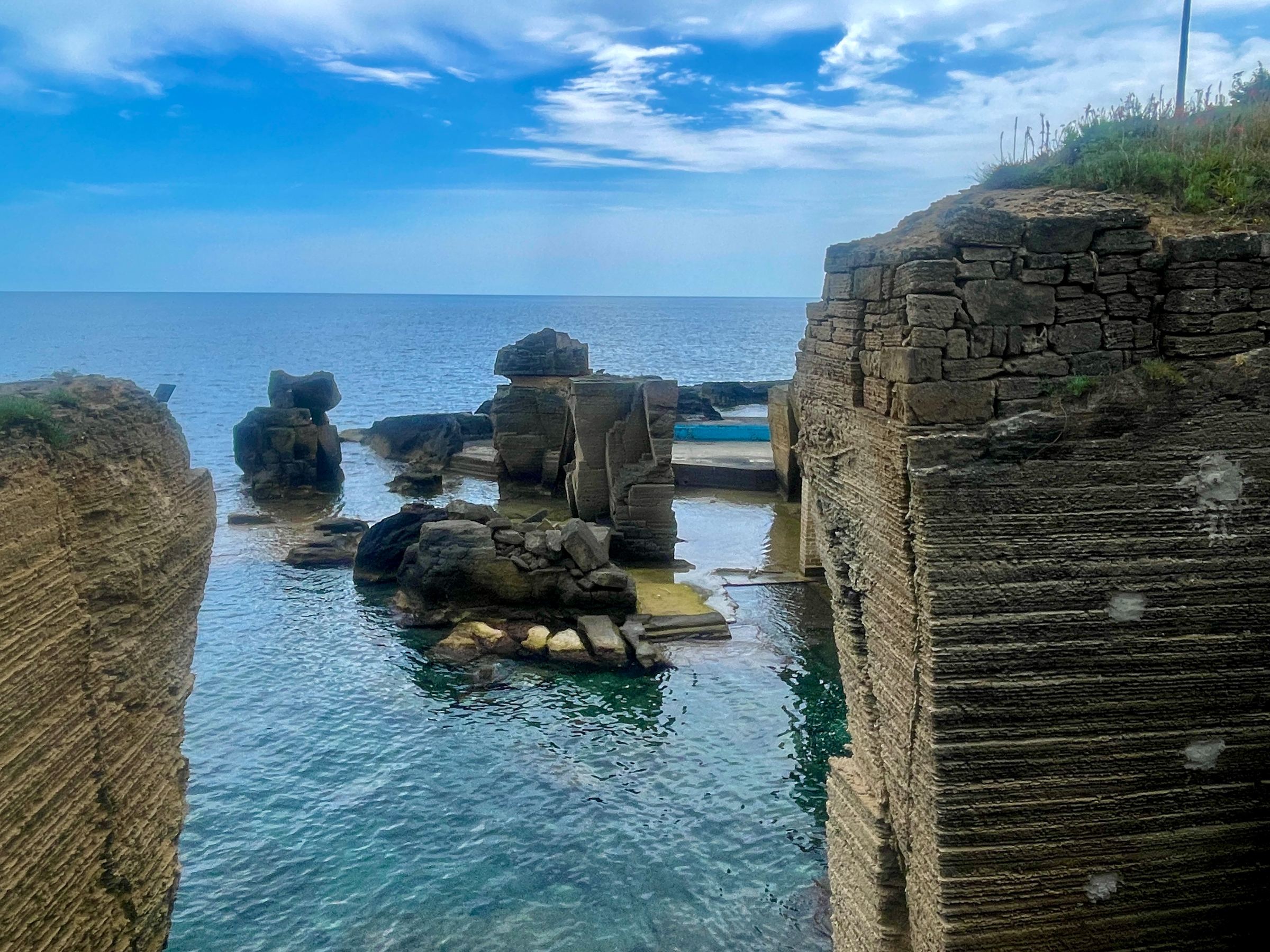
Italy inhabits tectonic real estate. Mt. Vesuvius may ring a bell? Santa Cesarea Terme’s version is sulfur hot water, where the Adriatic is made a toasty 30c, 85F for the rest of us. Steps and stonework leading to bathing areas accessed from prepared and natural ledges.
For our departure day, the forecast speculated thunderstorms, interestingly expected to be most active in the mid morning through early afternoon. You pilot types will smile knowingly of what can be referred to as the duty 2 PM thunderstorm onset, a remarkably accurate old-pilots’ tale accounting for the buildups by terrestrial solar heating producing thermals as a means of cumulonimbus uplift. The early morning already scattering bubbling cumulus offshore, and more inland, a portent of things to come.

Departing town on foot, our directions wasted no time having us leave the road and climb steeply some 210m back up onto the plateau heading north. The climb began with stone steps, devolving into a rocky trail, and steep enough to seriously consider hand over hand on all fours. Trust me, it’s steeper than it looks. And note the darkening cumulus bases already churning at 09:30. Hmm.
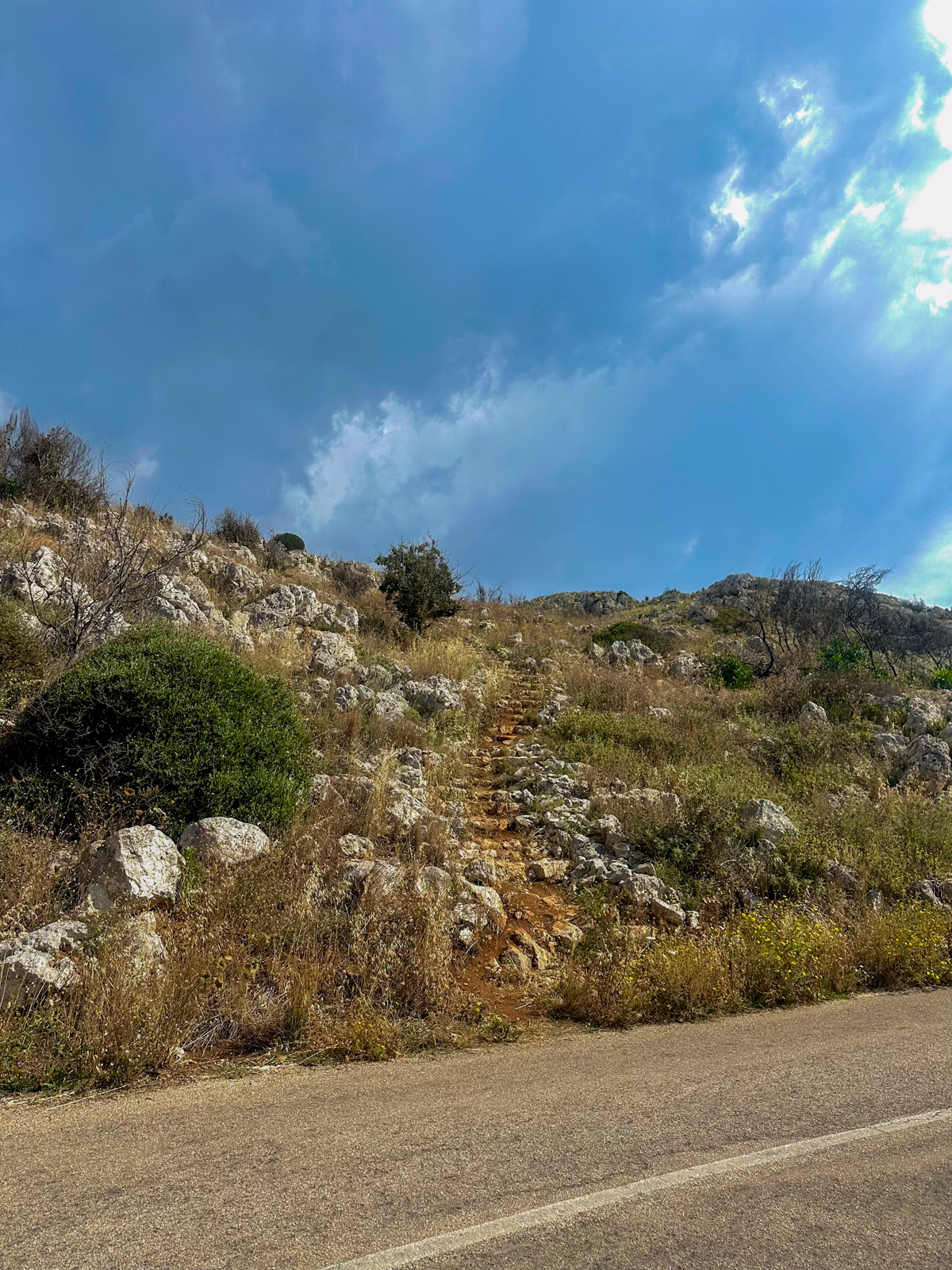
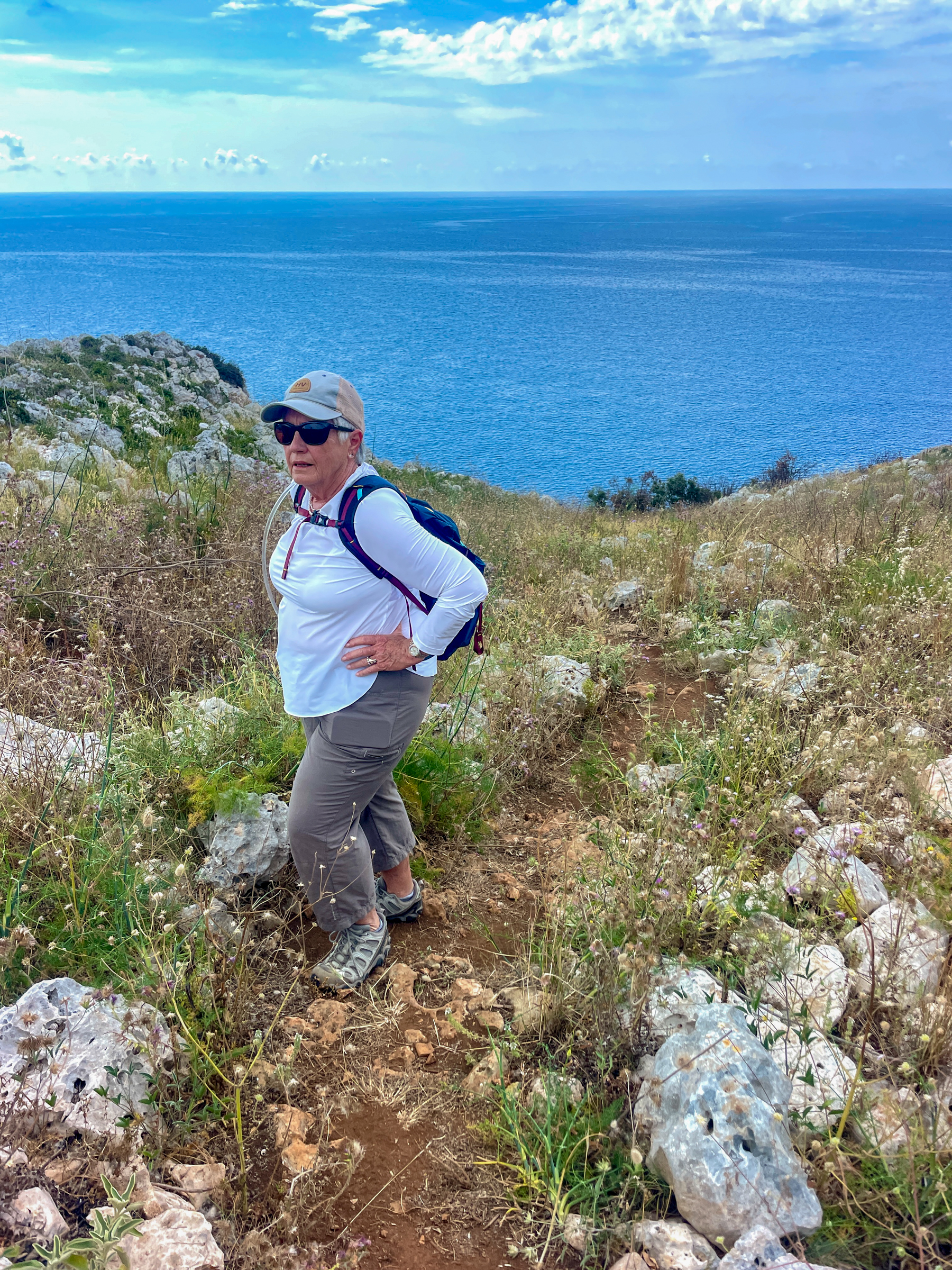
At the top, the missus catching her breath while I do the same. Steady camera a challenge while gulping air. You do see the trail, right?
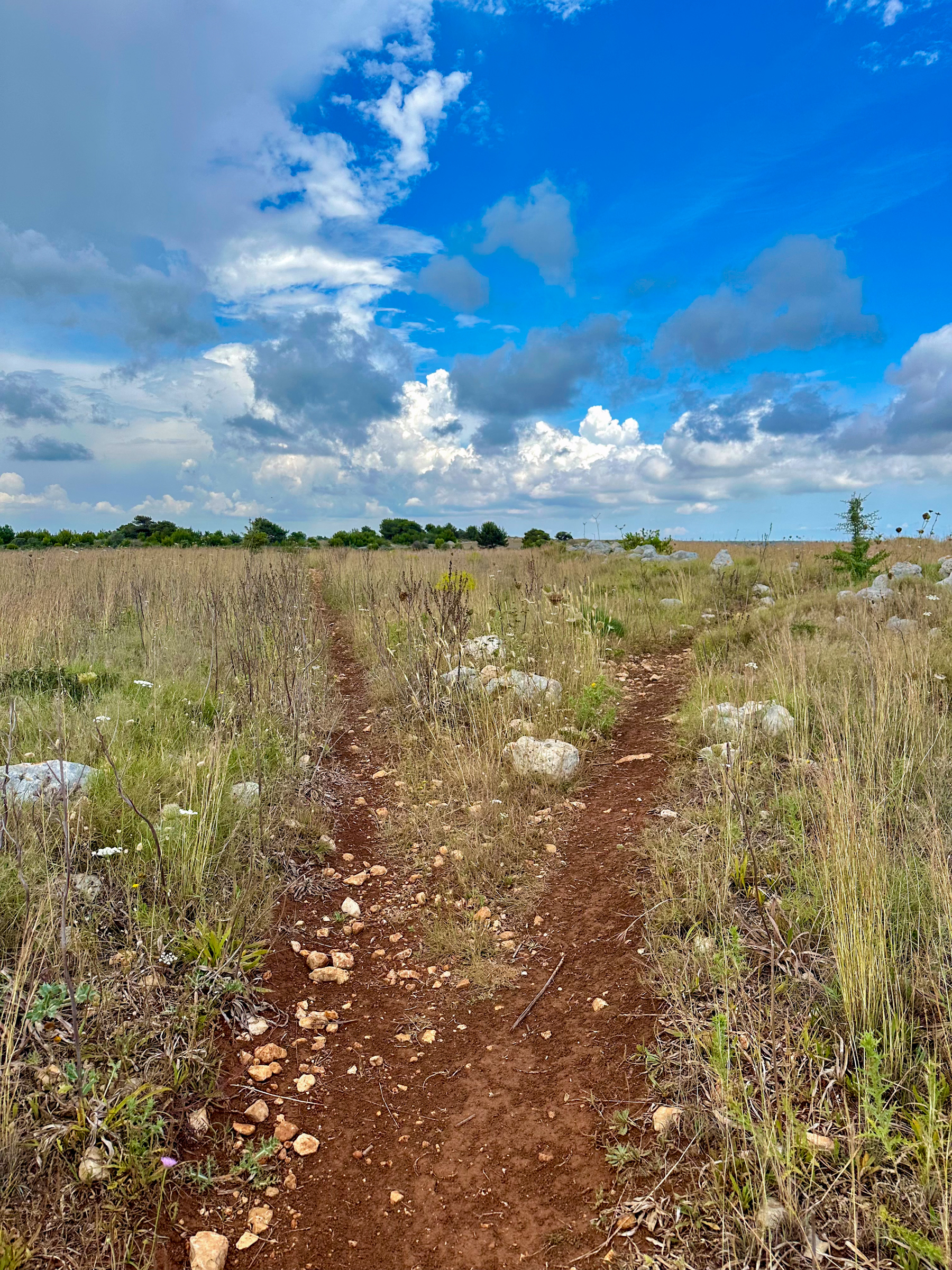
And then follow the trail, being careful to stay on the straight and narrow. Beginning to sprinkle now, then ultimately coming down hard enough we donned our rain gear, a necessity for only :30 or so. Frequent peals of thunder, Zeus’ tummy growling, but thankfully only one lightning strike well to the inland from our trail.

A long day, weather about. Make sure you take the correct juncture. Fortunately, it was to the right, angling away from the worst of the thunderheads.
Eventually our directions had us drop back to reach the coastline at tiny Porto Badisco, the worst of the tempesta now to the right back from whence we came.

Then the navigation got more interesting. We had to make some allowances because a prominent waypoint—a café—was in the finishing stages of complete removal, only some old rebar sticking out of the ground. The construction workers denied us passage until I informed then we were “on the camino” a reference to the Camino di Salento, a portion of which our route overlaid. Religious sojourning has its place, and here was no exception. But the directions to continue in an arc around a headland were less than clear, yet we made it work on intuition. Eventually coming upon this un-described addition to our day. And which of us two is the black sheep? The sheep began crowding over the path, whereupon the shepherd, sitting on a rock at 3 o’clock in the frame, whistled for his sheepdog to get to work and a few barking forays later the path was again passable. Score one for the camino pilgrims.

As the crow flies, our destination, the Tenuta Sant Emiliano, to the north of here is relatively close. Not so via the trail. From here we arced along the headland with the sea to our right, heading to another climb steeply up onto the mesa, navigating toward and eventually around an ancient watchtower, the Torre Emiliano seen here on the distant bluff, then up close, below. Defensive watchtower for those marauders from the east over the centuries.


Torrey typically walked at a faster clip than us, me the slowpoke more than Cathy, who nonetheless would slow down so that we could hold hands and chat. Torrey is quite adept at following the written directions, but also knows how to use her I-Phone’s map function when it makes sense. A couple of miles after here our directions had us access the main road for 150m, then depart it on a dirt road that was intended to have us arrive at our inn in about 2 km via the back of the property. Torrey had had enough, and stayed along the road following her Google map, which took her unerringly to the front door in about 1 km. I should say that the inn was not visible from the road, nor from the dirt road that we plodded along following the directions. When we were probably only 300m from the inn, the trail seemed to come to an end in the middle of nowhere, the inn still unseen. Lost! No, I was not a happy hiker. Torrey texted us that she was at the Tenuta enjoying a lemon sorbet. We responded that we were lost, and were backtracking to find the error of our (my) ways. I eventually decided to use my phone Maps function, and discerned that using the auto road was the smart move. Our loss added another mile plus to what was already an 8 mile day. Two days later we’d leave the inn by the original directions to it, but in reverse, of course. And knowing where you were made passing through the area where the trail died with tall grass overgrowth easy-peasy. But not so on that long day arriving.
BTW, I sing T-Mobile’s praises, as we had unlimited high-speed text messaging and internet throughout, phone calls if we needed it, e-mail in the bargain. Their coverage is so extensive and the Adriatic so narrow that along some of the Italian shorelines we got pop-up text messages from T-Mobile welcoming us to Albania and Greece. And those folks in pink pay me not a whit for this appreciation.
The Tenuta is another Agriturismo lodging. And just sayin’—the vegetables and salad greens are decidedly freshly from the field. We passed this smiling lady as we left two days later, out the front door and to the right, an underhand pitch from the inn’s front door.

Torrey already outdistancing us as we carried forth on our last leg to Otranto, another 12 km day.
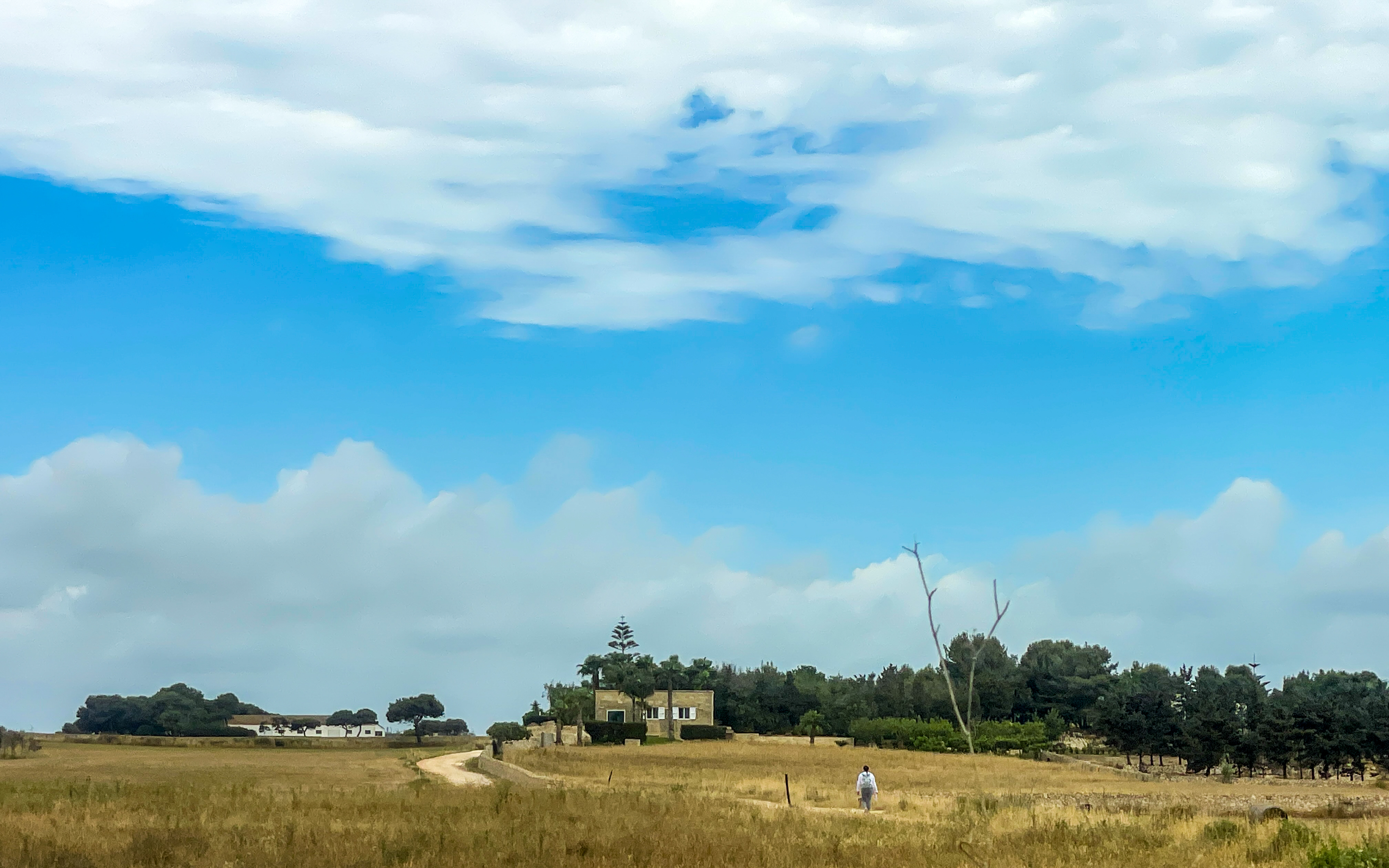
Lots of nice scenery on this leg.

An abandoned masseria. Our trail on the left.

At about 8 km the trail returns to the shore.


That scenery overlooked by Orte Beach Bar-Restaurant. Just a trailside establishment where we took a sit-down with an ice cold Coke Zero and an ice cream bar. Immaculate bathrooms.

A more recent military watch post, now watching over hay rolls, a common enough scene over our many days of walking.

And a couple of kilometers farther on, our path enters the old Roman Empire city of Otranto from its port. This particular day had a “there goes the neighborhood” sense to it with the uncommon arrival of a French cruise ship.

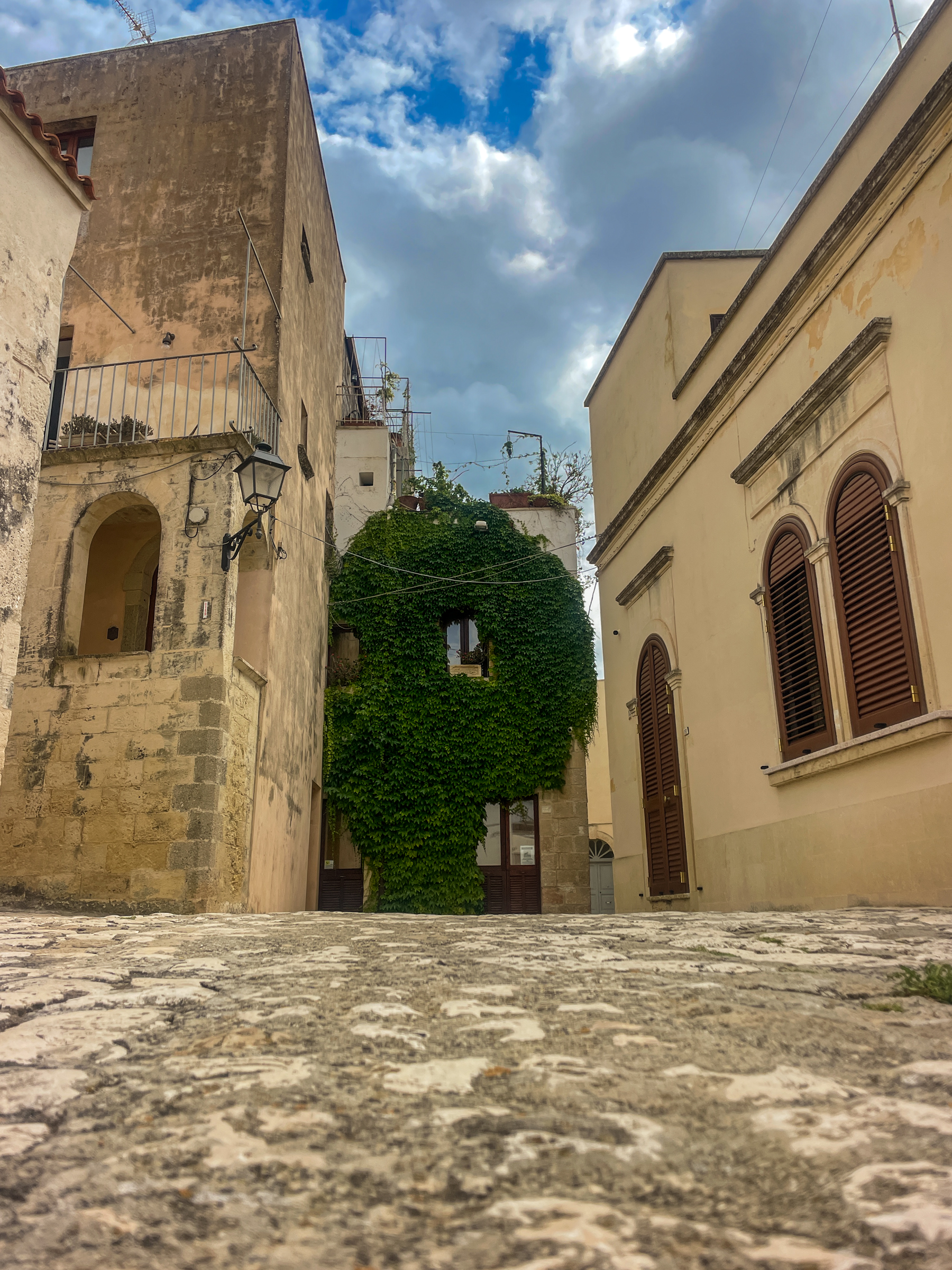
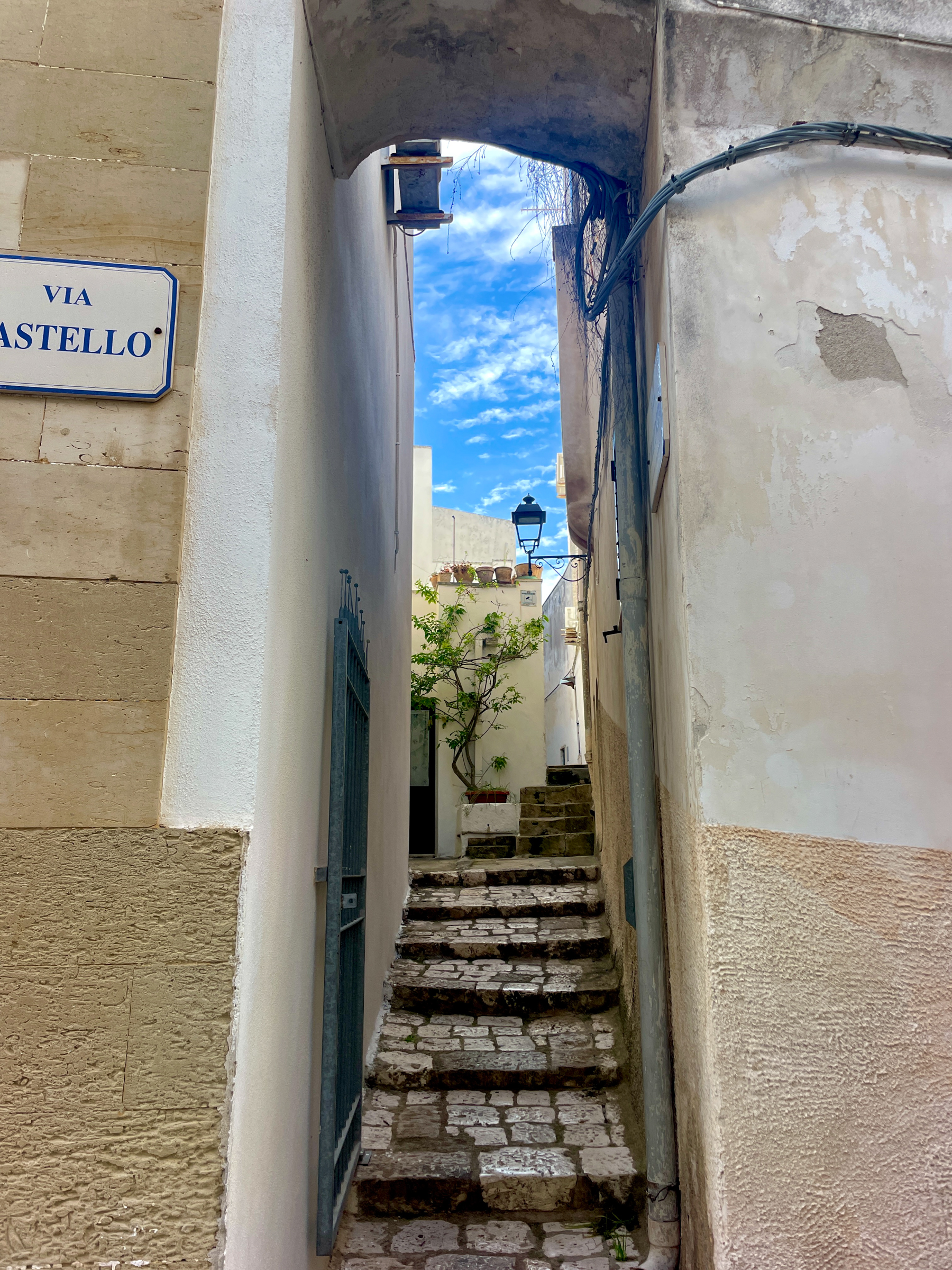
After Lecce, Otranto is the largest community we visited, possessed of a population of nearly 6,000. It has a modern part which we saw only on departure two days hence, and a bustling walled old city overlooked by a substantial Aragonese Castle that is more fortress than palazzo. Our lodging, the Corte di Nettuno (Court of Neptune) is decorated nautically throughout, and is a short walk from both the castle and the port. The castle has been repurposed as a museum with changes of exhibits chosen every several months by its leadership, and currently an historical perspective on Frieda Kahlo. Go figure. The old city is a bustling shopping and dining area laced with twisting narrow stone pathways and considerable visual appeal.

We happened upon the tiny Basilica di San Pietro (yes, that Saint Peter) just as the woman with the keys was opening it up. Breathtaking frescoed walls, so intimately available given the modest dimensions.

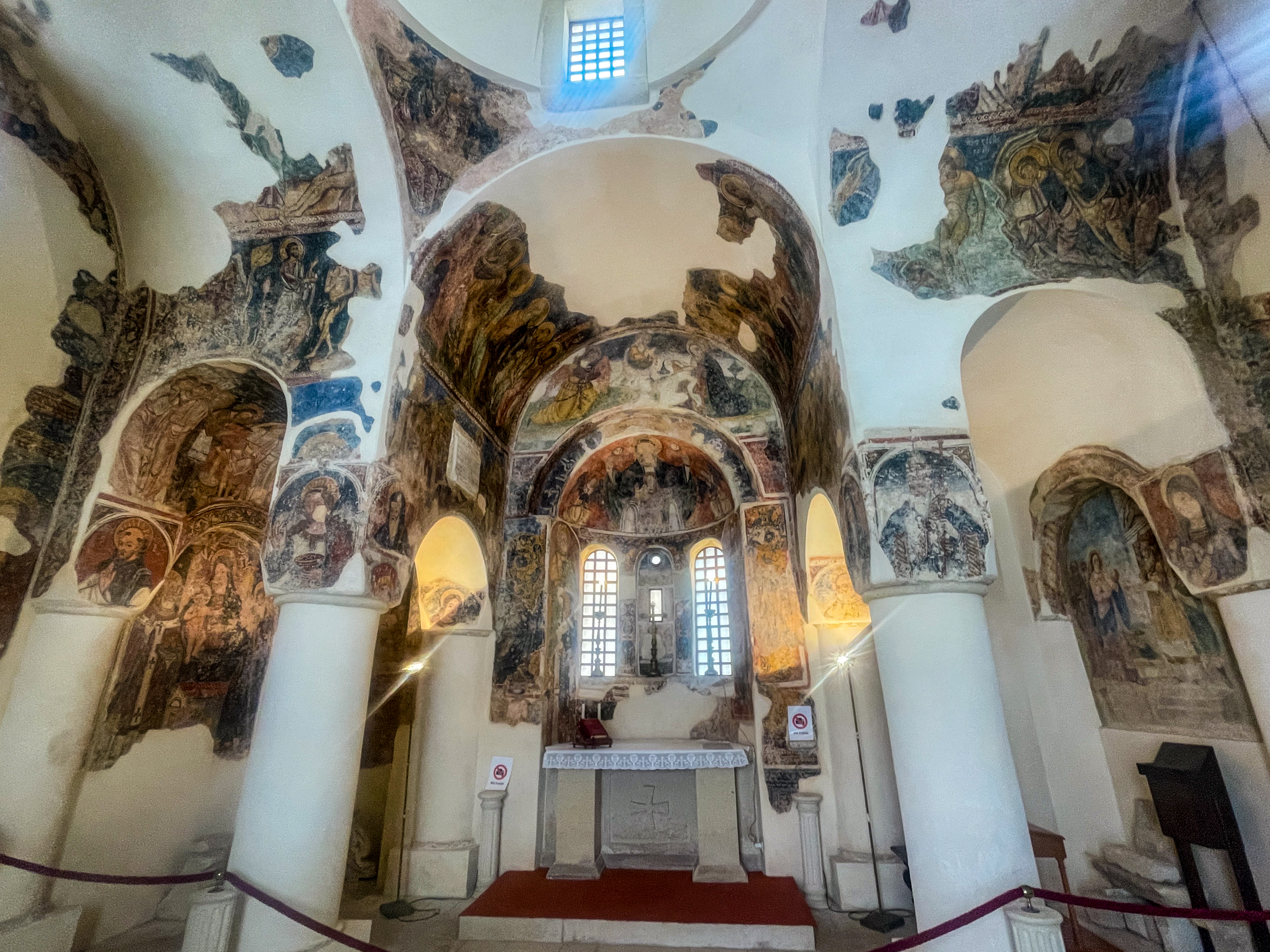
The small round glass piece above the cross is designed to let through the dawn morning light to illuminate the chapel.

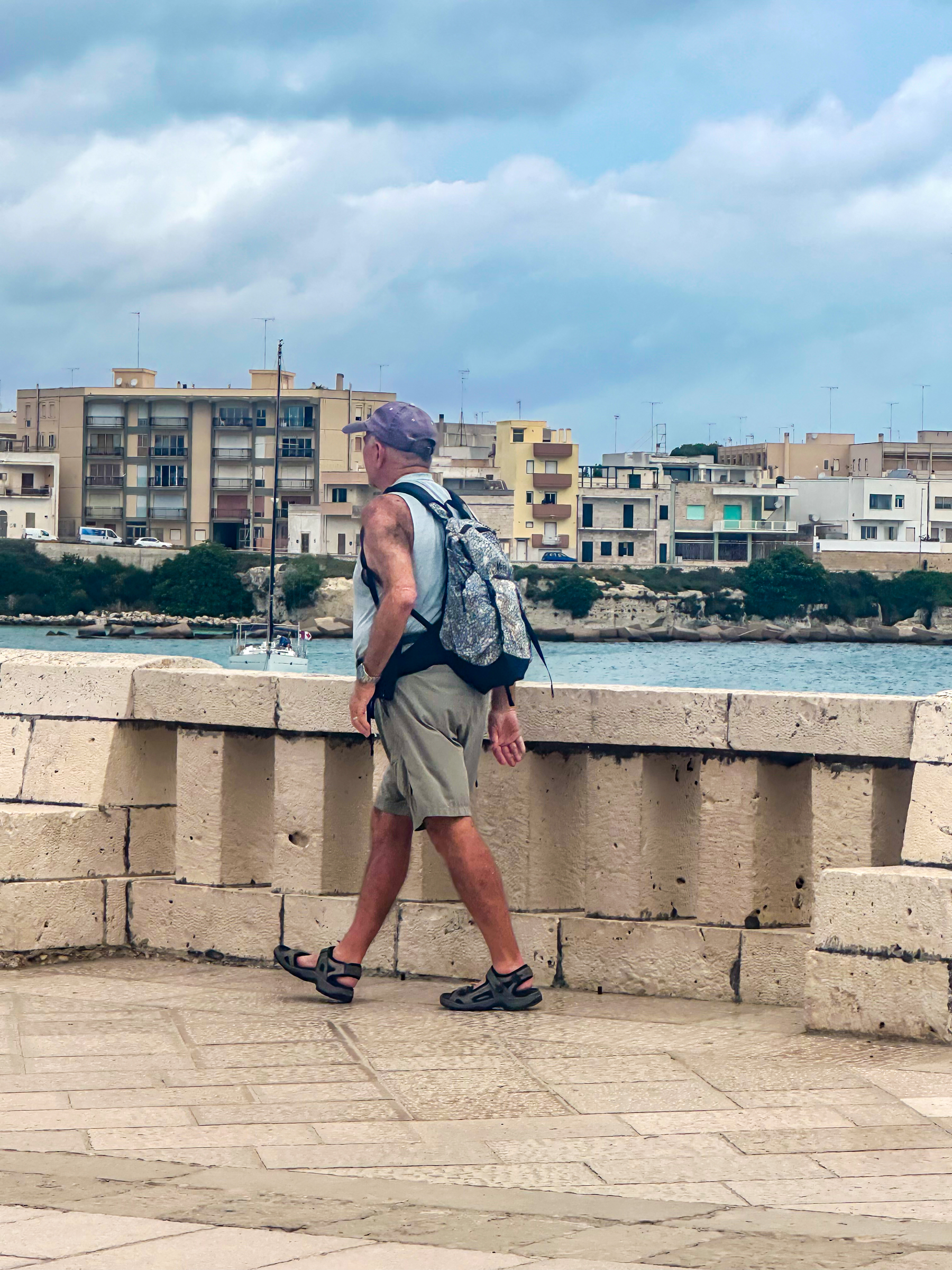
I decided I couldn’t be alongside the Adriatic Sea without getting in the water, so I took my Kindle, a towel from the Court of Neptune and ventured forth to a beach of white sugar sized and colored sand, a rarity along the rocky Puglian coast. Cathy and Torrey had ventured forth ahead of me looking for gifts and some household goodies, and saw me over yonder purposefully striding to my date with the sea. Old guy still AGAG (All’s Good Above Ground). It was a Saturday, and relatively warm, so the stone boardwalk was like the Mission Beach seawall for people watching. I guessed the water temperature as somewhere between the upper fifties and sixty. Trunking it, it was a short immersion for me, and I noticed few other takers. I found a nice bench to watch the world go by and dabble with Amor Towles’ “Lincoln Highway.”
When my shorts were mostly air-dried, I suited back up and sent a text message to the ladies so that I could join them, which as it turns out corresponded to a mid afternoon lunch at L’Ortale, a literal hole-in-the-wall gem that Torrey had researched online. You have to know it’s there, and be willing to enter in spite of the closet-sized entryway. Like a speakeasy, what you get is not what you can see from the entryway, but an outback courtyard that ambles up to a couple of dining and imbibing levels. They take your order and you pay at the entry way, then proceed outback with the proffered vibrating and buzzing “your order is up” device. The offerings are all the usual beverages including coffees, waters, sodas, artiginale (artisan) brewskis, Salento wines, and…get ready for this…a large selection of locally crafted gins…and an equally expansive selection of locally produced tonic waters. The barista engages with you as to your tastes, then provides multiple shot glasses with tasting-sized samples from which to choose, then repeats the process for your selection of tonics. My reference to gin-clear water that doesn’t necessarily mean colorless?
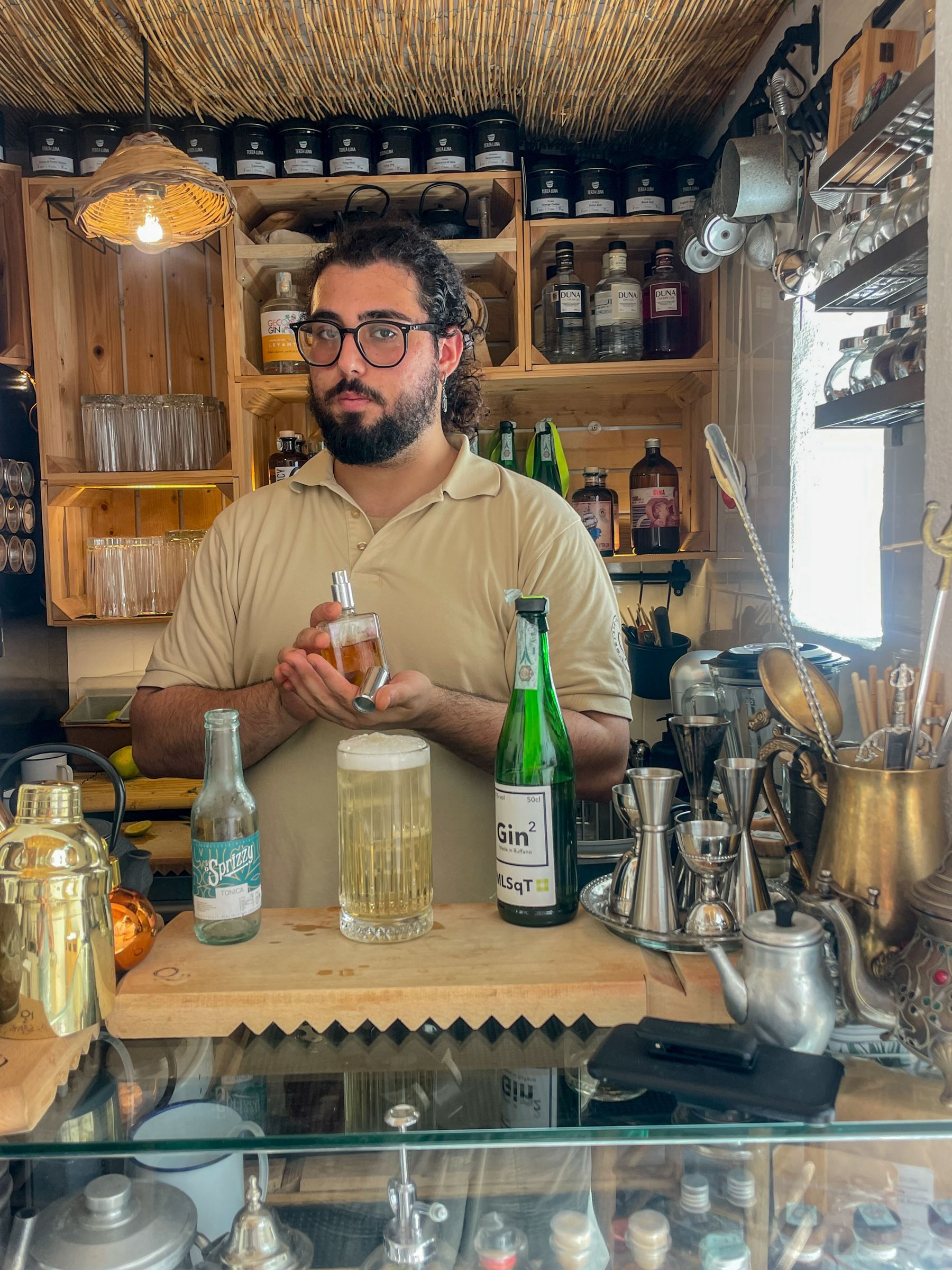
That’s the color of Gin-squared, not the color of the clear Sprizzy tonic water. I just now see my I-Phone holster on the bar top. We chatted (in English) while he prepared my beverage, me resting on a white-cushioned stool near the wall behind me. Sitting there, I felt a gentle pushing against my backside. Turning around I found el gatto stretching languidly.

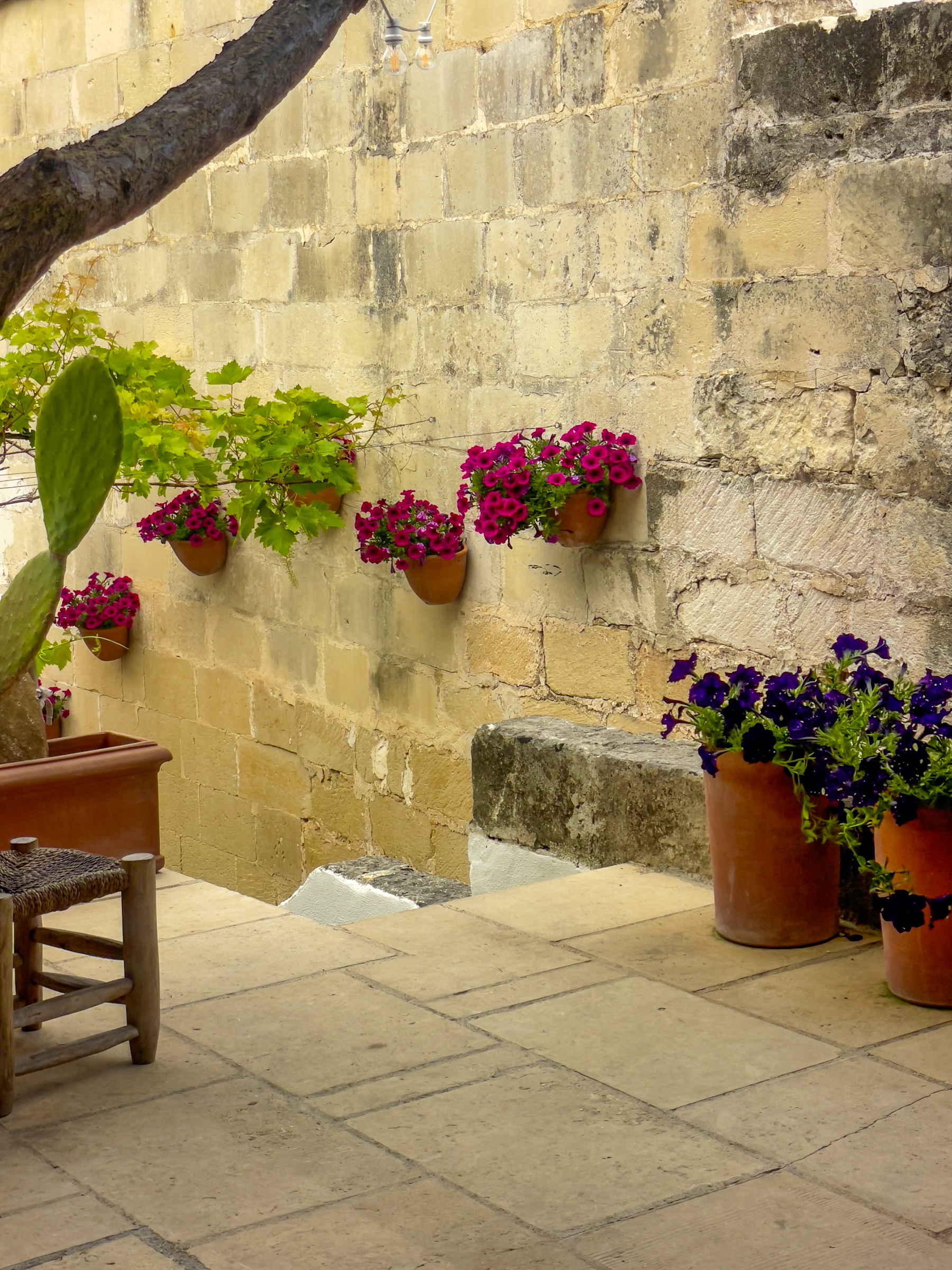
The seating area outback has both an overhead lattice and trees and vines for outdoor shade. Very peaceful and unpretentious. Oh, I must mention that the audio system plays a continuous mix of 40’s Big Band favorites. Lemmesee—a swim in the Adriatic, watching the boardwalk walk-bys, reading a fine novel, joining my ladies for lunch with a curated G & T in a walled old city dating from Roman times with this as my stool-side view while serenaded by Glenn Miller? Priceless.
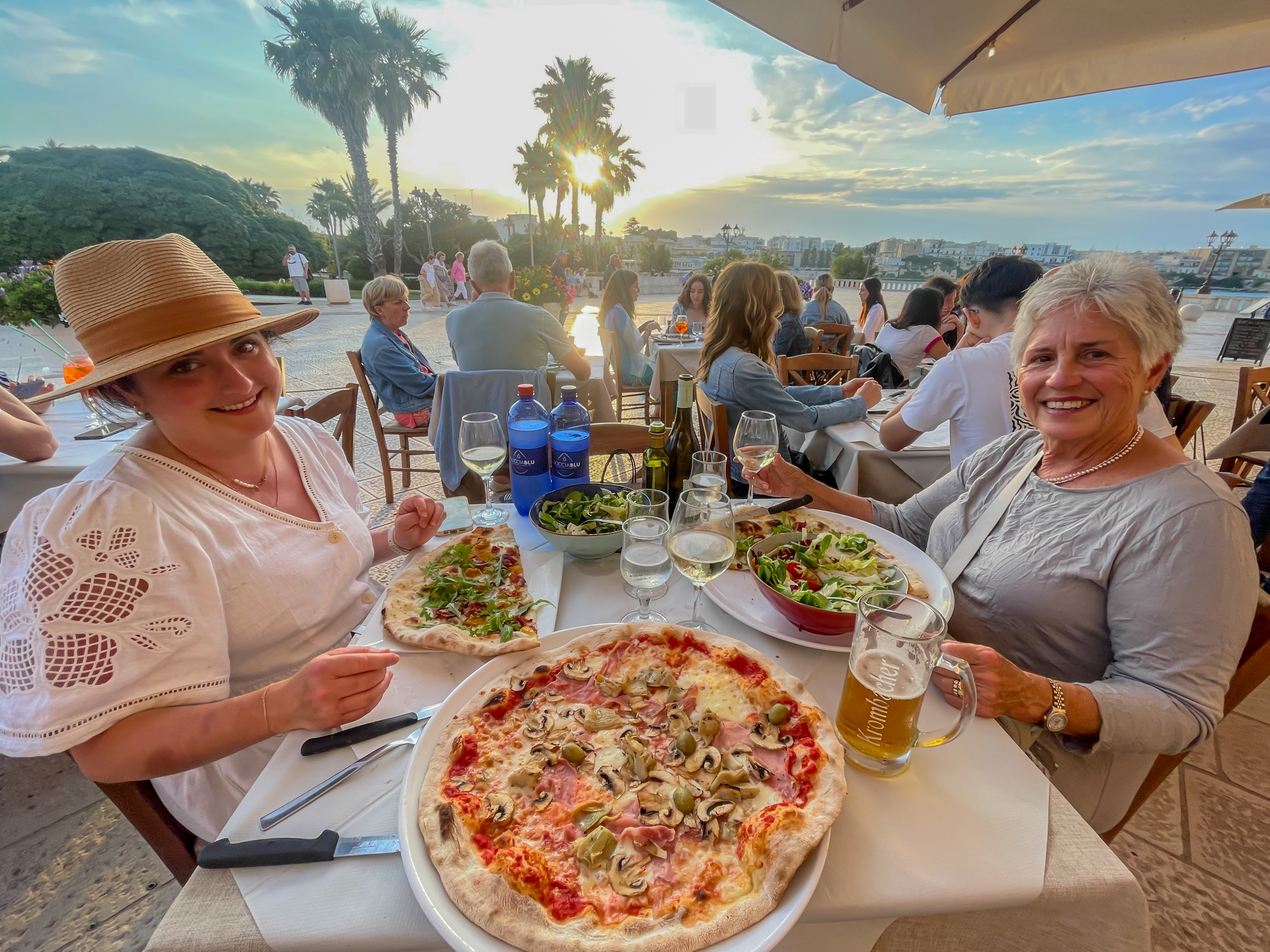
That Moveable Feast thing? In our last evening in Otranto we ended up in an outdoor café near the walled old city arched entryway. We ordered two pizzas and a salad. That morphed into two salads. This could easily have been accomplished with one pizza and one salad…for the three of us. Small portions? No way.
Last look at the Moveable Feast. Breakfast at Corte di Nettuno. How do you get your honey? It just drains with that angled comb holder. And yes, I chewed some hive in the bargain. Yum.

I wish to end by singing my praises of my traveling partners. Both adventurers, particularly as compared to my age-advancing stick-in-the-mudness. If there’s a culture, they want to explore it, all the more so if it involves fine dining. Fancy, refined lodgings certainly, but miles of twisting dirt pathways? Bring it on. I am a most fortunate man, my whole life through, and all the more on moveable feasts like this one.
Ciao, Tommaso


Recent Comments