th2ombre
It's ALWAYS about the light
Norway, north to south
Posted on October 1, 2025
Never having visited anyplace in Scandinavia was reason enough to explore Norway, a land of stunning topography drawn from a history of plate tectonics and ice-age glaciers, as ocean-centric now as in the time of its Vikings. The straight line coast of Norway is over 1600 miles long, but taking in the undulations of fjords and the circumference of its over 300,000 islands, its actual coastline is 17,991 miles in length. This is a hint at what to expect, and how necessary sea vessels are for getting about. Ours was a curated, self-guided passage built on a suggested itinerary by Inntravel, an outfitter in the UK we have used over the years for less-beaten-path adventures. Getting there and back is not easy from SoCal—San Diego-Montreal-Copenhagen-Bodø, Norway-Svolvaer, Norway…above the Arctic Circle at 68 degrees north and 14 degrees East. The return was Oslo-Copenhagen-Munich-San Diego. Upper Norway is a land of summertime midnight sun and winter perpetual darkness. In September the days were of similar duration to Del Mar, but the celestial bodies favored shallower arcs drifting more purposefully above the southern horizon.
Our outfitter put to rest any worries about conversing in a country whose native tongue has its quirks, including three versions of the “O” vowel of English. And the only one that is pronounced like our “O” is the one spelled as “Å” with a tiny “o” above it, the last letter in their alphabet, btw. English is so widespread and its syntax and pronunciation on a par with right here in Del Mar, that all conversations began with it naturally. We found the citizenry outgoing, friendly and hearty. This is a place of robust elements and the population to go with them.

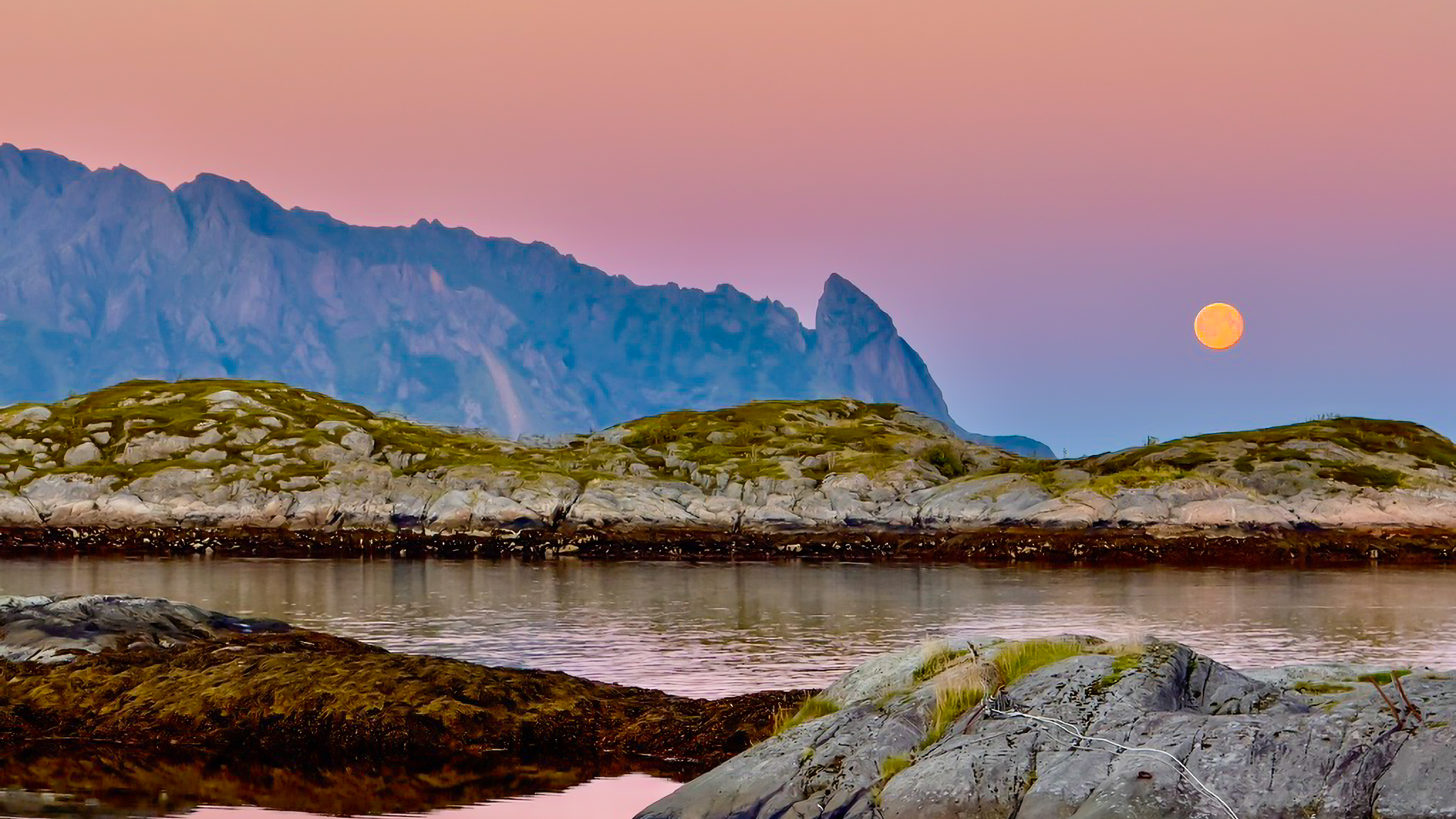
Our Svolvaer lodging, a two bedroom apartment, was on a small peninsula jutting out from the town, proper—the largest “city” in the archipelago of the Lofoten Islands, population 4700. The view, looking south from the balcony of our rooms at 3 AM. The moon never got overhead, staying low to the southern horizon. I was up at this hour in hopes of getting a Time-Lapse and stills of the Aurora Borealis, its green wispy color reflecting in the seawater near at hand, in the above time-exposure.
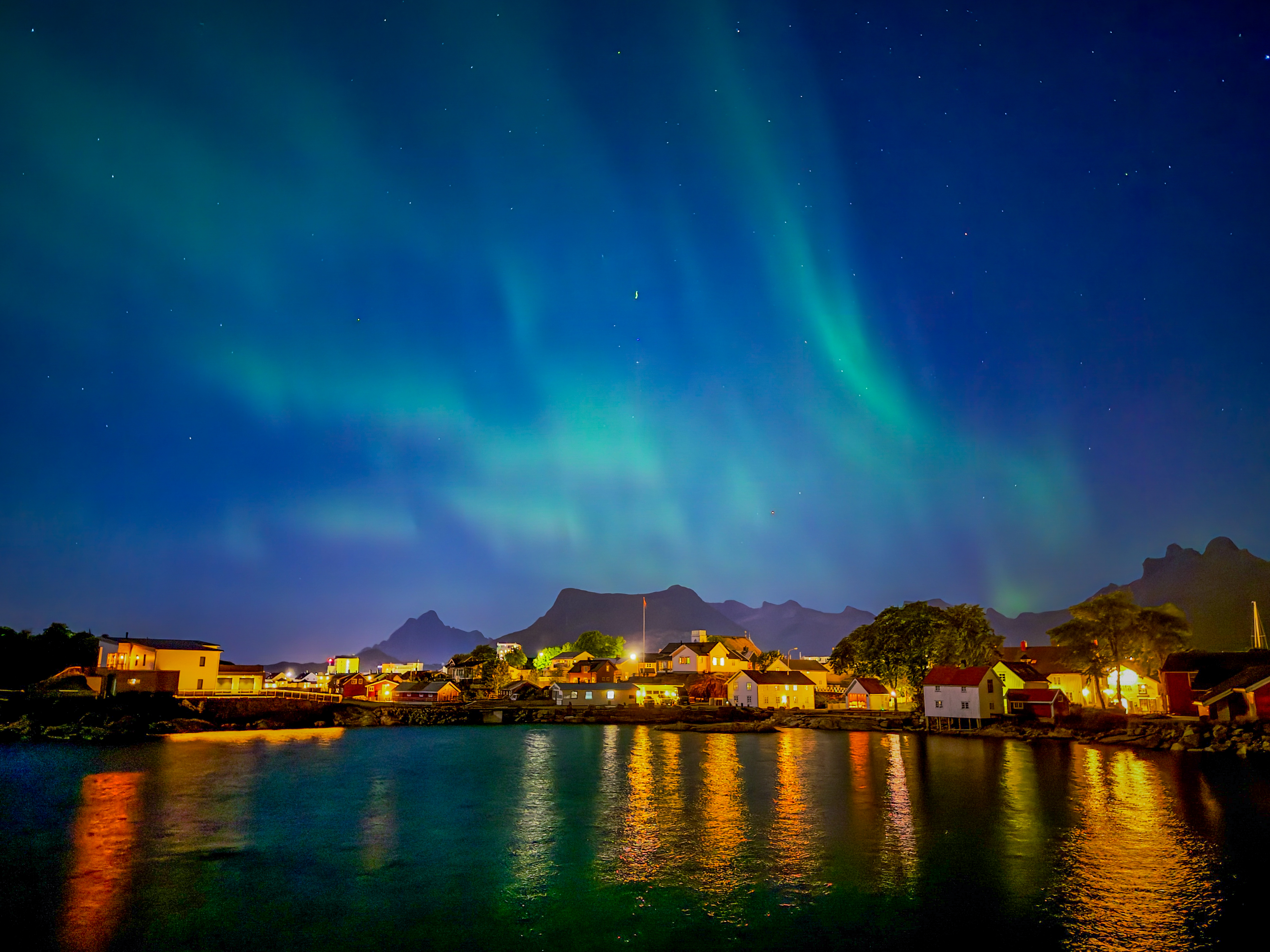
Turning 90 degrees to the right, the Northern Lights, in full swagger, an ever-wafting dance of the veils above the community’s reflections.
The Lofoten archipelago is comprised of six main islands and countless smaller bumps above sea level. Pretty much everywhere one gets used to jaw-dropping scenery.
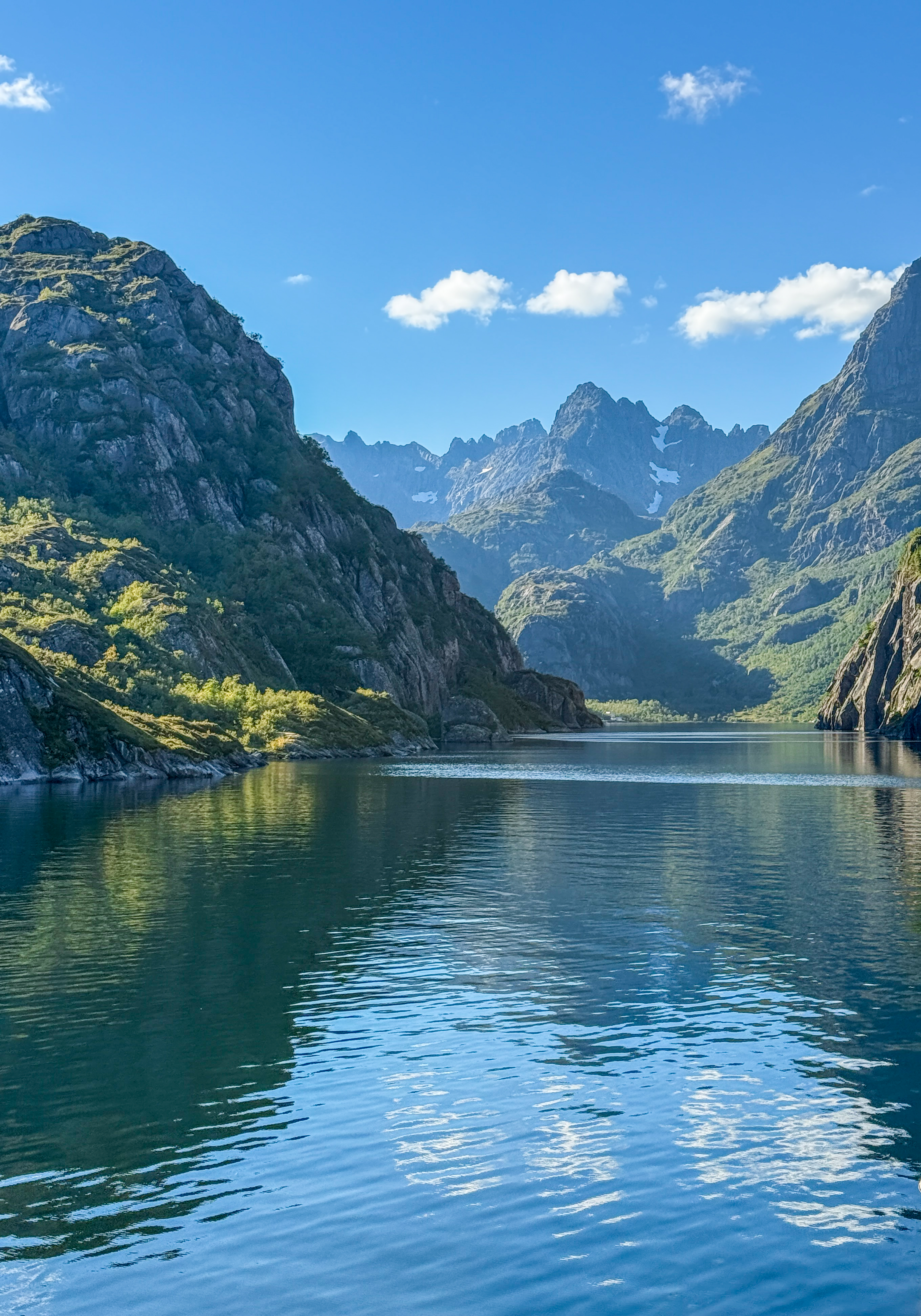
Norway’s west coast is strewn with fjords, like Trollfjord, above. And yes, trolls are part and parcel with Nordic mythology. That Viking thing in another guise.

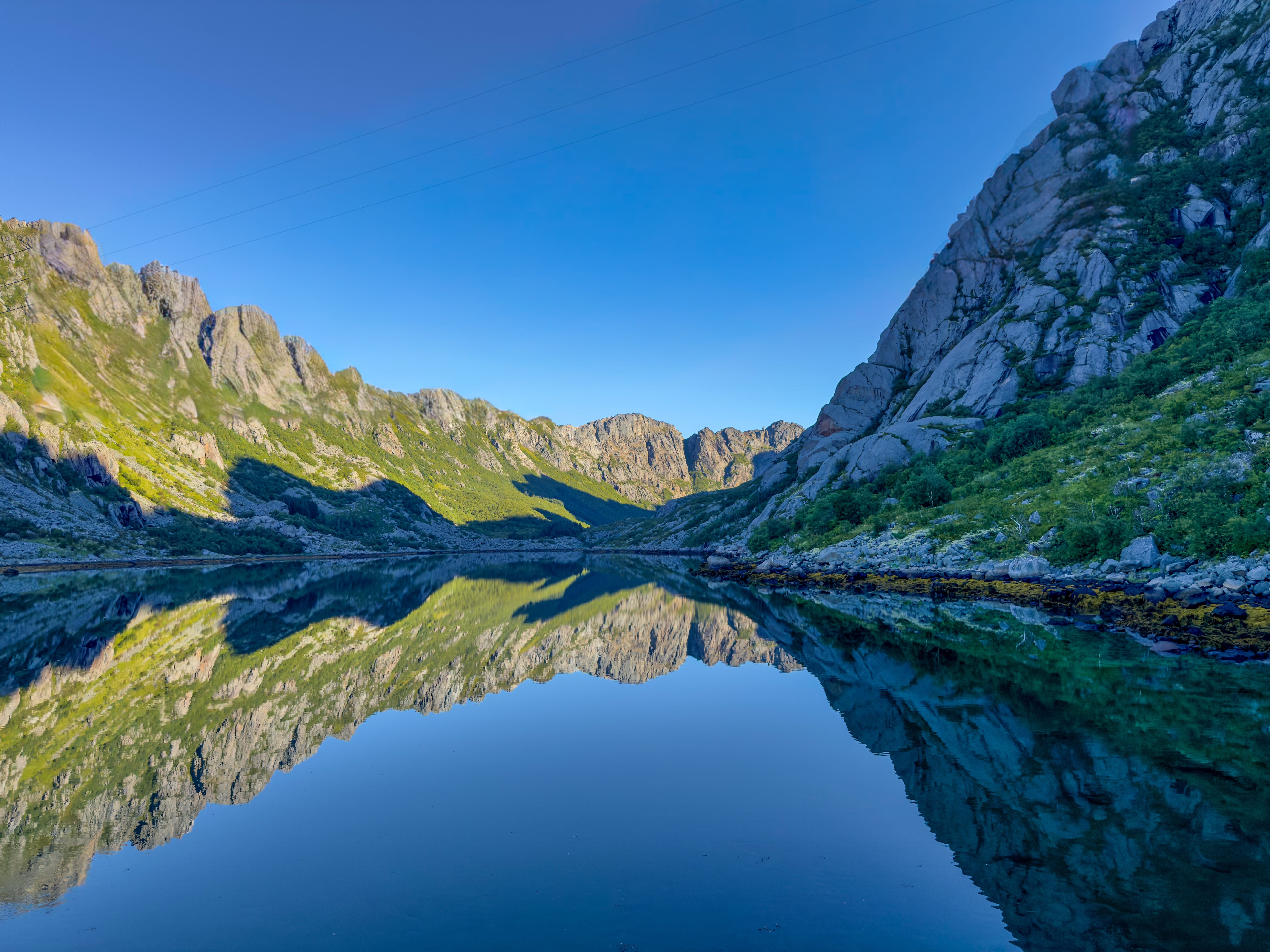
There are other quaint habitations, like Henningsvaer, above, or this inlet a few kilometers away, below. The reflections were so surreal that walking up to get this picture it was actually disorienting—what was rock, and what was reflection? A natural house of mirrors. It’s worth remembering that all of this is seawater, and because the Gulf Stream points right at Noway’s coast, the water temperature felt about like here . I just looked, and as I write, it is 55F in Svolvaer, a bit above our Del Mar winter low.
Above, our last sundown in Svolvaer, before boarding the Havila Polaris, a 179-cabin steam ship running on LNG and electric power, departing at 8:30 PM for a three night/four day passage to Bergen. Not knowing any better, I thought of this as a tramp steamer, given that it made fifteen stops along the way in small coastal and fjord-ensconced villages, the exceptions to “small” being Trondheim and Bergen—Norway’s third and second most populous cities after Oslo. And while I stand by that term, it doesn’t do justice to the refined nature of the Havila Polaris. Neither Cathy or I have ever done any sort of cruise, so I have little to compare with, but this voyage was a mellow passage, always close at hand to jutting headlands, islands and fjords. The views were stunning. The food and drink, and turns around the deck all fine accompaniments.

There are multiple observations to be made here. Norway is a seafaring nation, and has been since the Vikings. That red-hulled ship is a purpose-built vessel serving the oil capture business offshore in the North Sea. Well offshore (pun intended), never seen from our route heading to Bergen. Norway is a highly electrified country, and it gets its electrical energy hydraulically. See pictures of waterfalls, below. The petrochemical take from the sea bottom is sold on the world market to fund the “Government Pension Fund of Norway,” the largest sovereign wealth fund in the world. It is actually two funds, one named as above, and the other, called the “Government Pension Fund Global” where the “global” is a clue to its world-wide investment strategy. Norway, with a population of only 5.6 million, earns money from the oil, and invests that to generate the funds used to run the government and help provide the socially enhanced lifestyle common in Scandinavia. The Krone to dollar math is quite simple for travelers—move the decimal point one space to the left to turn Krone into dollars, e.g. 1,000 NOK more or less equals $100. But sticker shock lurks at the cost of living in Norway for both its citizens and its tourists. A second worthy point to share is the fantastic cloud panoply to which we were treated daily. Unlike our May Gray/June Gloom marine layer blanket, I found the skies routinely showing off four or five layers of clouds, each sufficiently un-overcast to reveal them all. It’s a sky show guaranteed to capture a pilot’s or photographer’s eye.
Below, the wharf area in Kristiansund where we made a one-hour port call. Notice the red forklift which has come out of the red building (a common color theme throughout Norway) and is heading up the ramp to retrieve cargo or to send cargo for on-shipment. Ditto passengers via a separate ramp. The dark-hulled and white superstructure vessel is an auto ferry. They are all over the place along the coast because the fjord-gouged terrain does not lend itself to N-S roads. Anyway, this is supporting evidence to that tramp steamer title to which I default.

Under the heading of “Pilots and Skyscapes” this is one which training teaches aviators to avoid. That is a definitively robust downburst going off just beyond the headland. We rounded the point and took up a courses to the left of the rain shaft. This was a day when there was a shore excursion offered, but which was already full two days ahead of time when we heard of it on boarding the ship in Svolvaer. The excursion was a bike ride to someplace south of Kristiansund, and then transfer to a speedboat to race at high speed to the Havila Polaris as it trundled south at a less clamorous pace. From this, I’ve learned that seasoned cruise passengers select cruise excursions online once one’s bookings are completed, and in this specific case, I take pleasure in not being one of the fool-hearty cruise excursion cognoscenti. Their attire probably needed laundering by the Polaris’ crew that very evening.

Someplace along the west coast of Norway, I haven’t a clue where. Nice sky?

Torghatten mountain, pretty much comprising the entire island of Torget at which we gawked outbound from Brønnøysund. From the backside, it’s just your run of the mill massive rock peak, but from this side, that shadow on the vertical face is a gigantic cleavage in the peak, and at dead center, you can see through to the other side via the natural tunnel that is 35 meters high and 160 meters long. It is a common hiking site in the area, presumably accessed by boat. Given our rocky proximity, perhaps this is a clue as to the importance of careful oceanic navigation, and how abruptly the seashore drops into the depths?

Later that same evening we were treated to yet another near-full moon moonrise, three o’clock in the frame. There’s another of those North Sea platform-service ships. In Bergen I spoke with a crew member of such a ship and learned that they are actually capable of pulling up a drilling platform after closing down the underwater well base, and carting it all to another drilling location to start a new well. Ingenuity.

We arrived early in the morning in Trondheim, founded as the capital of Norway in the Viking times of 997 by the first of two King Olafs, both of whom were instrumental in advancing Christianity in the country.

Trondheim was originally called Nidaros, still the name of its beautiful Cathedral, with its vaulted ceilings and three organs, the largest of which has 30 stops for its 1809 pipes. Herewith, a segue to a further sharing of my ill-fit for cruising. When we arrived at those port destinations during civil daytime hours there was sometimes the opportunity to join an organized exploration program, but also we were free to follow our noses to whatever looked promising . The latter generally comports more closely with Cathy’s and my inclinations, but nonetheless runs up against my “there goes the neighborhood” concern. Passengers raced to be first off the ship. I’m ill disposed to join that stampede, but even hanging back and walking slowly, there was no escaping the feeling that we were sullying the ports. Sigh.

Our steamer transport concluded at Bergen, a World Heritage site, and taking over as Norway’s capital in 1299. Its inner harbor demonstrates multiple lighting moods, all of them luscious. A little gastronomy and history. No surprise that fish are an important part of Norway’s diet. A local delicacy is referred to as stockfish—actually cod, fished in Lofoten waters and then dried, hanging on large outdoors open-framed hjell racks during the winter months. In pre-refrigeration days this avoided salting as a means of preservation. An important source of protein, especially in regions where Catholicism meant Friday and festival fasting on terra firma meats. The dried stockfish was vessel-shipped to Bergen, a vital port for commerce throughout Western Europe and the British Isles. Its inner harbor, seen in the next frames, is actually called Bryggen, a bustling area in the Middle Ages with its various trades being plied by the German-derived Hanseatic League. Bryggen’s etymology is from the Norwegian word for “wharf,” and those colorful structures are built to the edge of the water, and beyond, as successful commerce spawned expansion.


Yes, I’m fond of lunar overwatch scenes, as with William Blake’s “the moon, like a flower in heaven’s high bower, with silent delight, sits and smiles on the night.”

We had two nights and three days to putter about Bergen before slipping aboard a high speed catamaran to take us some four hours up the Sognefjord, Norway’s longest, second longest on earth, at 205 km in length and over 4200 feet in depth.

Destination Balestrand. The view from our room at Kvikne’s Hotel, a lodging from the 19th century and thus reminding me of the Hotel del Coronado.

The Del Mar geezer taking in the scene with King Bele of the early fourteenth century. Picture by Cathy. I’m sitting on the bench back (not the UK Parliament’s back bench) because the seat bottom is rain-wet. Staying fanny dry while taking in his view.

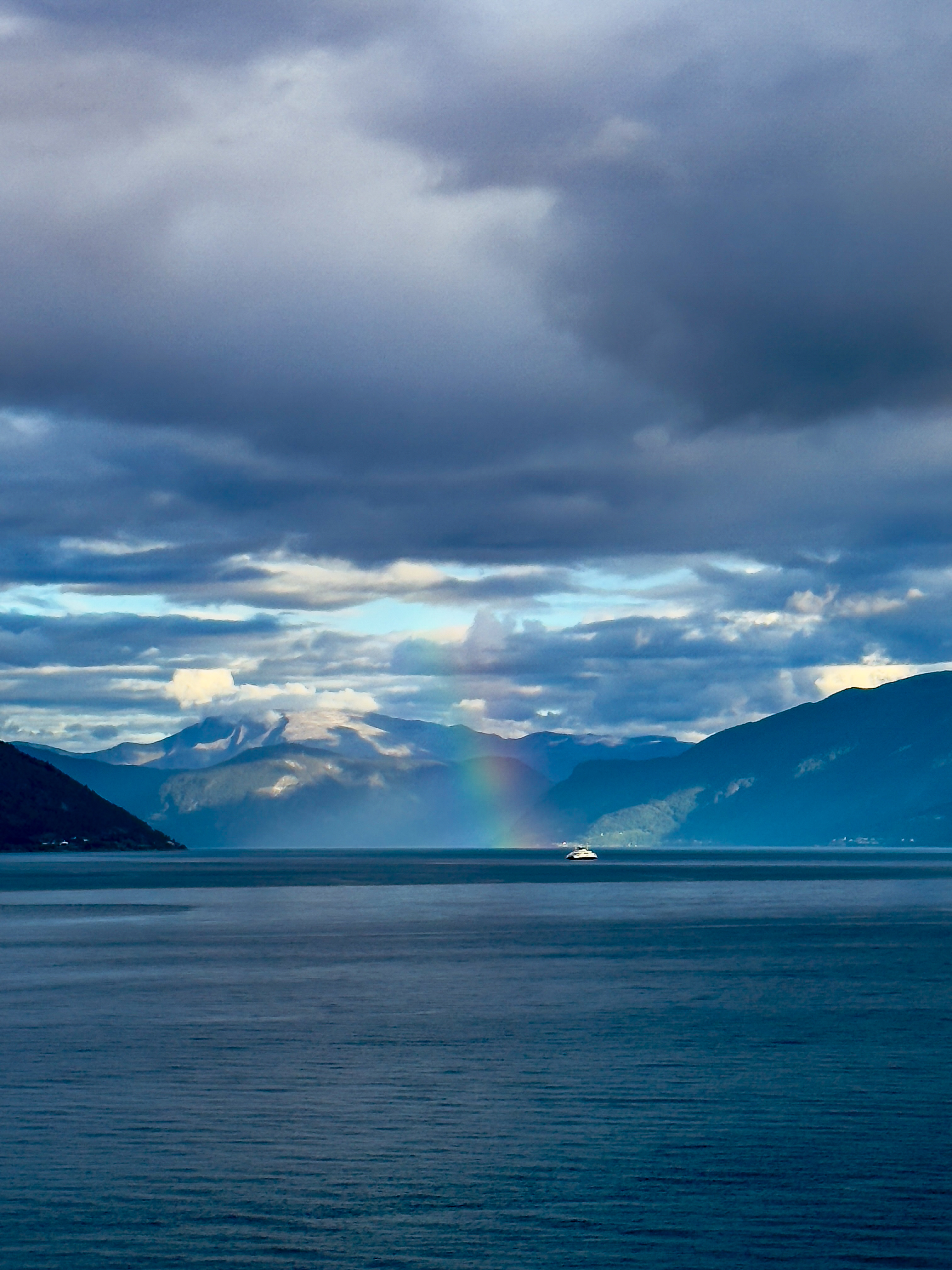
Nice scene, your highness. Sognefjord, a local auto ferry finding a pot of gold.
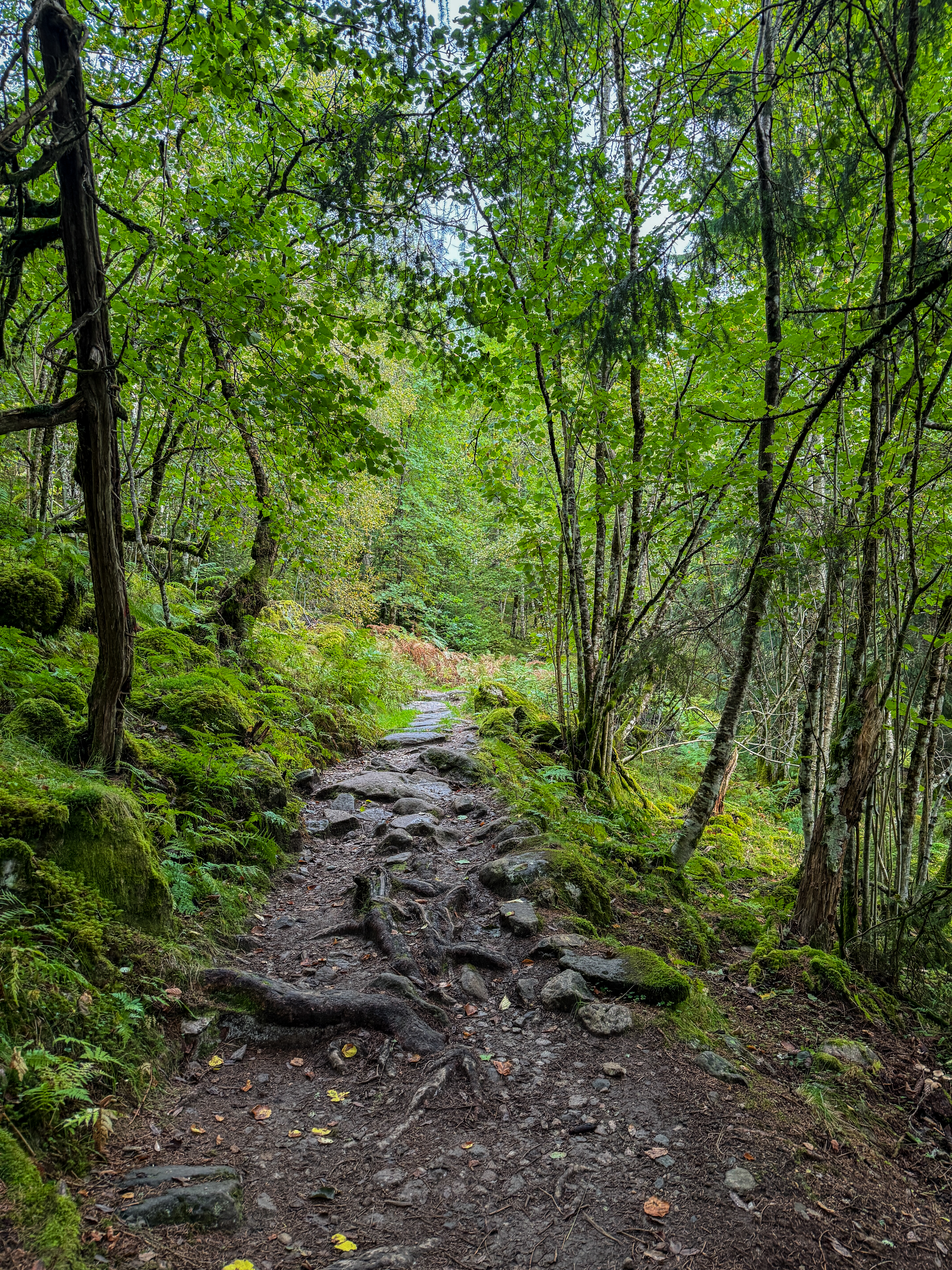
Balestrand is gorgeous, but small. What to do? Hike that ridge to the right in the destination picture above. I’m getting long in the tooth, but I did successfully climb the 1500 feet in some 4 km of up trail, leading, gasping and sweating, with only modest sotto voce grousing….
…to this exemplary view of the upper reaches of the fjord. Waay down there at about 7 o’clock in the frame, the tiny rectangular bump at the shore is our lodging—Kvikne’s Hotel. Looks eensy-weensy from up here.

The same vantage point, except from fjord water level the next day. Looking directly up the Aurlandsfjord, an extension of Sognefjord, leading to Flåm, our next destination.

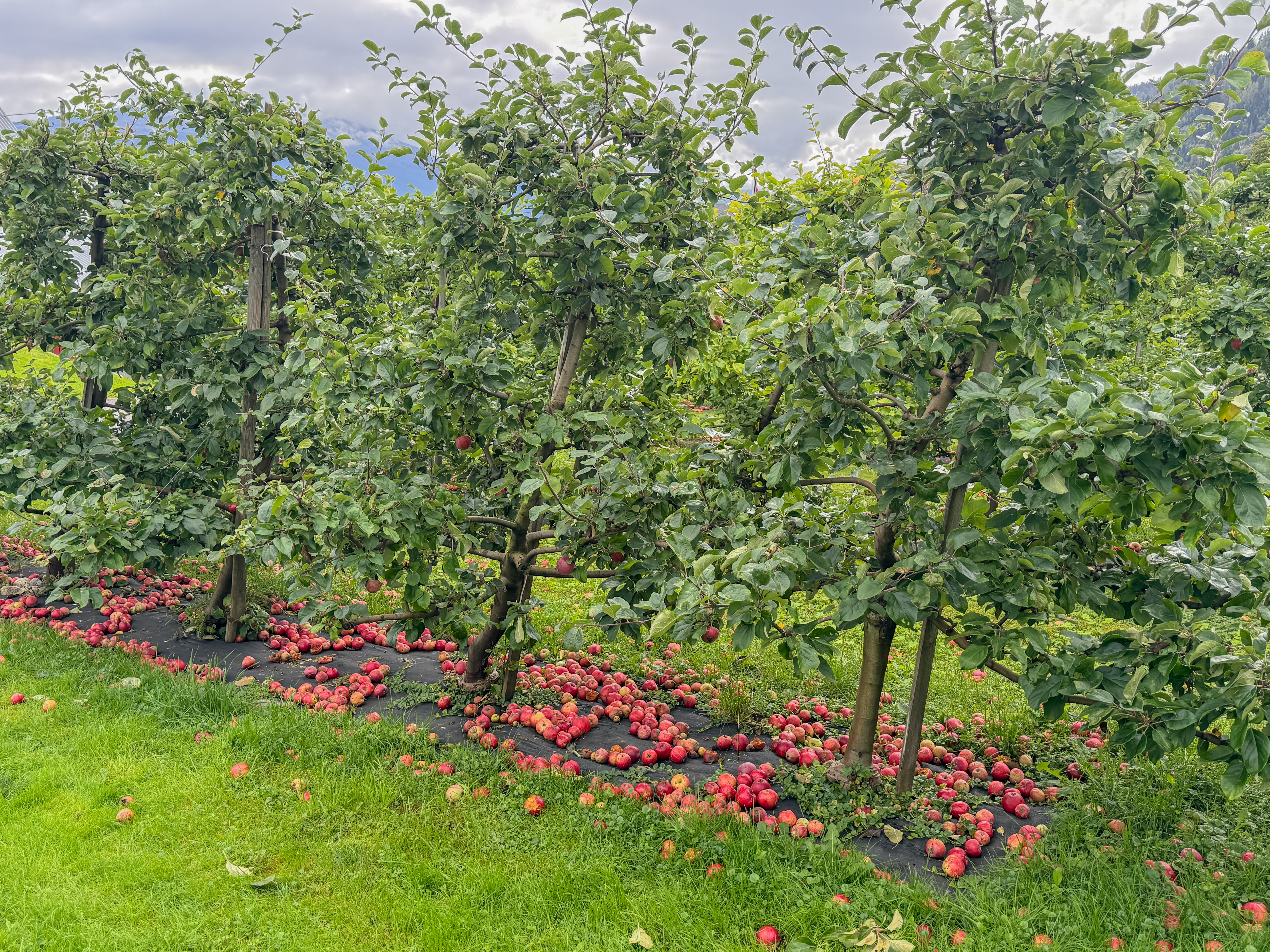
When in Rome, do as the Balestranders do. This is apple growing country, and the delicious fruit was literally falling off the trees, and then in-town processed into cider.
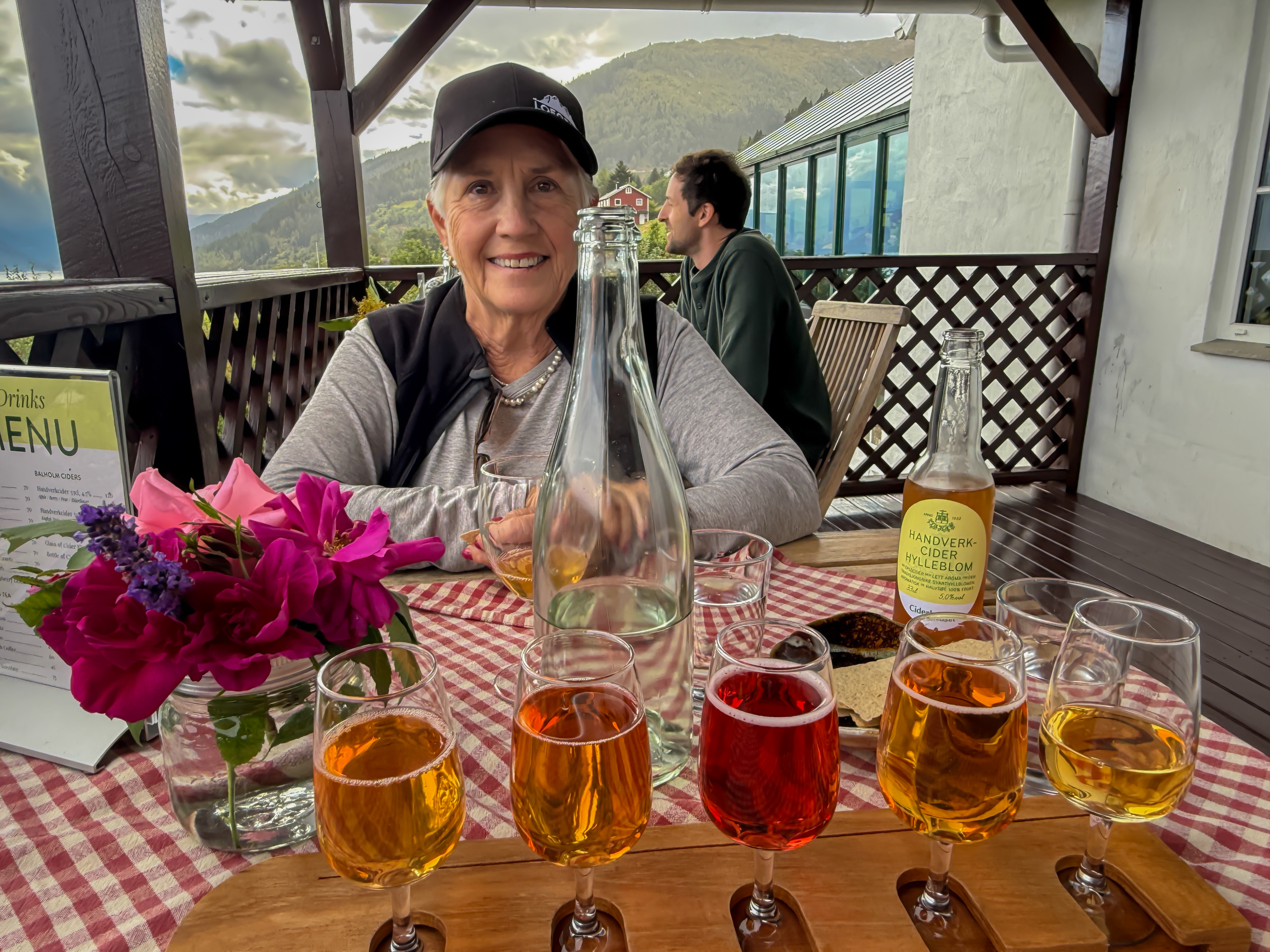
Following our 1500 foot climb, the trail back emptied into a quiet street on which was Ciderhuset, Cider House in English. Cathy chose a tall cider, and I opted for a cider flight to go with our lunch. Mildly alcoholic according to the chemical analysis, but without perceived effect on the body. Well, okay—after lunch and the final one mile stagger back to Kivikne’s, we availed ourselves of an afternoon siesta. But only because of the hike, surely not enhanced by the cider?
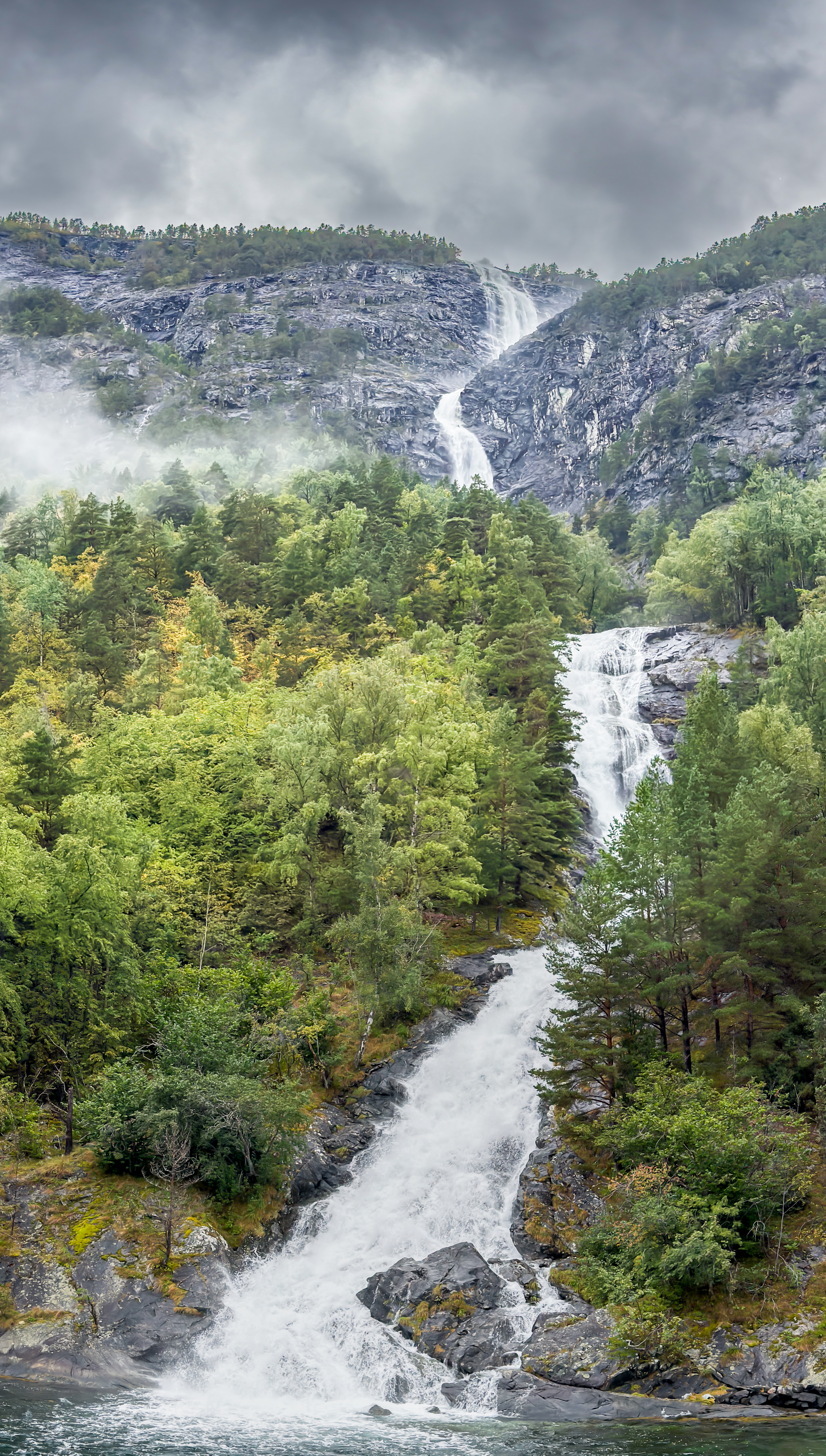
Decamping from Balestrand we took one of the high speed catamarans up the Aurlandsfjord to Flåm, the ship slowing for all of us to marvel at Brekkefossen waterfall. A fine example of how Norway has the means to meet its electrical generation needs with moving water.
Flåm is another outdoors activity haven. We chose to take the Flåmsbana railway the 20 km up valley to Myrdal for an out-in-the-elements return to Flåm. The electrical train stops a short distance from Myrdal to let us passengers stare wide-eyed for :10 at the power of Kjosfossen waterfall with its 305 foot free fall, its deafening roar matched only by the water-strewn air quickly soaking clothing and misting camera lenses. In a nod to tourism sensibilities during this stop the air suddenly comes alive with the tie-me-to-the-mast siren song of Huldra, a forest spirit from Norse mythology whose intention is to lure men into the woods and seduce them. Alongside the tracks, she is portrayed by a woman in red, very near the center of the frame at 3 o’clock in red. Quite the showstopper. I volunteered to join her in the spirit of the production, but Cathy nixed the idea…

The valley views from the train are hard to beat…

…but are nonetheless eclipsed by the views on foot and by bicycle. Near at hand, the steep switchbacks we hiked after disembarking. The train tracks rise 1 foot for every 18 feet, this descent is steeper yet, hence the switchbacks. We had to mince along being careful of our footing to keep from sliding downhill on our bums.

Another of our luck-outs was being there as the fall colors began showing off. Nice trail hike.
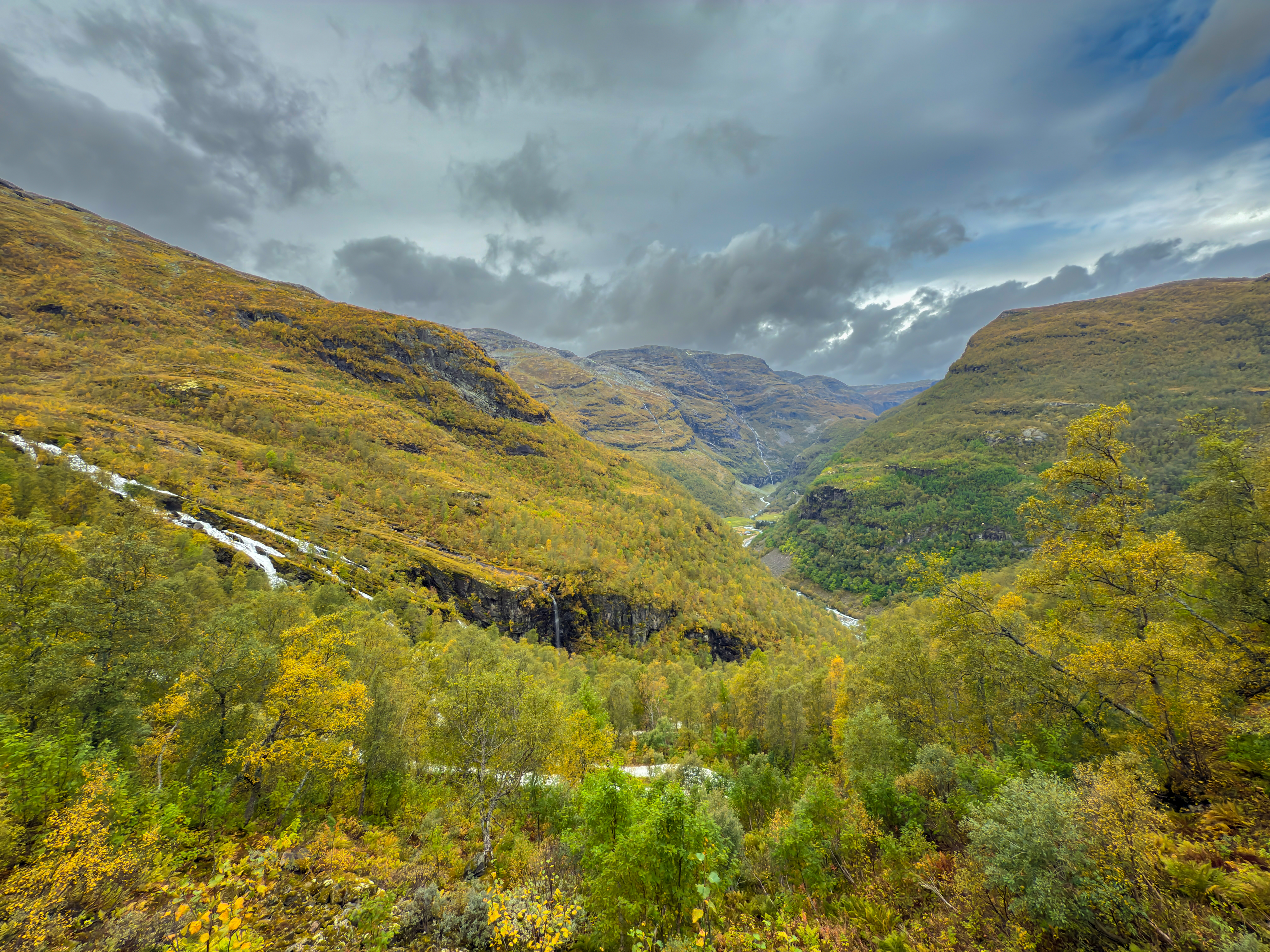
After nearly 5 km of downhill hiking we switched to our rental bikes awaiting us at a farmhouse for the 15 or so klicks back to Flåm. The views continued, unabated. Ye olde bike path.

Resting on our laurels to suck up some splendid mountain air. Waterfalls everywhere.

The next day we returned to Myrdal on the Flåmsbana, but now to connect with the Bergen to Oslo train, some five hours duration along an elevated plateau, with its own attention-grabbing views. Just a few km beyond this scene we passed Finse, with its Hardangerjøkulen glacier. Good thing the Norwegians speak English!
Following our afternoon arrival in Oslo Sentralstasjon we used our phone maps (let’s hear it for T-Mobile devices connecting seamlessly in over 200 countries world-wide) to walk to our Thon Hotel Rosenkrantz, then back out the door to explore. We mostly confined ourselves to the mid city and the area near the harbor, including the Nobel Peace Center,

…and the busy waterfront…

…including the Akershus Fortress, with its splendid Resistance Museum, detailing the many small and large resistance and sabotage efforts of the Norse patriots between 1940 and 1945 including their commando destruction of the German heavy water program seeking to develop a nuclear weapon—patriotism and courage worthy of salute.

Later that afternoon, we puzzled out a local train option to the airport, where we caught our flight to Copenhagen in readiness of the next morning’s early flight to Munich and on to Lindbergh Field. Yes, I know it is formally called San Diego International, but it is also where Charles Lindbergh’s Spirit of Saint Louis was made and is still an official name of the aerodrome. When you’ve got it, why not flaunt it?
Torrey, who had held the home front together in our absence, arrived curbside just as we came out of Customs and Immigration. Bogart promptly went bonkers at having us back home. It was reciprocal.
A Moveable feast
Posted on June 6, 2024

Apologies to Ernest Hemingway. The title refers not to struggling Parisian expatriate journalism, nor any unfixed holy date. No, I’m using the term literally. See, we Del Martians have just returned from two weeks of inn-to-inn hiking in Salento, the heel of Italy’s boot. Italy, where fine dining is a way of life. ‘Tis a several miles of walking each day, batteries needing recharge with gustatory abandon, a When in Italy, Do as Italians Do sort of thing.
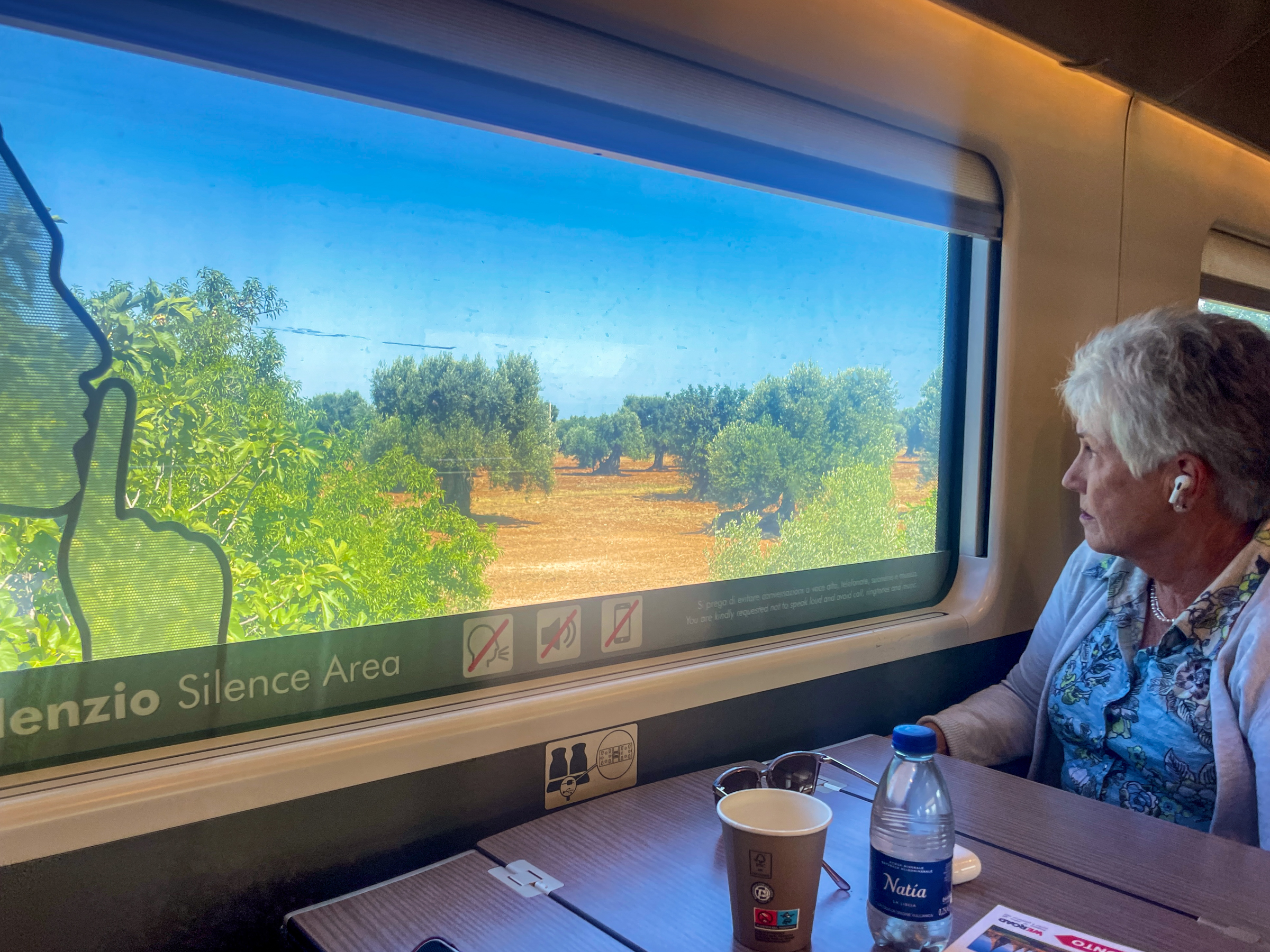
United to Rome Fiumicino/Leonardo da Vinci International Airport. If you’ve got it, why not flaunt it? Airport shuttle line to Rome Termini, and then distance train to Lecce, Puglia, along the way enjoying olive groves rushing silently by. That day’s destination pronounced “Leh Che, Pooliah.” Salento is the southern half of the Puglia region. In Italian, be sure to pronounce all those vowels, and they are more or less every other letter. This produces a lilting sing-song up and down bouncing ball pitch of the spoken voice, and a MLB change-up cadence in keeping with fine opera, no doubt why we love Puccini and Verdi?. Try it now. Say Leonardo… “Leh Oh Nar Dough” and don’t you just feel like Pavarotti in the shower? Puglia is agrarian, producing 70% of Italy’s fruit and vegetables, a third of its olives and olive oils, and a significant portion of its wine, including Negroamaro, a regional varietal, and quickly a favorite or ours. Considered the Florence of the south, Lecce has been inhabited since at least the Fourth Century BC. And I should mention that Lecce is the southeastern terminus of the original Apian Way. All roads lead to, or from Rome.
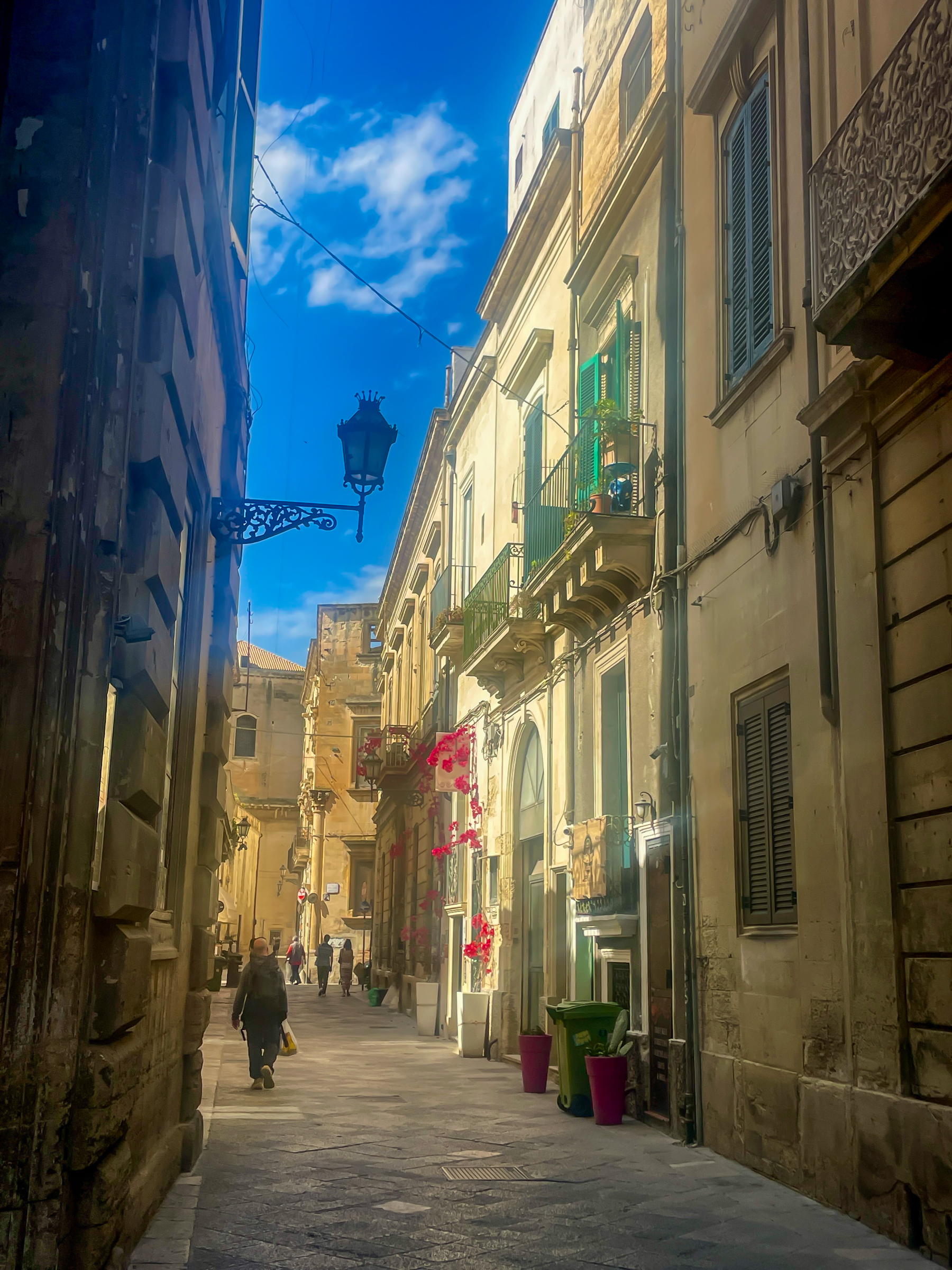
That train ride, a milk-run to Lecce was nearly six jet-lagged hours, of olive groves and tiny towns, then a walk of a quarter hour through the labyrinth of narrow stone-paved lanes to reach our first lodging, Palazzo Rollo, its arched opening on the right just shy of the bougainvillea. Torrey, Cathy and I shared a two-bedroom suite with living room and kitchen. Our outfitter—Inntravel, from the UK, listed this curated, unaccompanied trip as Pathways of Puglia, and this narrow lane fits the bill as a tasty appetizer of things to come. https://www.inntravel.co.uk/walking-holidays/italy/the-south/puglia. Throughout Salento, streets and walkways were without wafting trash and dog logs, absent of graffiti except near train stations, and restrooms in even the tiniest trailside hamlets were clean and equipped with all the niceties. Civilized.
Palazzo roughly translates as palace, apt in this case. The entrance, a calm haven in the midday sun. Lecce has many guided walking tours, and the Rollo was a routine stop, crowds held discretely back by that rope.

With lovely views from our room of the neighboring Campanile at Piazza Duomo both during the day…
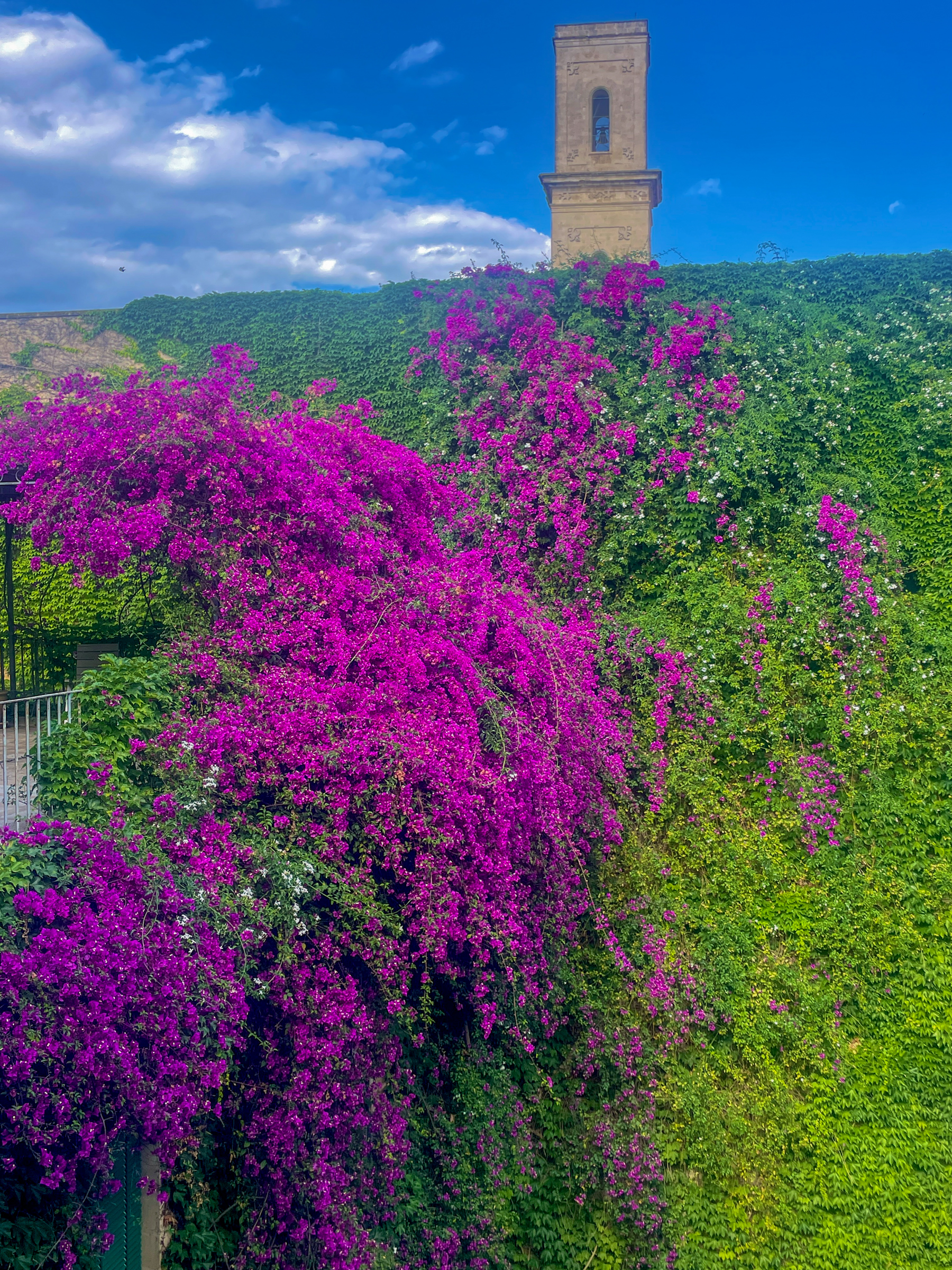
…and at night…full moon rising on the left, seen from the two- floors-up rooftop bar and lounge area.

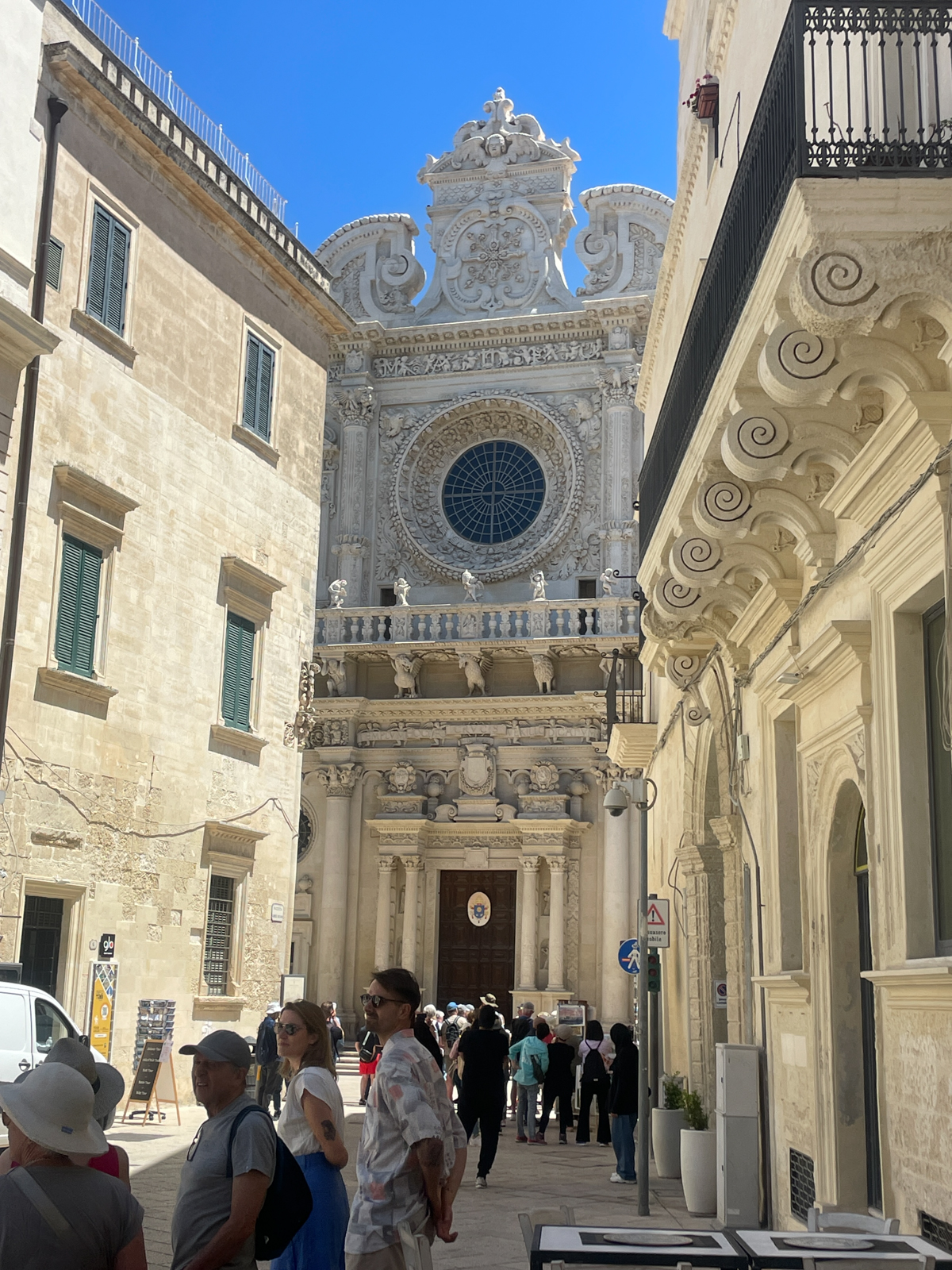


If you’re reading this, you know me well enough to acknowledge that my Del Mar roomies are foodies? Italy. Food? So, of course, one would expect the ladies have researched and reserved a cooking class. “The Awaiting Table” conducted by acclaimed chef, sommelier del vino, teacher and raconteur Dottor Silvestro Silvestori. We rendezvoused by the amphitheater for a day-long cooking and dining and wining extravaganza, regaled with stories and facts from a unique Puglian perspective. Then a saunter through the old quarter to the green grocer, and next the fish monger before repairing to his school. Everything for today’s class was growing or swimming just hours ago. That movable feast thing.
Today’s class was on making fresh Puglian regional orecchiette (sing it aloud, Luciano) pasta—semolina and barley shaped into little cups and strings—to which will be added for simmering, eggplant, muscles, fish, calamari, and spices. All of it accompanied by aciete de olive. Very virgin aciete de olive.
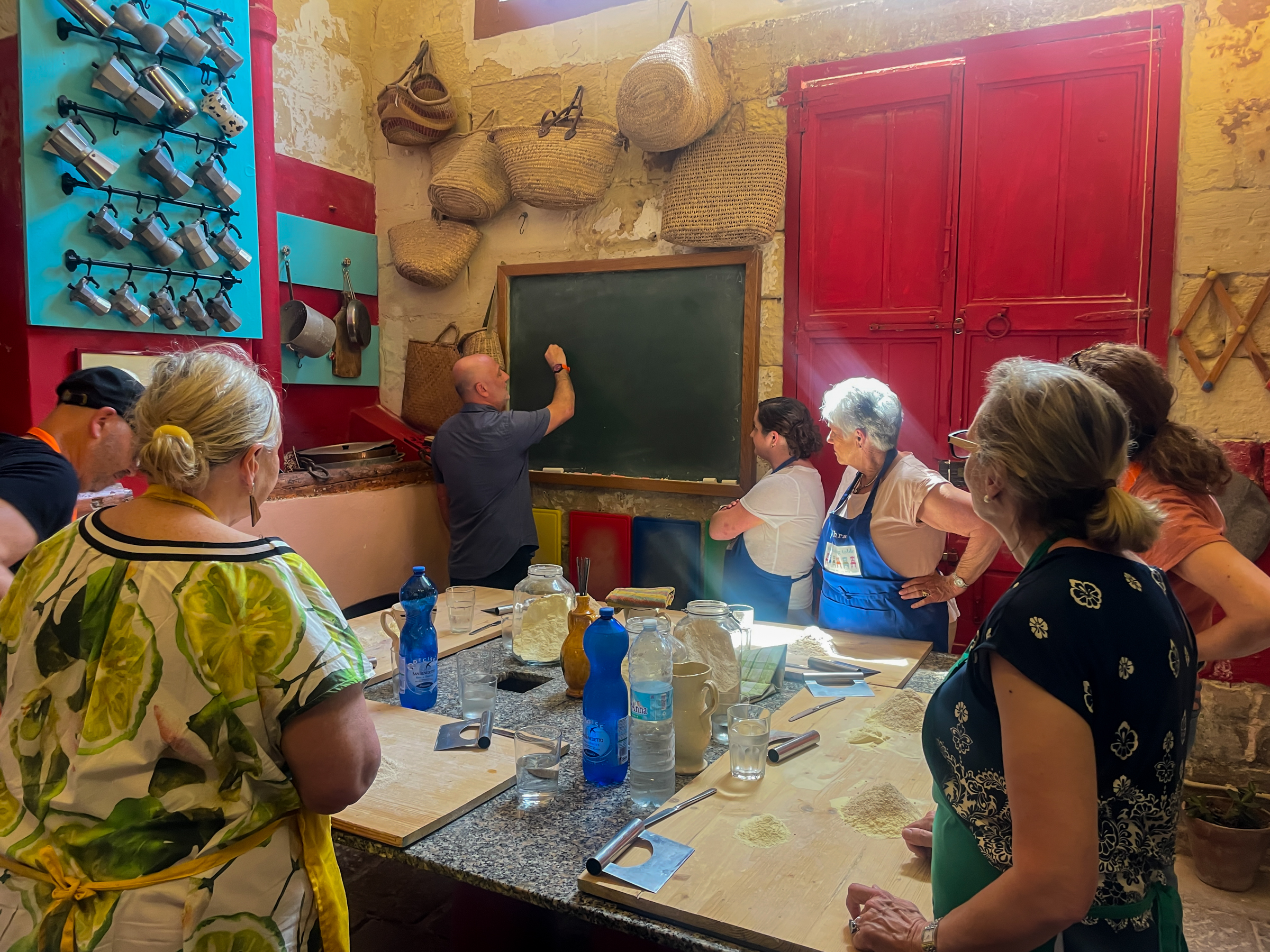
As the meal preparation ended, the serving dishes were taken from the kitchen to the proof of the pudding is in the tasting room for a sumptuous mid afternoon multi-course lunch accompanied with yet more olive oil, and of course fine wines, Rosé being a local favorite. Today’s seven students broke into subgroups to share with one and all each of the many preparatory steps. A little more vino, perhaps? Fueling up for the next day’s commencement of actual inn-to-inn, community-to-community walking.

Of course you know of my inexperience with any cooking involving more than three steps? So what did I do besides observing from the periphery and snatching the occasional photo? I frequently repaired to a handy sofa joined by Dottor Silvestro’s dachshund, Salciccia (Italian for Little Sausage) who took sufficient liking of me as reason to invite herself up for schmoozing. Which reminds me of a dachshund my sister used to have and named Johann Sebastian Bark. I can’t help how my mind works. A blessing. A cross.

The next day after breakfast at the Rollo, we walked back to the Lecce station and boarded a train for Gagliano del Capo, transferring there to an Inntravel pre-arranged cab which delivered us to Santa Maria di Leuca, literally Fine Della Terra—Land’s End. The sole of the boot heel. Where the Ionian Sea to the west abuts the Adriatic Sea to the east. Politely ensconced along the quay with our daypacks by our non-English-speaking friendly and professional driver, who then proceeded with our roll-aboards to Masseria Alcorico. Those suitcases, always taxied without us, would be waiting at that day’s destination either in reception, or typically in our rooms.
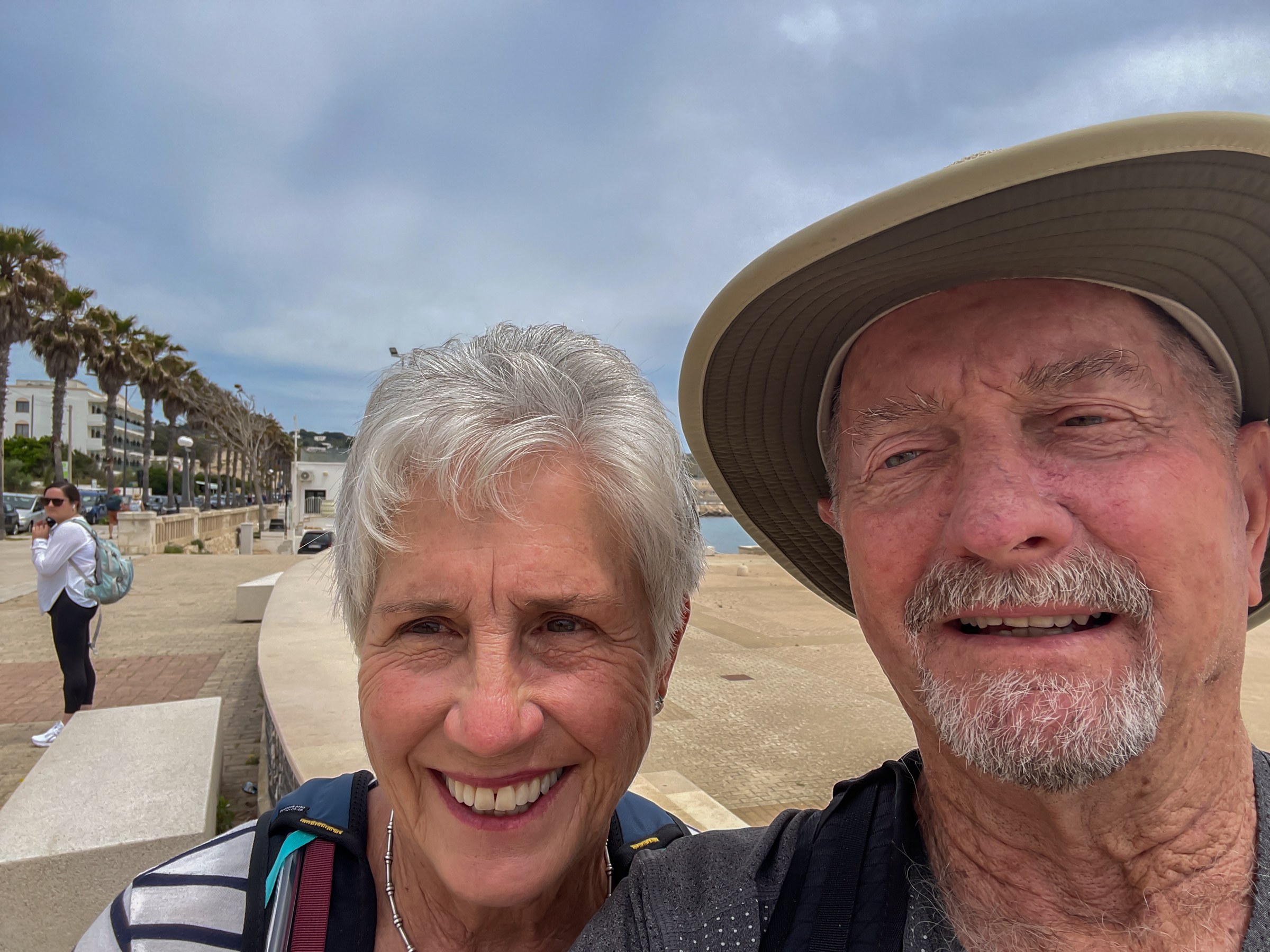
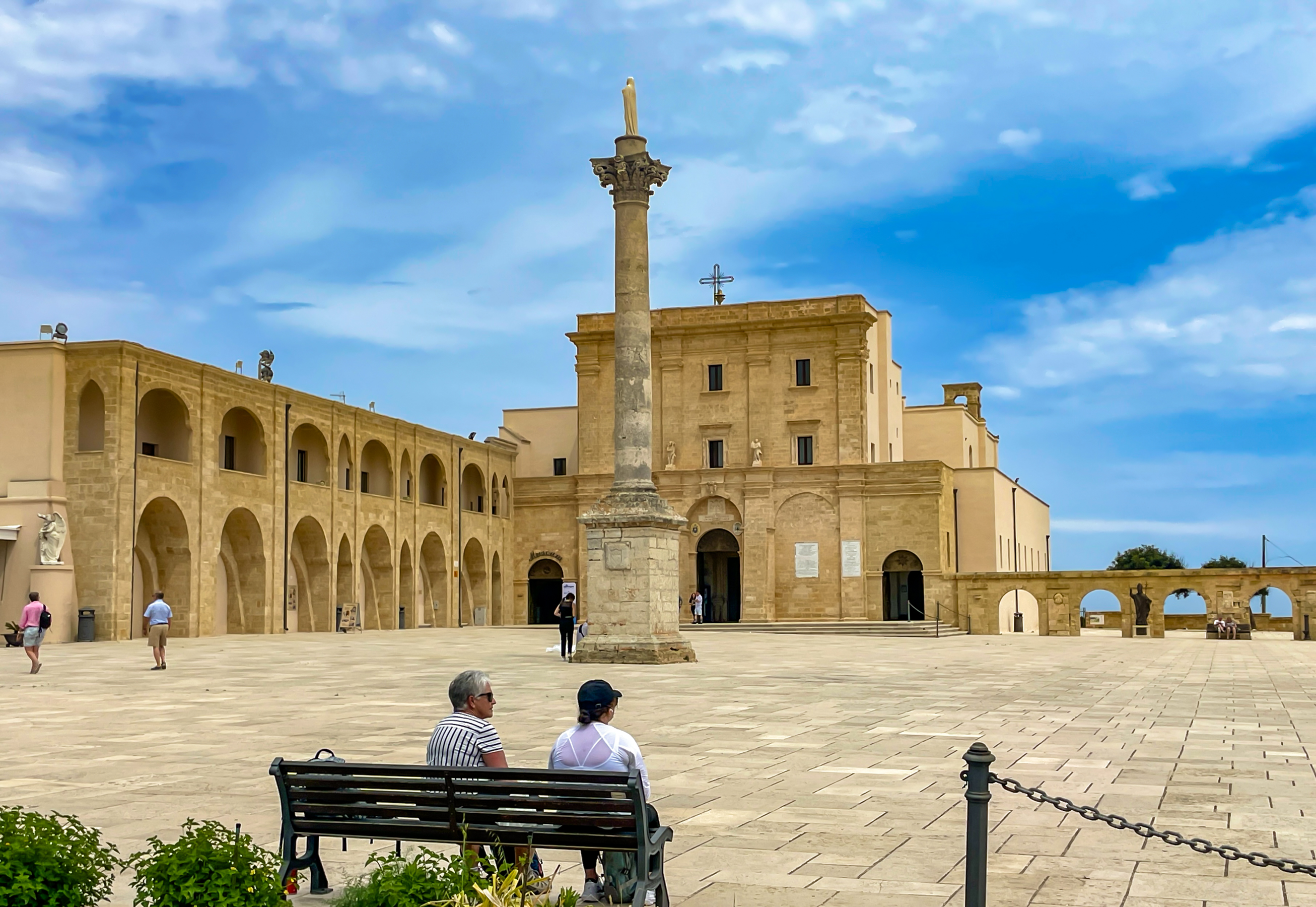
A brief stop at a quayside café for a few add-ons to our Rollo-prepared lunch and then up the steps to the Santuario di Santa Maria for a piazza bench picnic next to the land’s end lighthouse. Crowds? Not so much.
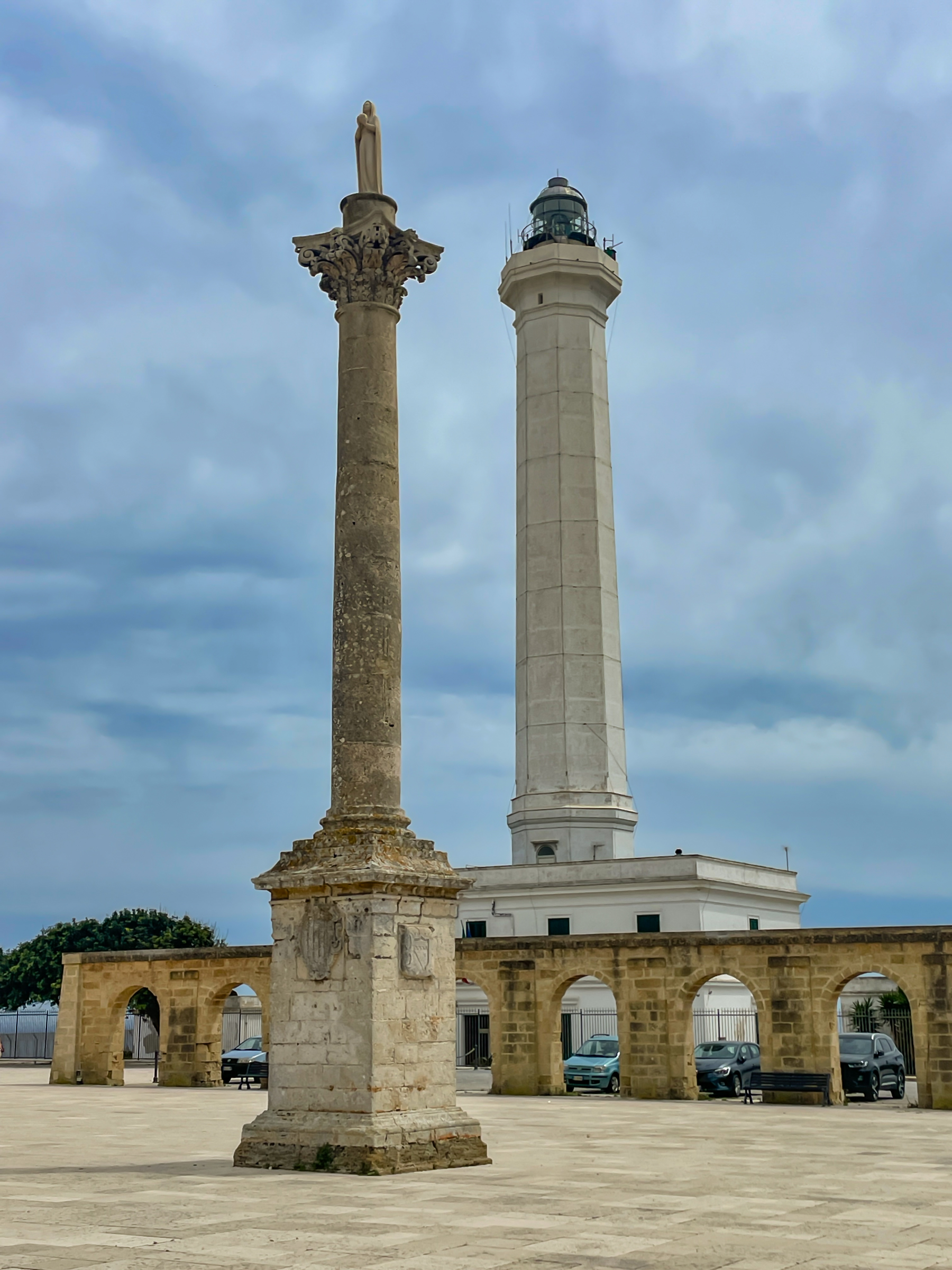
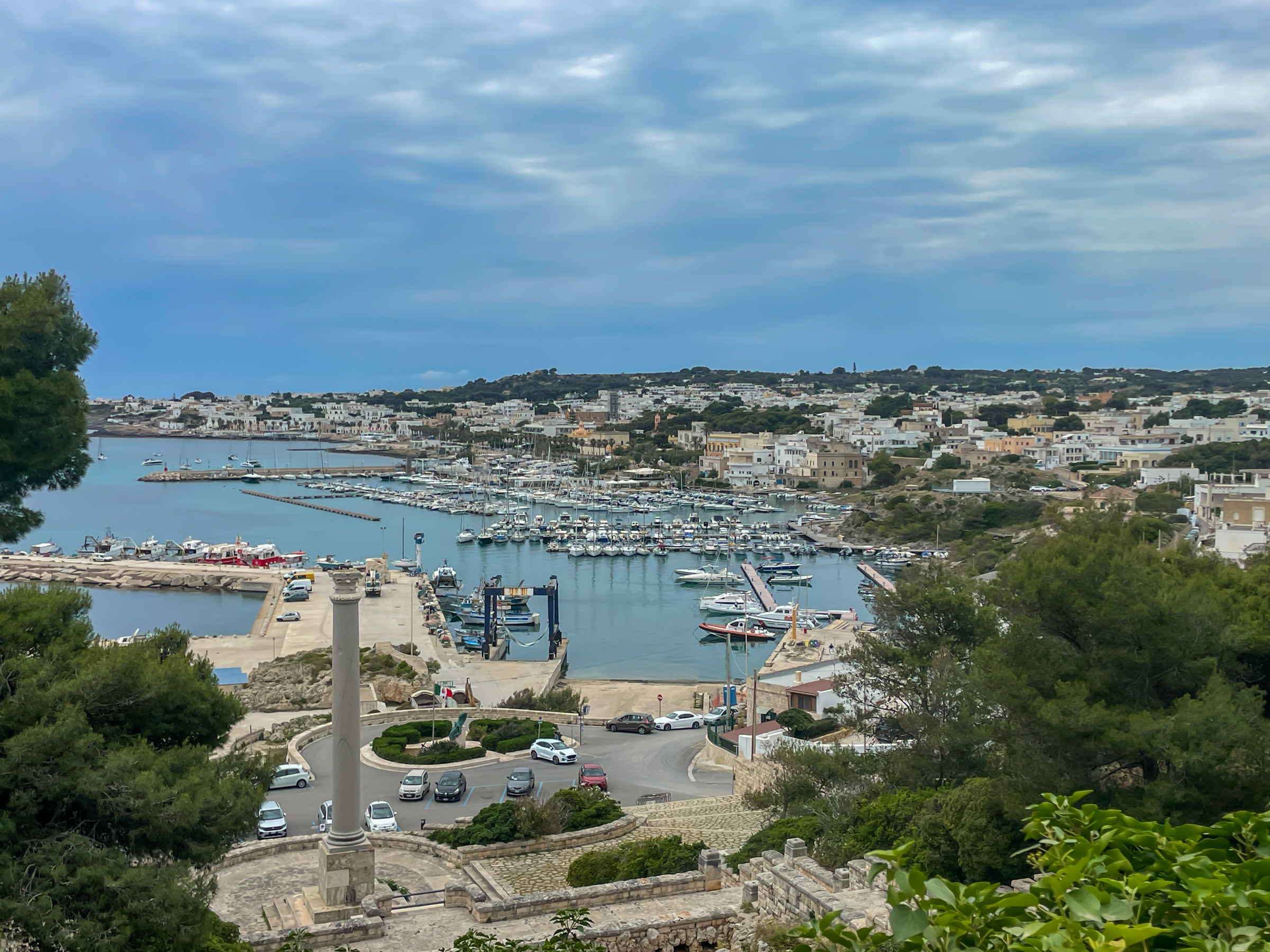
After lunch we continued following the Inntravel written instructions along country pathways on a bluff not unlike the near-the-coast mesas of Del Mar and Torrey Pines. “Along this next stretch (still a surfaced lane) you’ll start to see a number of cone-shaped, but flat on top, stone pajare in the fields…once ancient dwellings and have long been used by field workers…particularly [during] the olive harvest.”

“Follow this country road for 550m to arrive at a X-roads with [a] cycle track sign. Continue SA [straight ahead] here. After a further 300m, pass a road leading off to the R…”
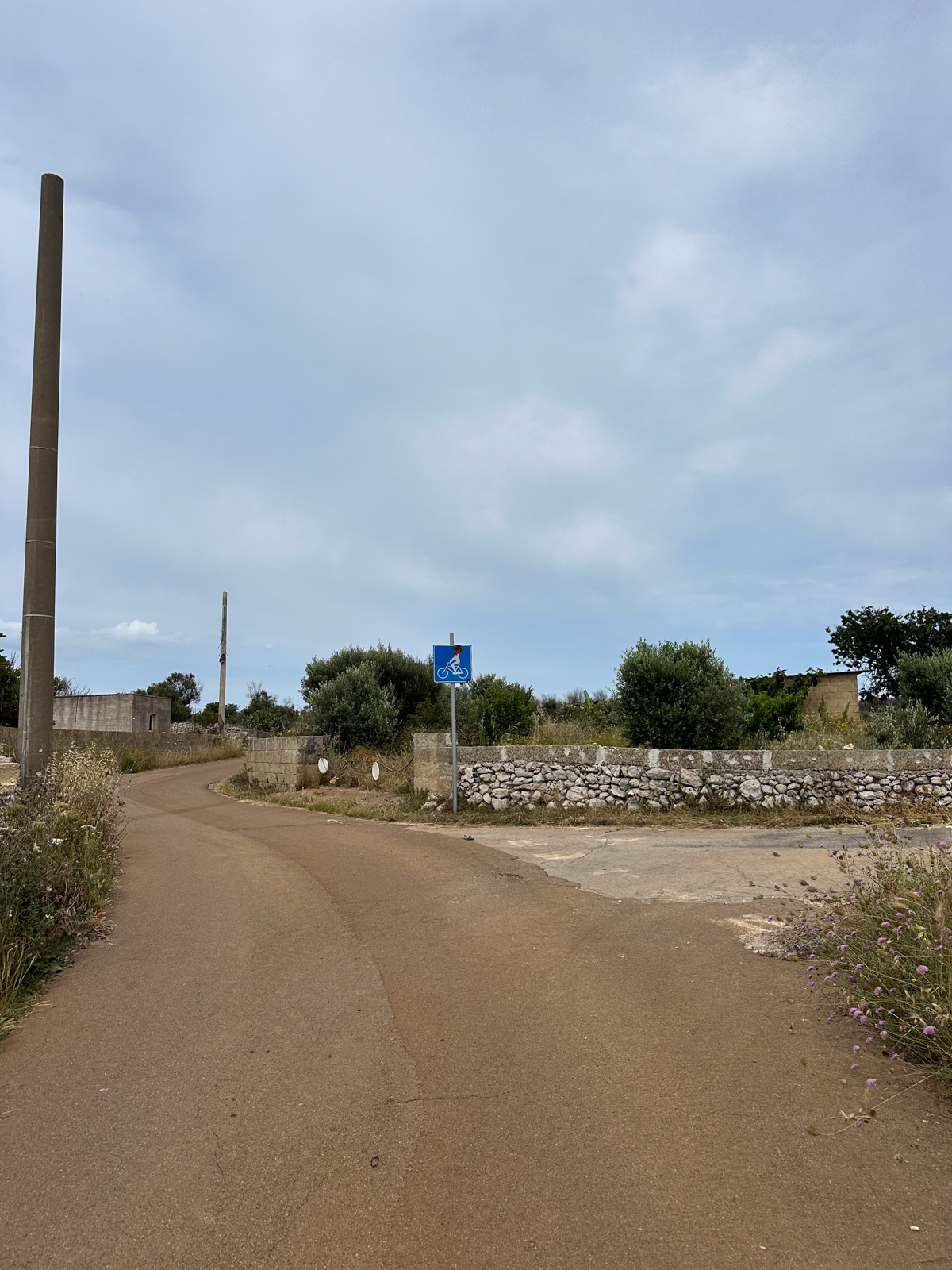
Inntravel specializes in curated unaccompanied walking and biking trips. They arrange for the inns and the taxis…trains and planes, if needed. Their directions are written, and generally quite explicit and up to date. Nowadays they have a GPS program one can download and place into an appropriate mobile device. I’m unfamiliar with the program, and Inntravel reiterates that their written directions are the relevant navigational guide. I’m a Gringo, familiar with English measurements and these are Metric, but I can multiply kilometers by .6 in my head to get miles, then use my octogenarian pace on multi-mile hikes of about :25/mile to calculate a time to the next nav waypoint in the directions. Important when trails are more obscure and trailside overgrowth from Spring rains challenge visibility. A similar technique for distances in meters. A meter is 39.7 inches or about 3 feet. Those 550m mentioned above, multiplied by 3, equate to roughly 1650 feet, or about 0.3 miles when divided into 5250 feet. Multiply 0.3 by :25/mile and you get :07 to :08 from the preceding waypoint to that bicycle track sign. Dead Reckoning is the term in Pilotspeak. Doing it in my head while walking. I had a couple of great audio books in my I-Phone, but didn’t feel I had the mental bandwidth to enjoy the story and not get lost.
“Another 350m brings you to a TJ [T-junction of two pathways] (with sign and Tel no. for Masseria Alcorico here). Turn L to arrive at the Masseria on the RHS [right hand side].”

A few other informative tidbits to share. Masseria is a colloquial for “farm.” Many, like Masseria Alcorico are still a part of the working agrarian regional life in which they are located, but have joined what must be a government-sponsored program known as Agriturismo. You get it, an amalgam of tourism in an agricultural cultural setting. Upscale agricultural, if you get my drift. This day was our shortest, but also possibly our warmest, the temperature somewhere a tad above 25C, or upper 70s F. I made a point of sipping frequently out of my Osprey daypack hydration system, but was still hot, knackered, and thirsty by the time we reached Alcorico in the mid afternoon. Alcorico has a pool. And a full service bar. A quick pitstop in the room, down to my nylon hiking shorts, and off to the pool. Refreshing. “Ana birra, per favore?” Also refreshing, and almost adequate to my trail dust thirst. Almost. I decided vacationing in Italy was authority enough for a second brewski, poolside. I hadn’t yet learned the Italian word for second, which I now know is seconda, quite similar to the Spanish segunda, which I already knew. I gestured like a mute bozo for another and requested “due,” meaning two, as in a second beer. She brought me just what I asked for, of course. Yup, two (due) more beers to go with the first still being consumed from the chilled glass. Along with peanuts and those roasted fava beans that are bar beverage staples in the region. Okay, due (doo eh) means two, seconda means second. Babel translation eat your heart out. I saved the third brew in our room fridge and took it to dinner later. Around 8-ish in Italy. Oh yeah, the second beer quenched my thirst. At least until cena (dinner). Moveable feast.

Breakfast in all of the inns was a variation on the European model. Cappuccinos for the ladies, juice for His Geezerness. Along with bottled acqua minerale—still for the ladies, “fizzante” for me. Tables with cheeses, meats, cereals, granola, yogurt (a particularly delicious and creamy local version somehow mixed with honey), and several varieties of breads, rolls and pastries. I fell, tastebud over tastebud, for a local delicacy, the pasticciotto, an oval shaped semi-soft outer surrounding a custard filled inside. Mouth watering. And thence, submarine sandwiches and fruit loaded in our daypacks, to commence the next 7 to 9 miles of penance from last evening’s feast and self-flagellation preparation for this evening’s feast.
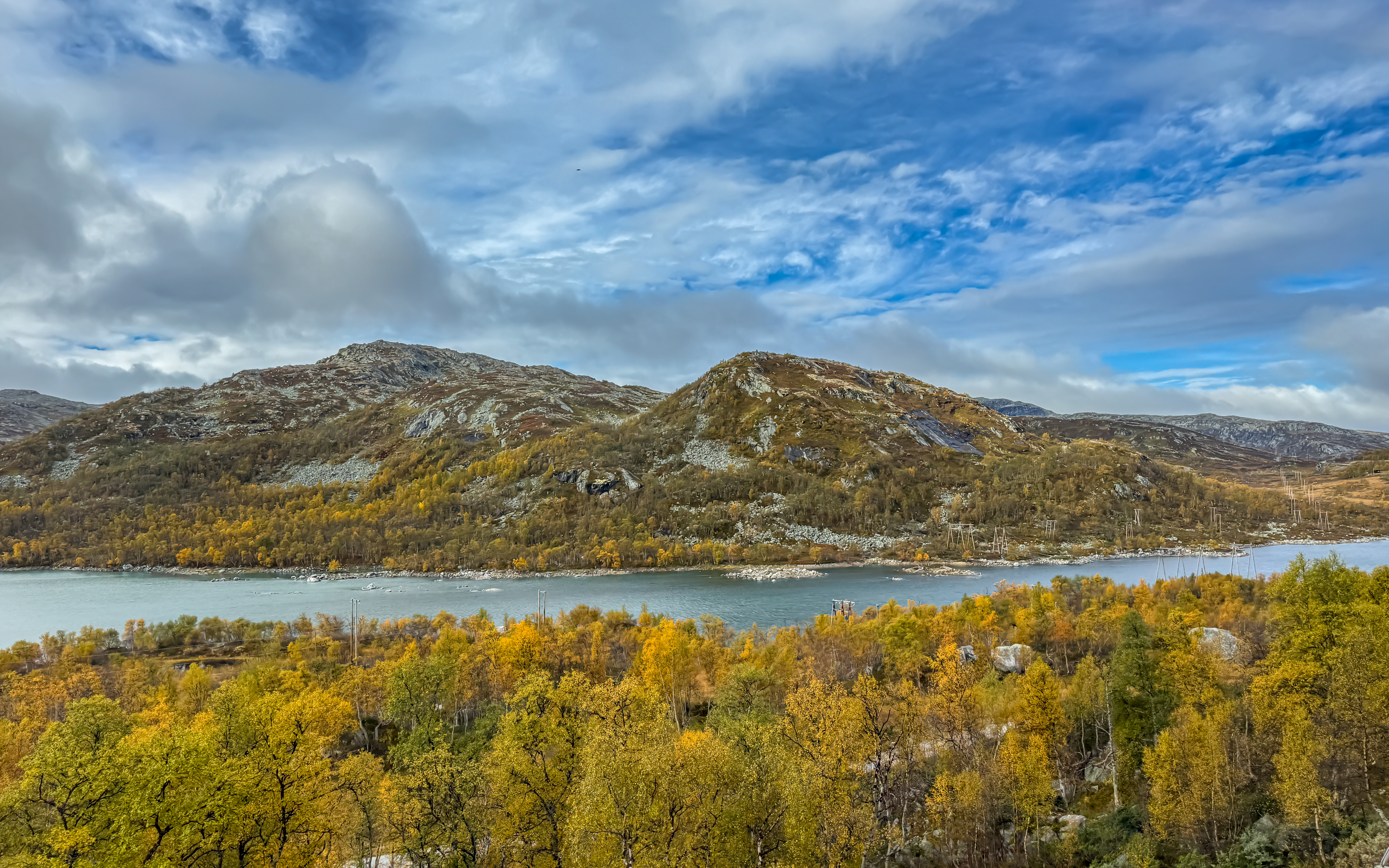
The picture at the outset of this missive is from this next day of hiking. First, a hike along the rural mesa so we could navigate the narrow byways of ancient Gagliano del Capo to exit eastward toward the Adriatic, and down the gorge conveyed in that image sometimes with handrail protection, sometimes not, leading first to glimpses of the sea, and then a no holds-barred nearness to the water lapping at the typical Salento rugged rocky shore.


This stretch was a footing challenge for the three of us. Very uneven ground, a mixture of rocks and dirt. Quite literally ankle-challenging. A good place for walking sticks, but we’d left ours behind as we journeyed with only on-board luggage. Those pointy sticks not blessed by the TSA for the passenger cabin. It went on for rather a long time, but no complaining as to scenery.

After 7 miles we finished in Corsano with a pre-established 3:30 PM pickup at Piazza Santa Teresa by our friendly taxi driver and driven to our next lodging—Palazzo Mellacqua, in Castiglione di Otranto. Another “palace” unimaginable from outside on the street, demurely revealing its elegant petticoats once through the front door. Husband and wife innkeepers who spoke about as much English as I do Italian, but their comportment said it all. So happy to have us as guests, so polite and solicitous, and justifiably proud of their beautiful inn. A birra (becoming a regular post hike event) as we chatted and planned a sumptuous dinner in their elegant restaurant. All of this in a small town with a population of maybe 2,000?
And here’s another moveable feast glimpse at Italian dining culture. The meals were regularly multi course affairs. Aperitvo time for charcuterie…perhaps a seconda birra for me, Prosecco for the ladies? Decide on the first course and the second. Which wine or wines would please us? Something dolce to finish? The innkeepers’ adult daughter was rumored to run the restaurant, but it sure seemed to be the husband who waited table on us, and his wife in the kitchen. M’ladies chose some sort of fish thing as their seconda course, and I elected beef, which brought a question of how much would I like? Not a question I recall being asked in these parts. Some confusion here, resolved by him bringing me out a slab of beef about three inches thick, fifteen by eight inches in planform. He gestured suggested dimensions of my steak, beginning with nearly half of it. I finally talked him down to maybe a fifth of it. And this is how it came out. My only regret is having only one stomach and set of coronary arteries for my tastebuds. A little more Negroamaro, signore? And their fish, a sea bass if I recall, was every bit as big.

The next morning our cab took us to Piazza della Vittoria, a lovely square in Marittima, from which we headed back to the coast in Castro.
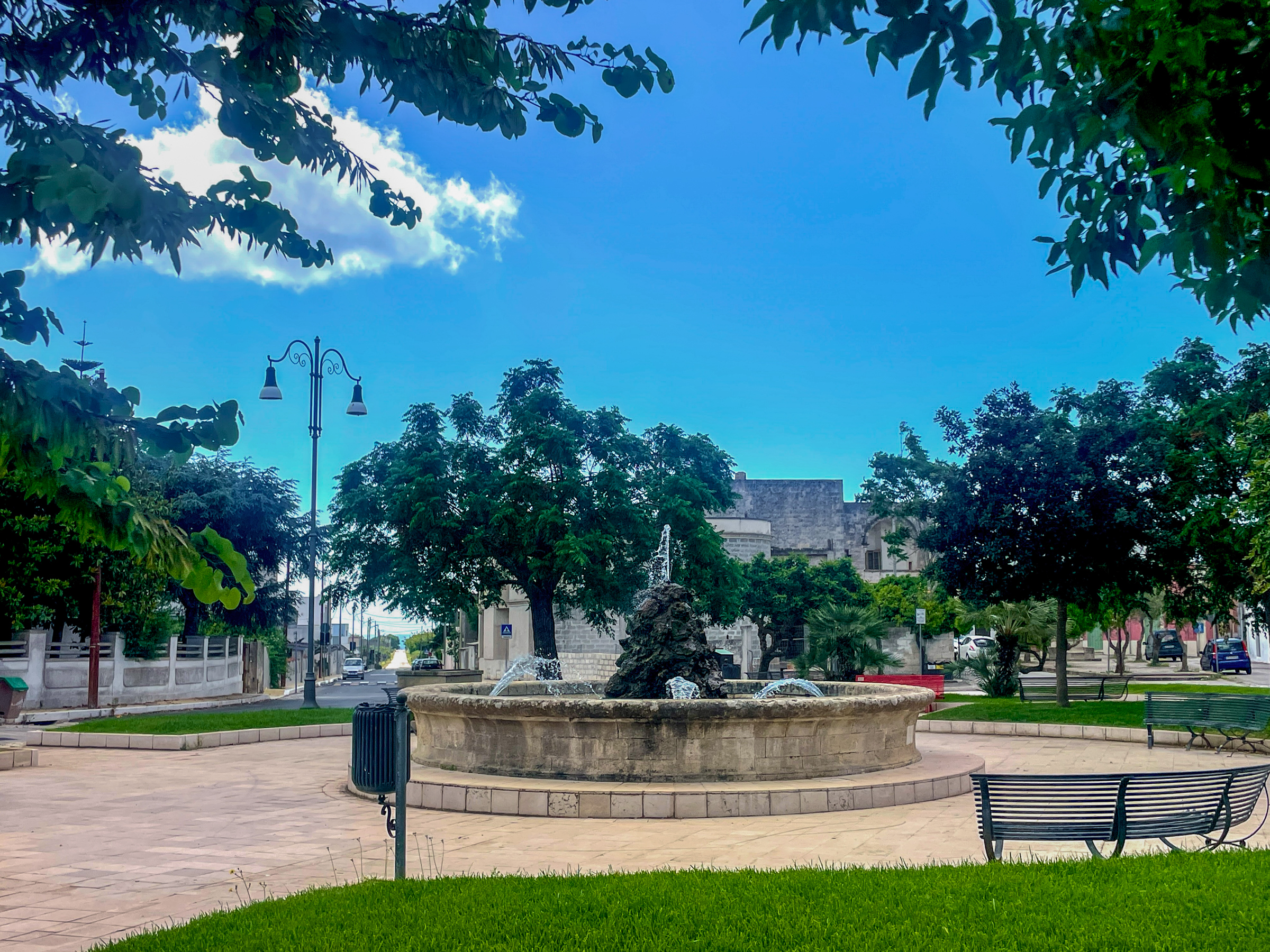
This pathway yielded yet more glimpses of Italy’s quiet side, coming upon another stone-walled lodging with the added flavor of the ubiquitous Vespa scooter…
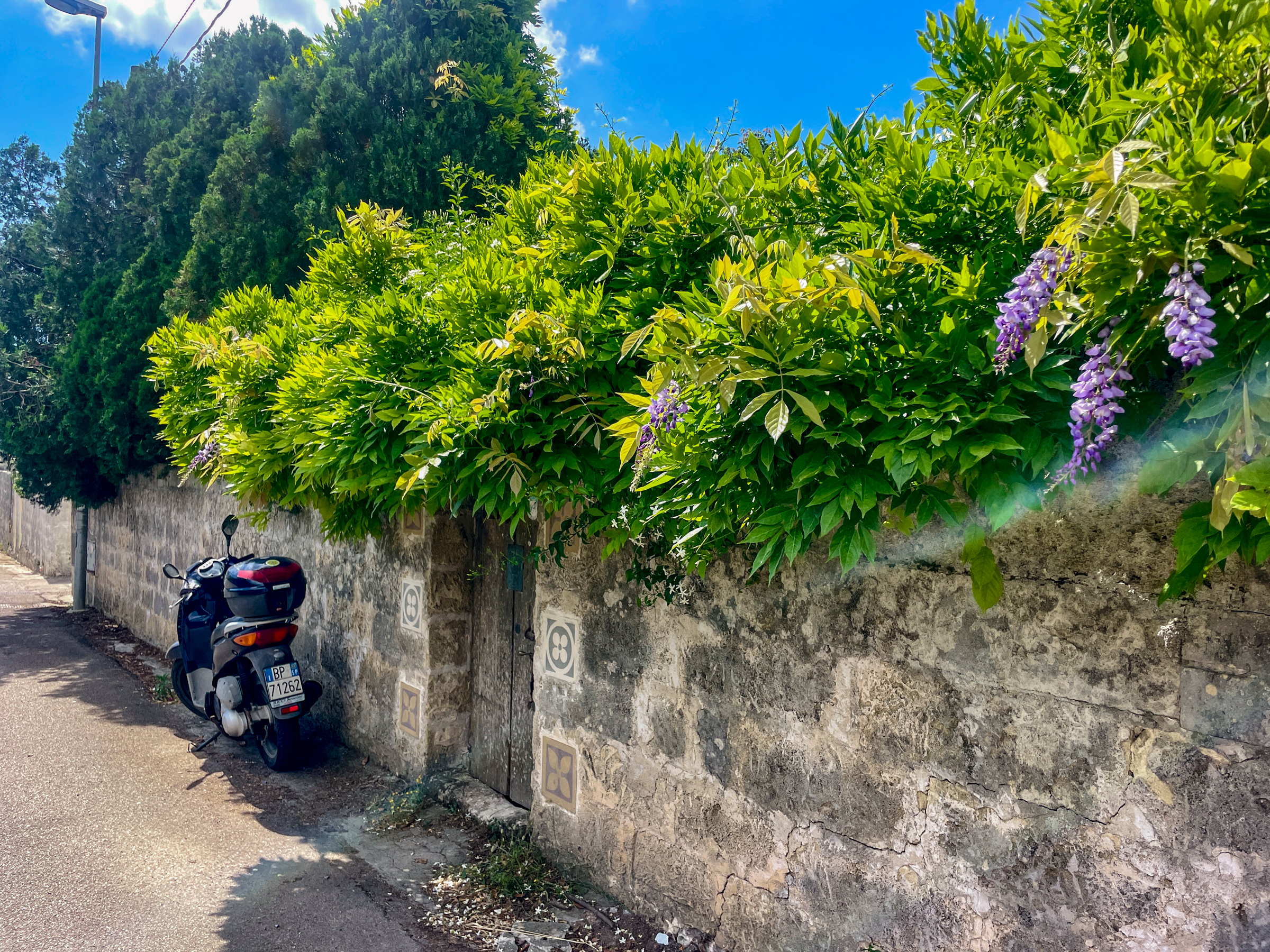
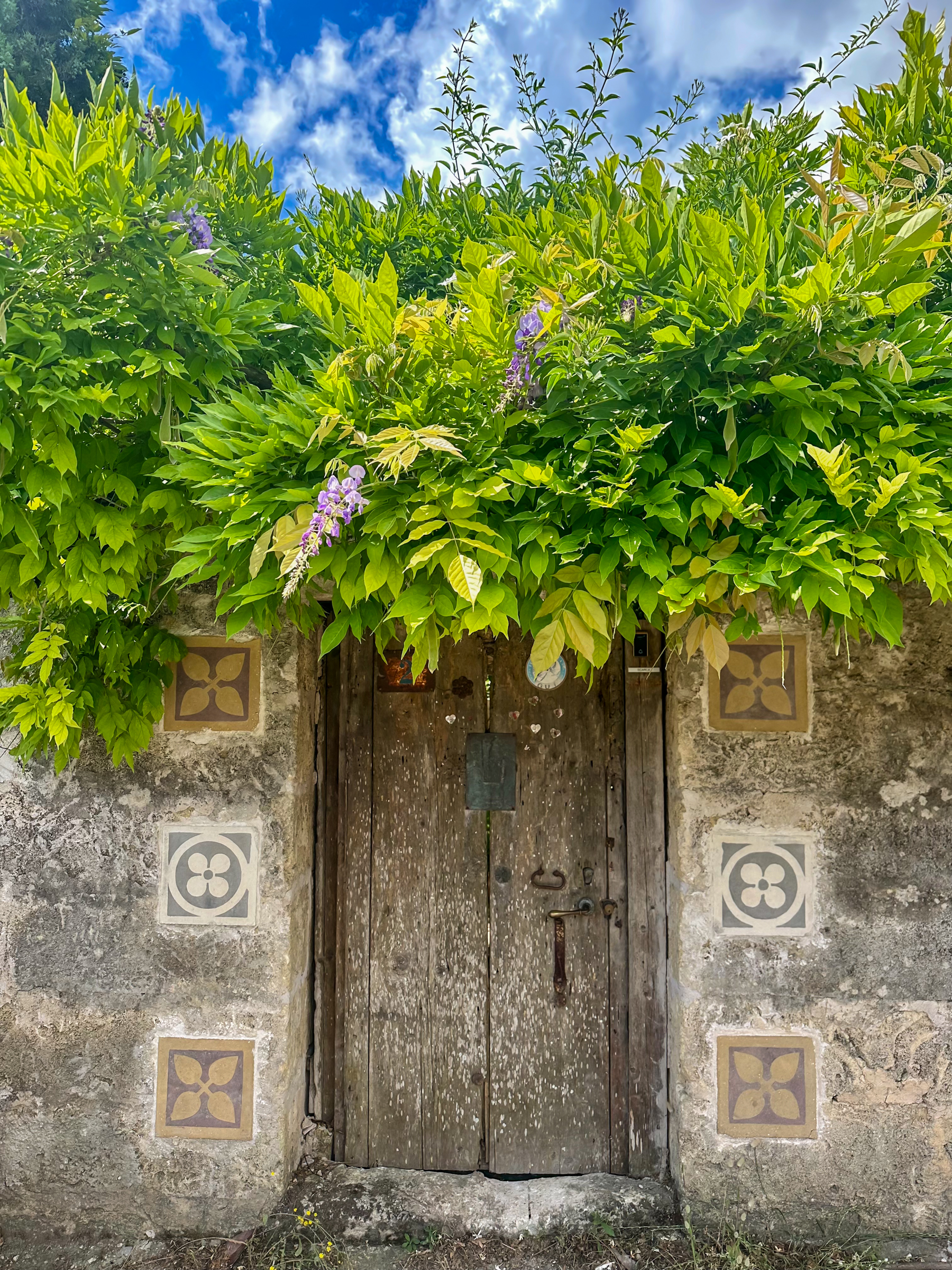
…with such an elegant front door. Photo courtesy of Torrey Close, proving yet again that she has a well-honed target eye.
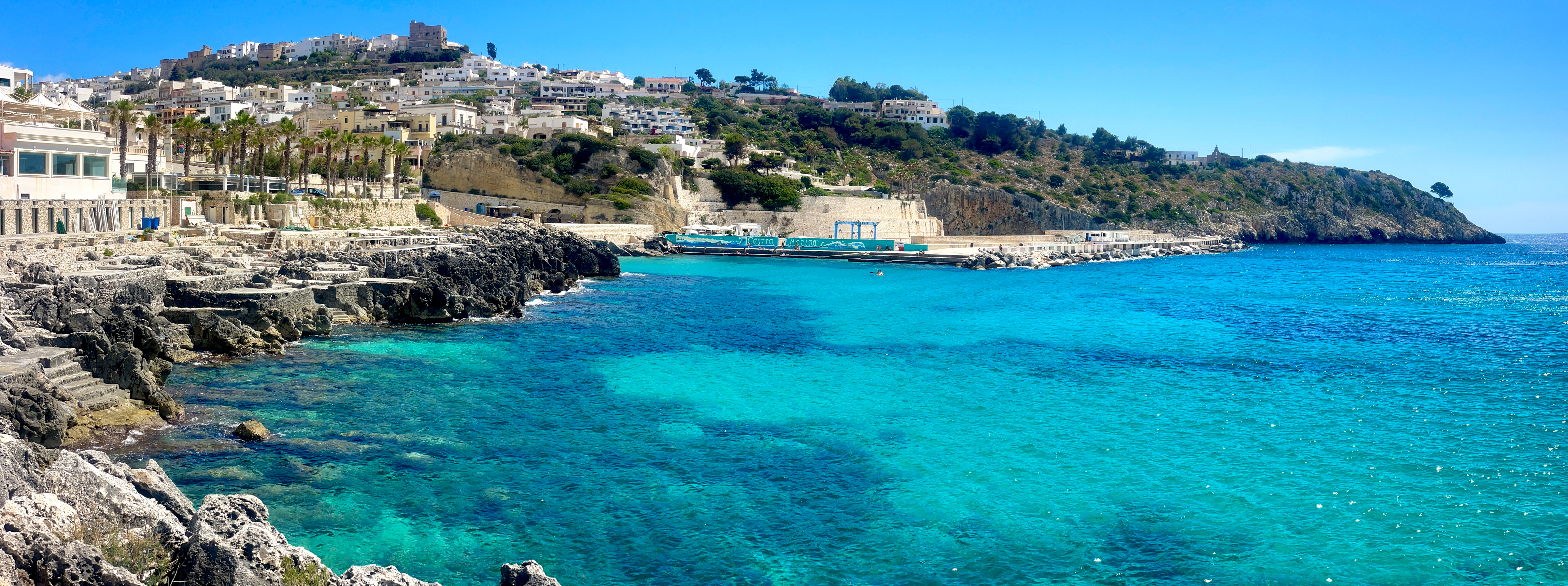
Glimpses like this are why we choose exploring places culturally divergent from our own. Not to mention glimpses like this one at the bottom of the ravine a kilometer below the walled home. Yes, the water really is colored like this, with the gin-clear water visibility. Ah, you say, but gin is colorless, not aquamarine and blue. Stay tuned for refutation.

This was another 7 mile day, headed first for Castro. with its small sheltered harbor, alongside which we stopped in an outdoor café for cold acqua minerale and a little sit-down time.
Then working our way steeply back up to the mesa passing this handsome church as we began our climb.

On the climb up to the mesa top leading out of town through the Centro Storico (the old town) we stopped to take in the view from a piazza adjoining its 12th century fortified castle, the white buildings of our destination of Santa Cesarea Terme visible in the distance to the north.
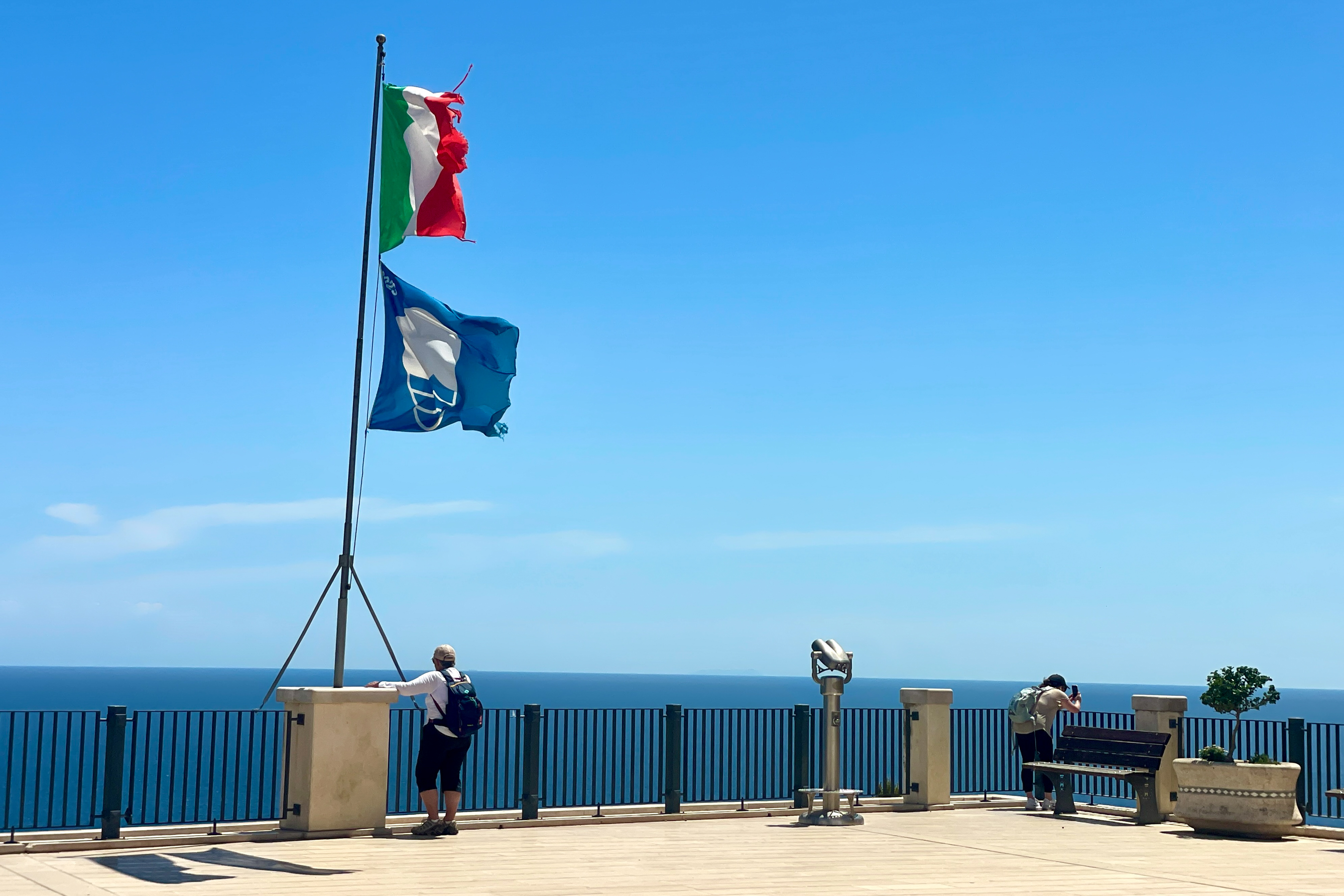
Leaving Castro by this colorful street.

You can make out the road sign showing that S Cesarea Terme is straight ahead. But Inntravel will have none of that busy road, shortcut kind of pathway. Leaving the road at what the directions describe as a car park, and which I think might be more accurately defined as an RV park, we were soon back on our typical alone in the toolies tracks. Yes, nature was everywhere, flowers, pollinators and scooting lizards our constant companions.

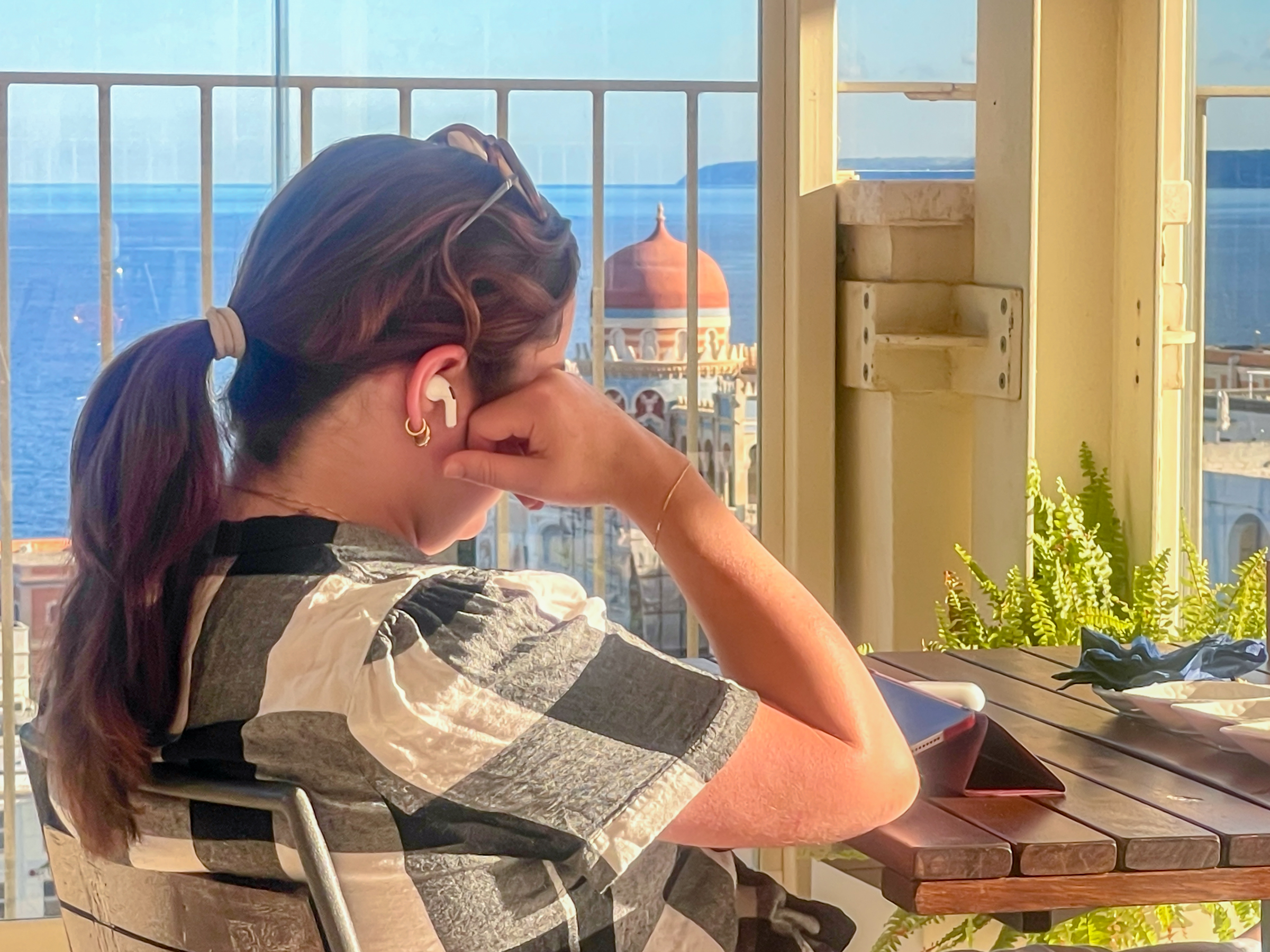
Destination, Est Hotel in Santa Cesarea Terme, and a little lounge-deck downtime after a shower and with a favorite audio book, overlooking the onion dome of an enormous private residence designed with a Moorish mindset when that style was once in vogue there.
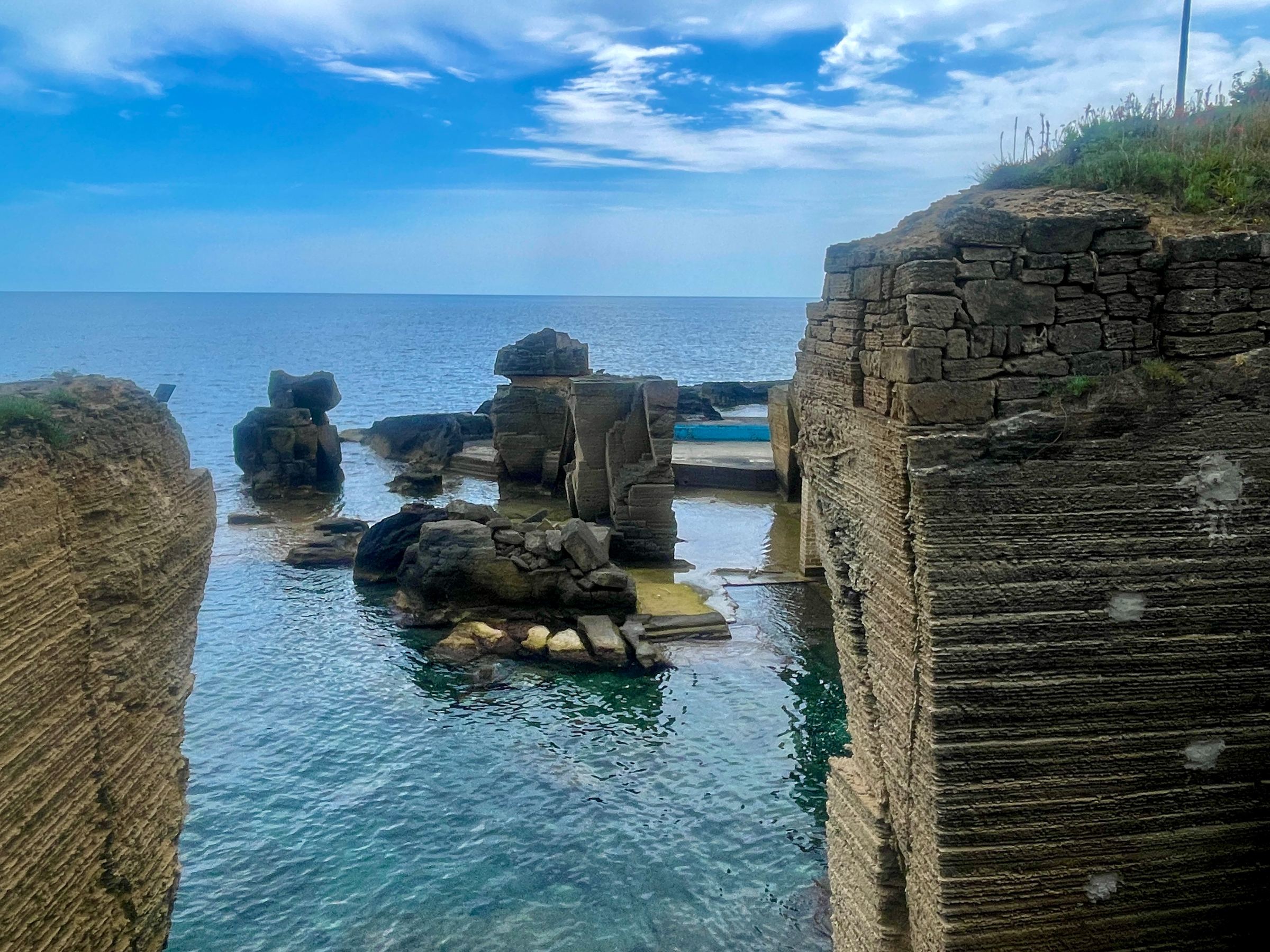
Italy inhabits tectonic real estate. Mt. Vesuvius may ring a bell? Santa Cesarea Terme’s version is sulfur hot water, where the Adriatic is made a toasty 30c, 85F for the rest of us. Steps and stonework leading to bathing areas accessed from prepared and natural ledges.
For our departure day, the forecast speculated thunderstorms, interestingly expected to be most active in the mid morning through early afternoon. You pilot types will smile knowingly of what can be referred to as the duty 2 PM thunderstorm onset, a remarkably accurate old-pilots’ tale accounting for the buildups by terrestrial solar heating producing thermals as a means of cumulonimbus uplift. The early morning already scattering bubbling cumulus offshore, and more inland, a portent of things to come.

Departing town on foot, our directions wasted no time having us leave the road and climb steeply some 210m back up onto the plateau heading north. The climb began with stone steps, devolving into a rocky trail, and steep enough to seriously consider hand over hand on all fours. Trust me, it’s steeper than it looks. And note the darkening cumulus bases already churning at 09:30. Hmm.
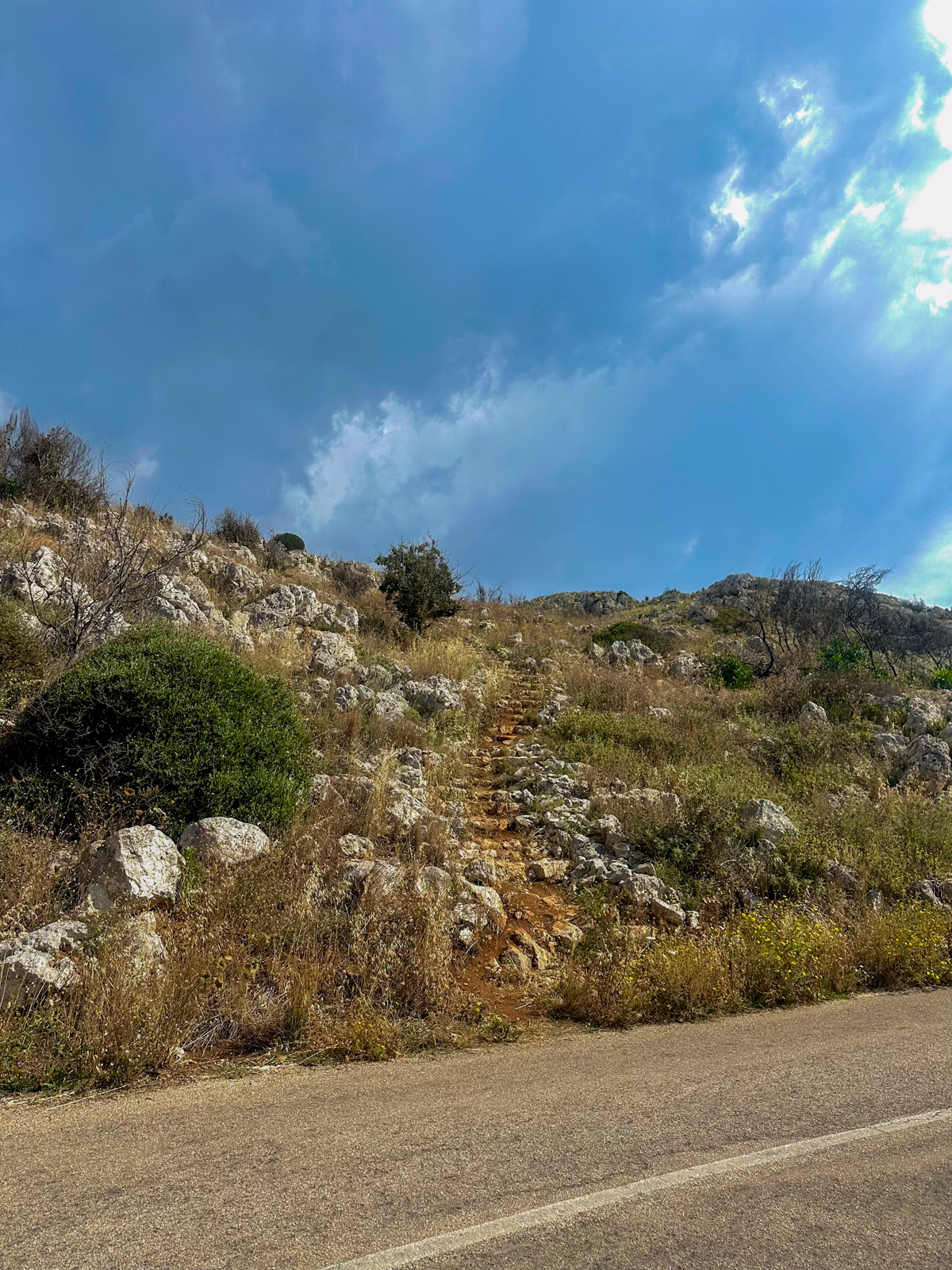
At the top, the missus catching her breath while I do the same. Steady camera a challenge while gulping air. You do see the trail, right?
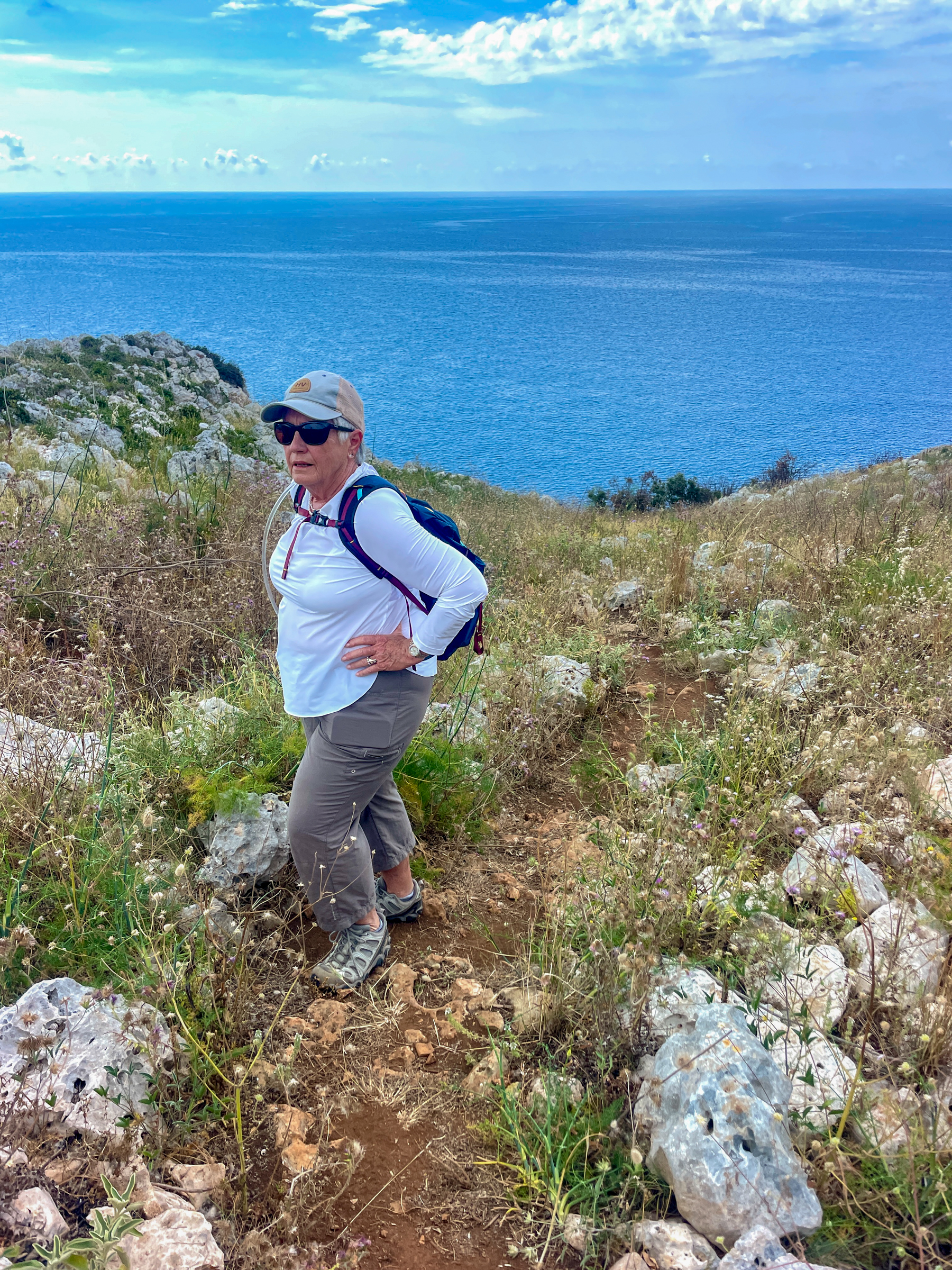
And then follow the trail, being careful to stay on the straight and narrow. Beginning to sprinkle now, then ultimately coming down hard enough we donned our rain gear, a necessity for only :30 or so. Frequent peals of thunder, Zeus’ tummy growling, but thankfully only one lightning strike well to the inland from our trail.

A long day, weather about. Make sure you take the correct juncture. Fortunately, it was to the right, angling away from the worst of the thunderheads.
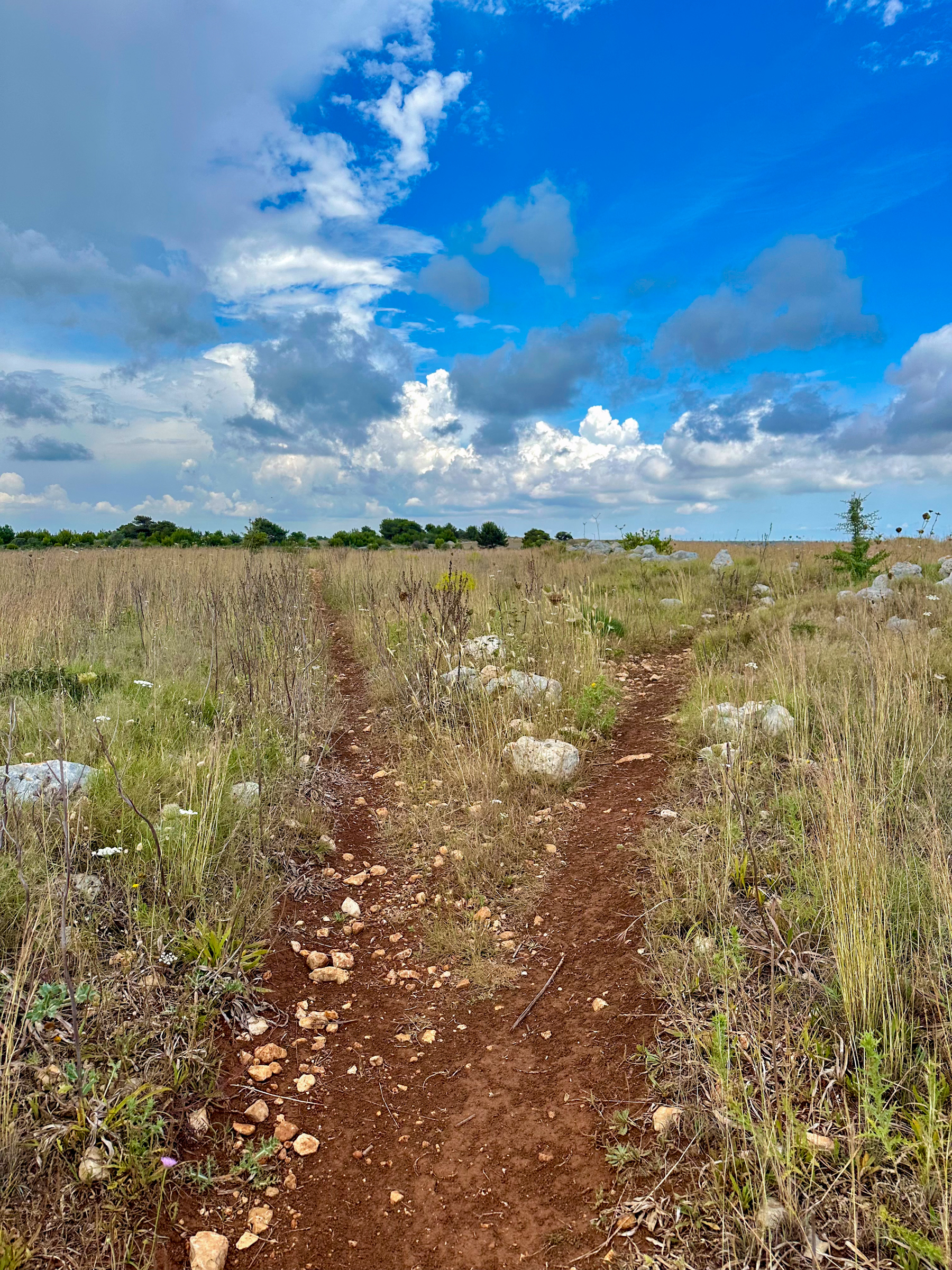
Eventually our directions had us drop back to reach the coastline at tiny Porto Badisco, the worst of the tempesta now to the right back from whence we came.

Then the navigation got more interesting. We had to make some allowances because a prominent waypoint—a café—was in the finishing stages of complete removal, only some old rebar sticking out of the ground. The construction workers denied us passage until I informed then we were “on the camino” a reference to the Camino di Salento, a portion of which our route overlaid. Religious sojourning has its place, and here was no exception. But the directions to continue in an arc around a headland were less than clear, yet we made it work on intuition. Eventually coming upon this un-described addition to our day. And which of us two is the black sheep? The sheep began crowding over the path, whereupon the shepherd, sitting on a rock at 3 o’clock in the frame, whistled for his sheepdog to get to work and a few barking forays later the path was again passable. Score one for the camino pilgrims.

As the crow flies, our destination, the Tenuta Sant Emiliano, to the north of here is relatively close. Not so via the trail. From here we arced along the headland with the sea to our right, heading to another climb steeply up onto the mesa, navigating toward and eventually around an ancient watchtower, the Torre Emiliano seen here on the distant bluff, then up close, below. Defensive watchtower for those marauders from the east over the centuries.


Torrey typically walked at a faster clip than us, me the slowpoke more than Cathy, who nonetheless would slow down so that we could hold hands and chat. Torrey is quite adept at following the written directions, but also knows how to use her I-Phone’s map function when it makes sense. A couple of miles after here our directions had us access the main road for 150m, then depart it on a dirt road that was intended to have us arrive at our inn in about 2 km via the back of the property. Torrey had had enough, and stayed along the road following her Google map, which took her unerringly to the front door in about 1 km. I should say that the inn was not visible from the road, nor from the dirt road that we plodded along following the directions. When we were probably only 300m from the inn, the trail seemed to come to an end in the middle of nowhere, the inn still unseen. Lost! No, I was not a happy hiker. Torrey texted us that she was at the Tenuta enjoying a lemon sorbet. We responded that we were lost, and were backtracking to find the error of our (my) ways. I eventually decided to use my phone Maps function, and discerned that using the auto road was the smart move. Our loss added another mile plus to what was already an 8 mile day. Two days later we’d leave the inn by the original directions to it, but in reverse, of course. And knowing where you were made passing through the area where the trail died with tall grass overgrowth easy-peasy. But not so on that long day arriving.
BTW, I sing T-Mobile’s praises, as we had unlimited high-speed text messaging and internet throughout, phone calls if we needed it, e-mail in the bargain. Their coverage is so extensive and the Adriatic so narrow that along some of the Italian shorelines we got pop-up text messages from T-Mobile welcoming us to Albania and Greece. And those folks in pink pay me not a whit for this appreciation.
The Tenuta is another Agriturismo lodging. And just sayin’—the vegetables and salad greens are decidedly freshly from the field. We passed this smiling lady as we left two days later, out the front door and to the right, an underhand pitch from the inn’s front door.

Torrey already outdistancing us as we carried forth on our last leg to Otranto, another 12 km day.
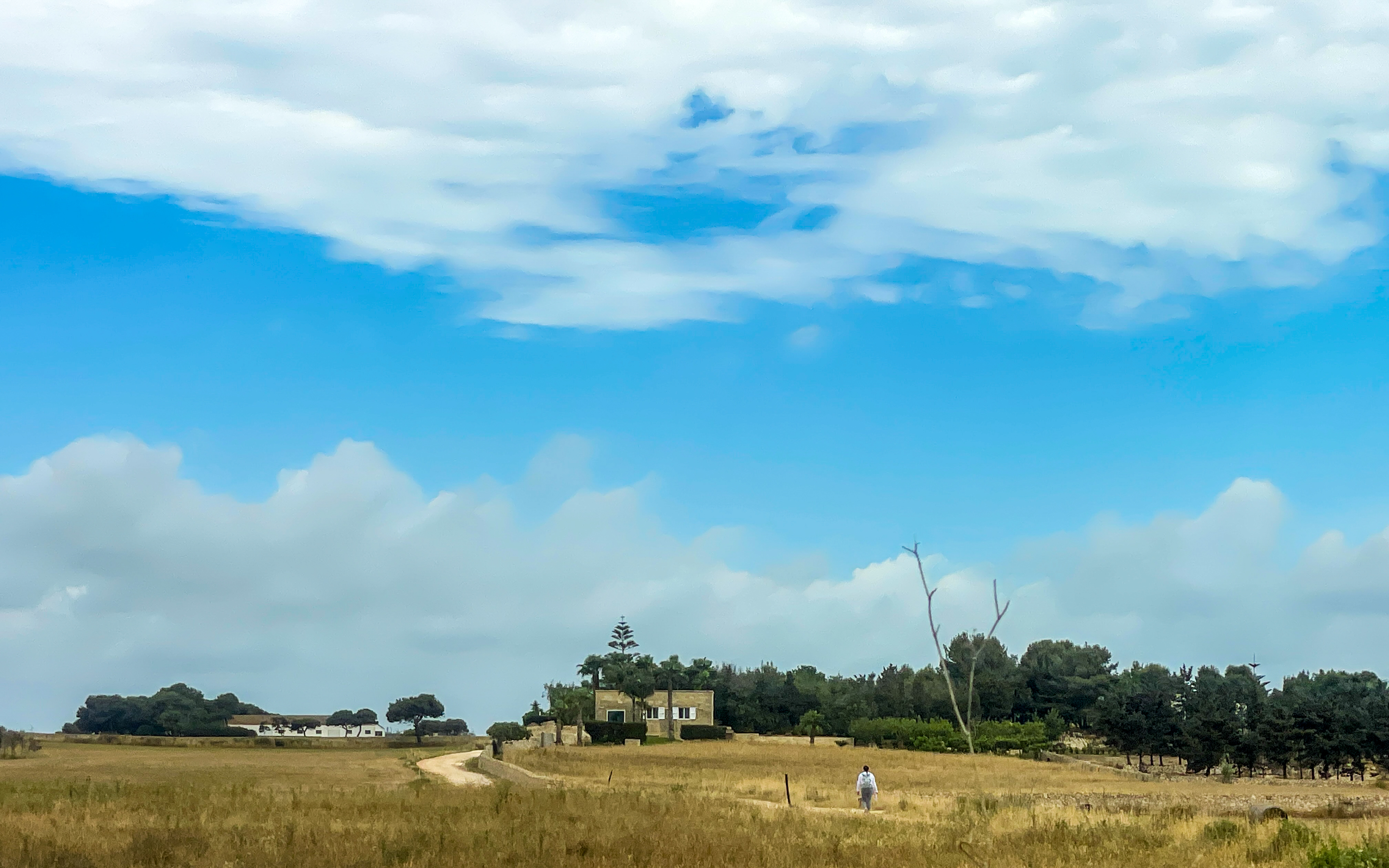
Lots of nice scenery on this leg.

An abandoned masseria. Our trail on the left.

At about 8 km the trail returns to the shore.


That scenery overlooked by Orte Beach Bar-Restaurant. Just a trailside establishment where we took a sit-down with an ice cold Coke Zero and an ice cream bar. Immaculate bathrooms.

A more recent military watch post, now watching over hay rolls, a common enough scene over our many days of walking.

And a couple of kilometers farther on, our path enters the old Roman Empire city of Otranto from its port. This particular day had a “there goes the neighborhood” sense to it with the uncommon arrival of a French cruise ship.

After Lecce, Otranto is the largest community we visited, possessed of a population of nearly 6,000. It has a modern part which we saw only on departure two days hence, and a bustling walled old city overlooked by a substantial Aragonese Castle that is more fortress than palazzo. Our lodging, the Corte di Nettuno (Court of Neptune) is decorated nautically throughout, and is a short walk from both the castle and the port. The castle has been repurposed as a museum with changes of exhibits chosen every several months by its leadership, and currently an historical perspective on Frieda Kahlo. Go figure. The old city is a bustling shopping and dining area laced with twisting narrow stone pathways and considerable visual appeal.
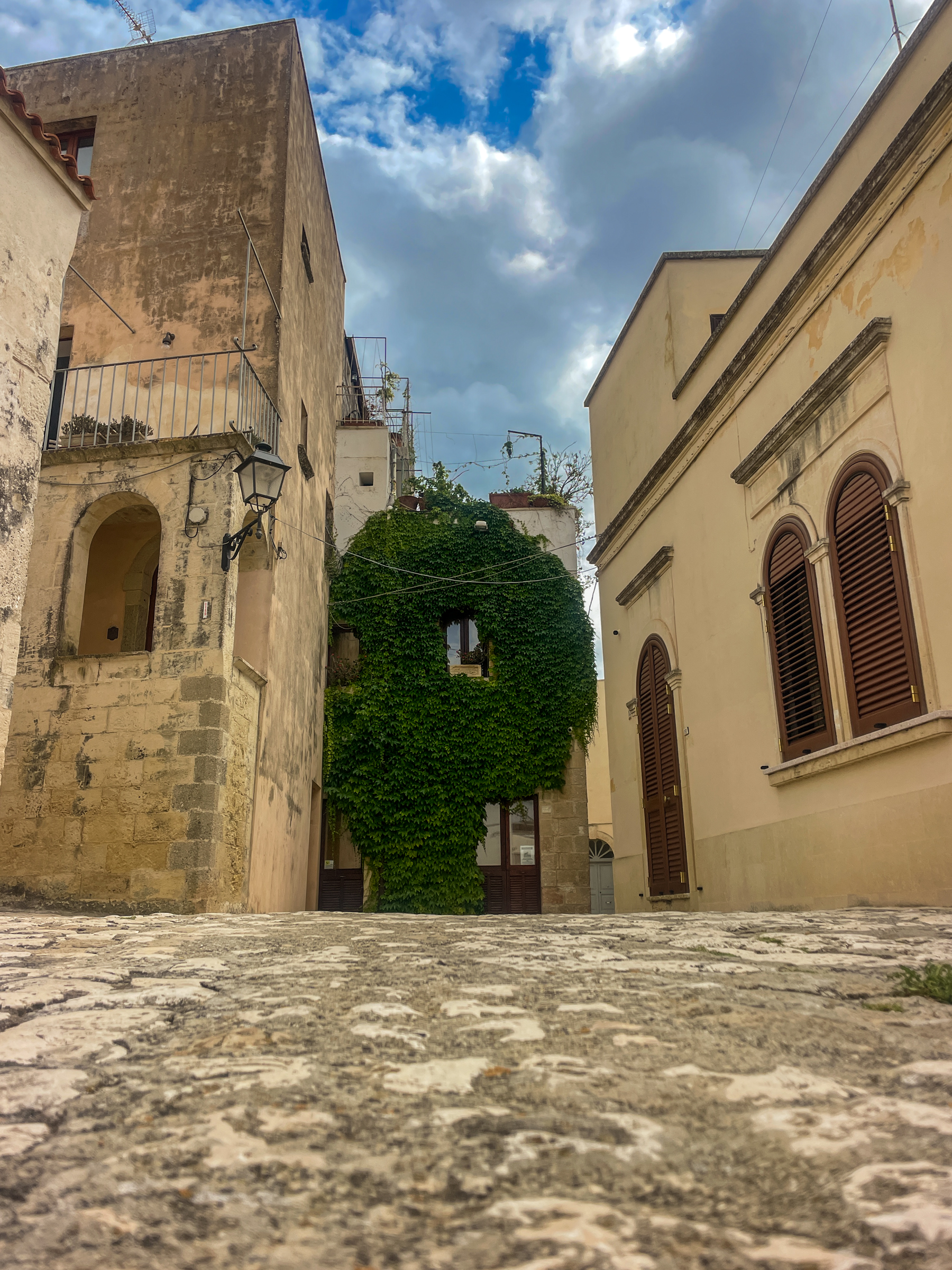
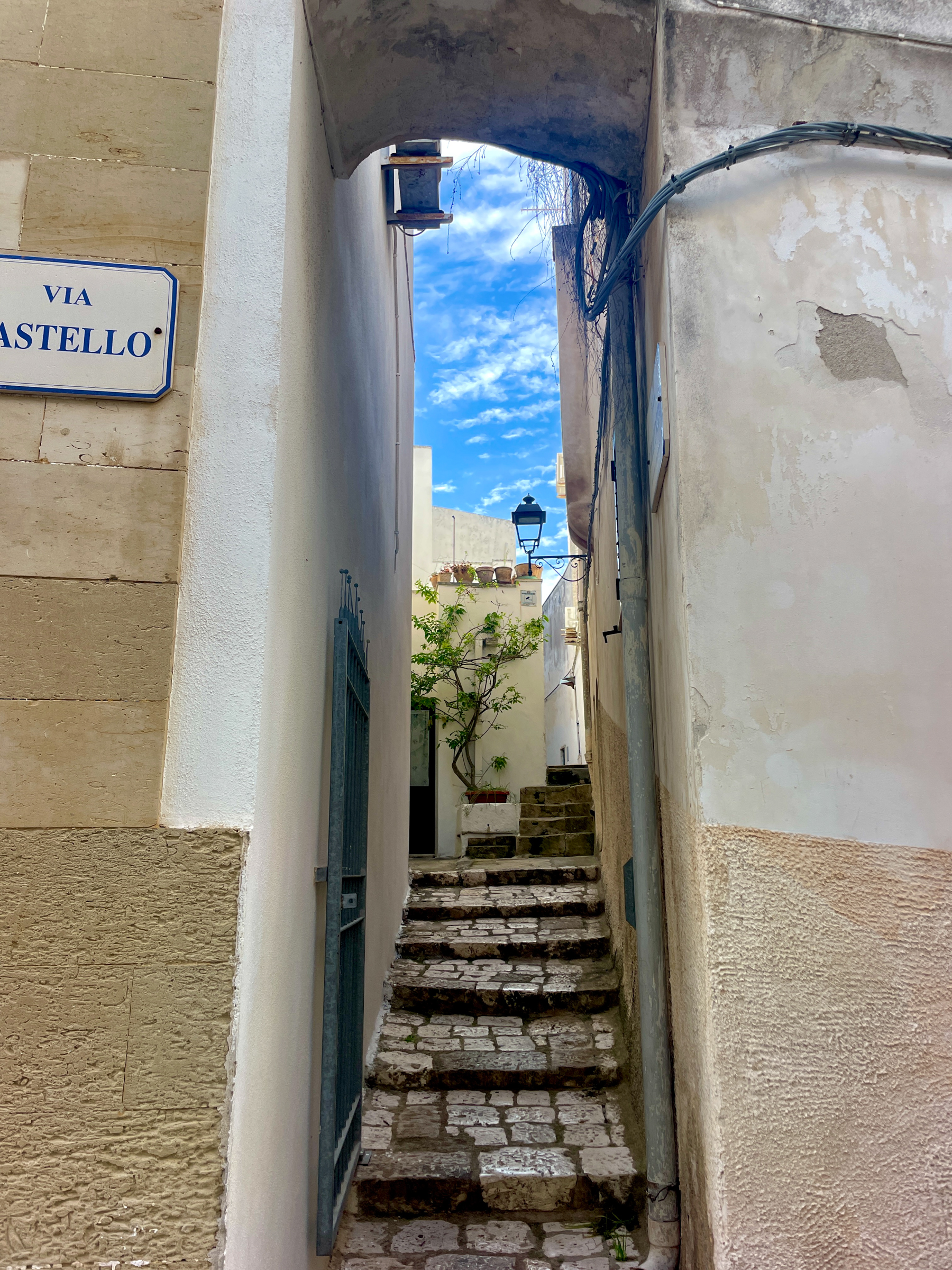

We happened upon the tiny Basilica di San Pietro (yes, that Saint Peter) just as the woman with the keys was opening it up. Breathtaking frescoed walls, so intimately available given the modest dimensions.

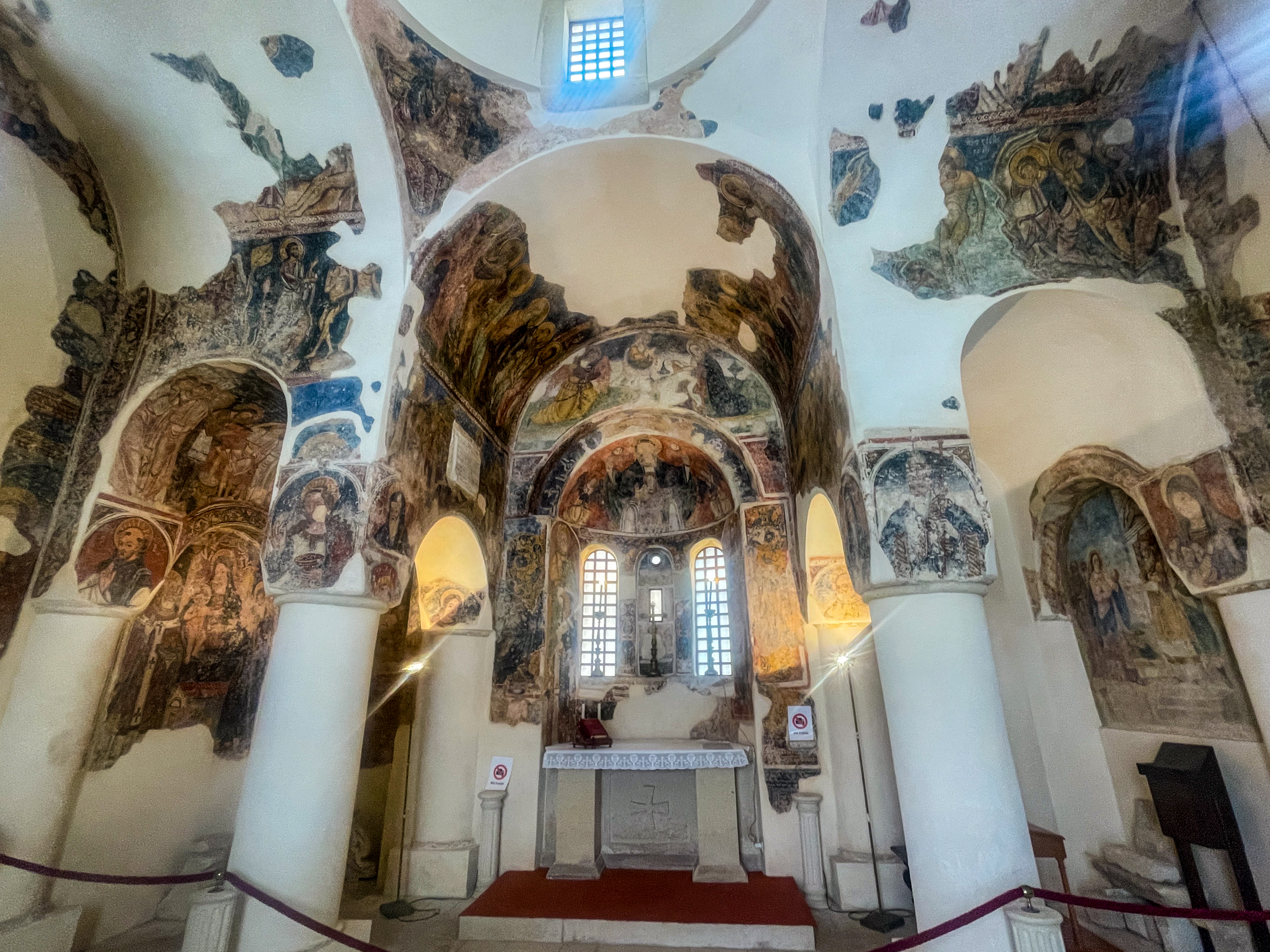
The small round glass piece above the cross is designed to let through the dawn morning light to illuminate the chapel.

I decided I couldn’t be alongside the Adriatic Sea without getting in the water, so I took my Kindle, a towel from the Court of Neptune and ventured forth to a beach of white sugar sized and colored sand, a rarity along the rocky Puglian coast. Cathy and Torrey had ventured forth ahead of me looking for gifts and some household goodies, and saw me over yonder purposefully striding to my date with the sea. Old guy still AGAG (All’s Good Above Ground). It was a Saturday, and relatively warm, so the stone boardwalk was like the Mission Beach seawall for people watching. I guessed the water temperature as somewhere between the upper fifties and sixty. Trunking it, it was a short immersion for me, and I noticed few other takers. I found a nice bench to watch the world go by and dabble with Amor Towles’ “Lincoln Highway.”
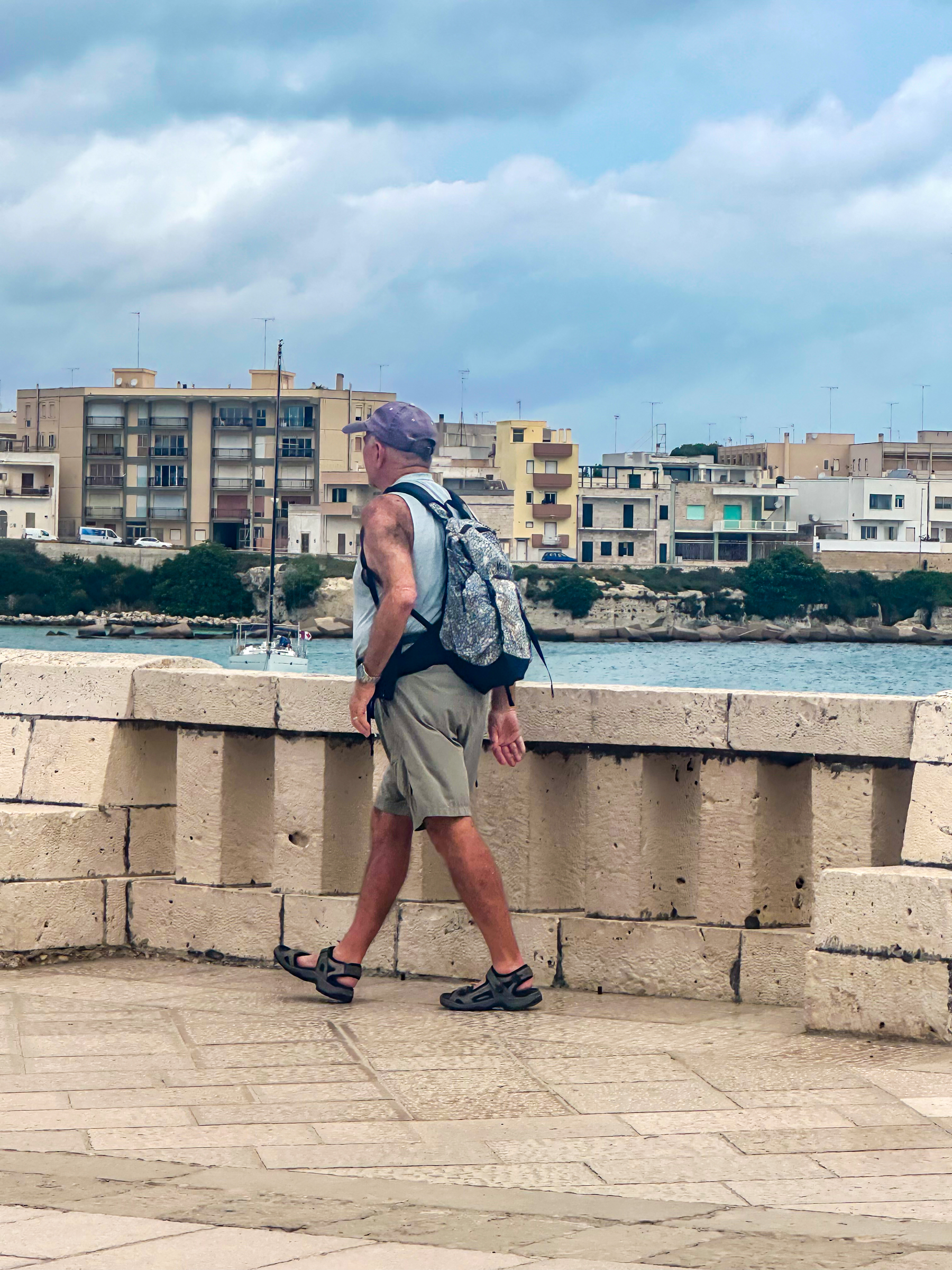
When my shorts were mostly air-dried, I suited back up and sent a text message to the ladies so that I could join them, which as it turns out corresponded to a mid afternoon lunch at L’Ortale, a literal hole-in-the-wall gem that Torrey had researched online. You have to know it’s there, and be willing to enter in spite of the closet-sized entryway. Like a speakeasy, what you get is not what you can see from the entryway, but an outback courtyard that ambles up to a couple of dining and imbibing levels. They take your order and you pay at the entry way, then proceed outback with the proffered vibrating and buzzing “your order is up” device. The offerings are all the usual beverages including coffees, waters, sodas, artiginale (artisan) brewskis, Salento wines, and…get ready for this…a large selection of locally crafted gins…and an equally expansive selection of locally produced tonic waters. The barista engages with you as to your tastes, then provides multiple shot glasses with tasting-sized samples from which to choose, then repeats the process for your selection of tonics. My reference to gin-clear water that doesn’t necessarily mean colorless?
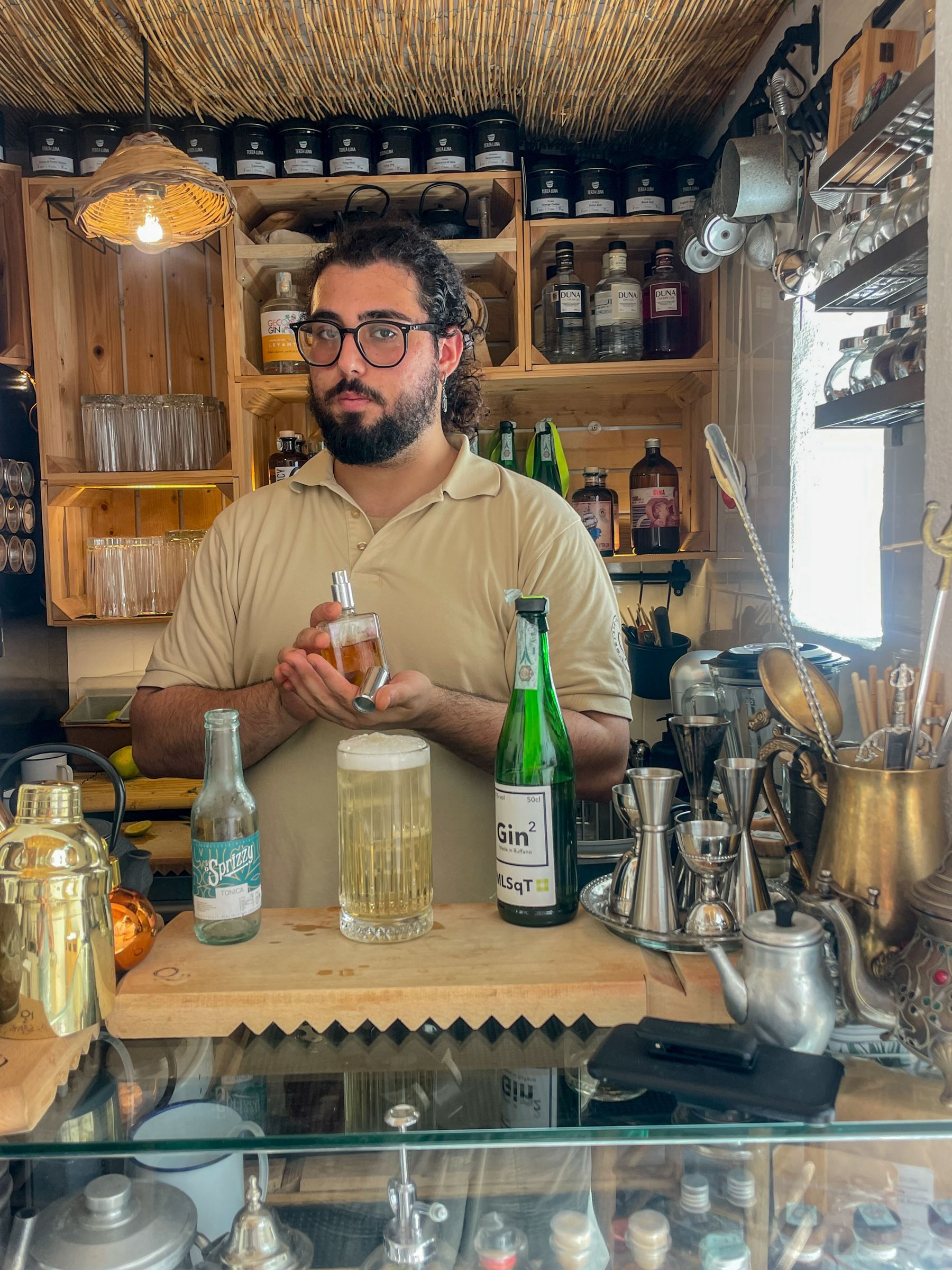
That’s the color of Gin-squared, not the color of the clear Sprizzy tonic water. I just now see my I-Phone holster on the bar top. We chatted (in English) while he prepared my beverage, me resting on a white-cushioned stool near the wall behind me. Sitting there, I felt a gentle pushing against my backside. Turning around I found el gatto stretching languidly.

The seating area outback has both an overhead lattice and trees and vines for outdoor shade. Very peaceful and unpretentious. Oh, I must mention that the audio system plays a continuous mix of 40’s Big Band favorites. Lemmesee—a swim in the Adriatic, watching the boardwalk walk-bys, reading a fine novel, joining my ladies for lunch with a curated G & T in a walled old city dating from Roman times with this as my stool-side view while serenaded by Glenn Miller? Priceless.
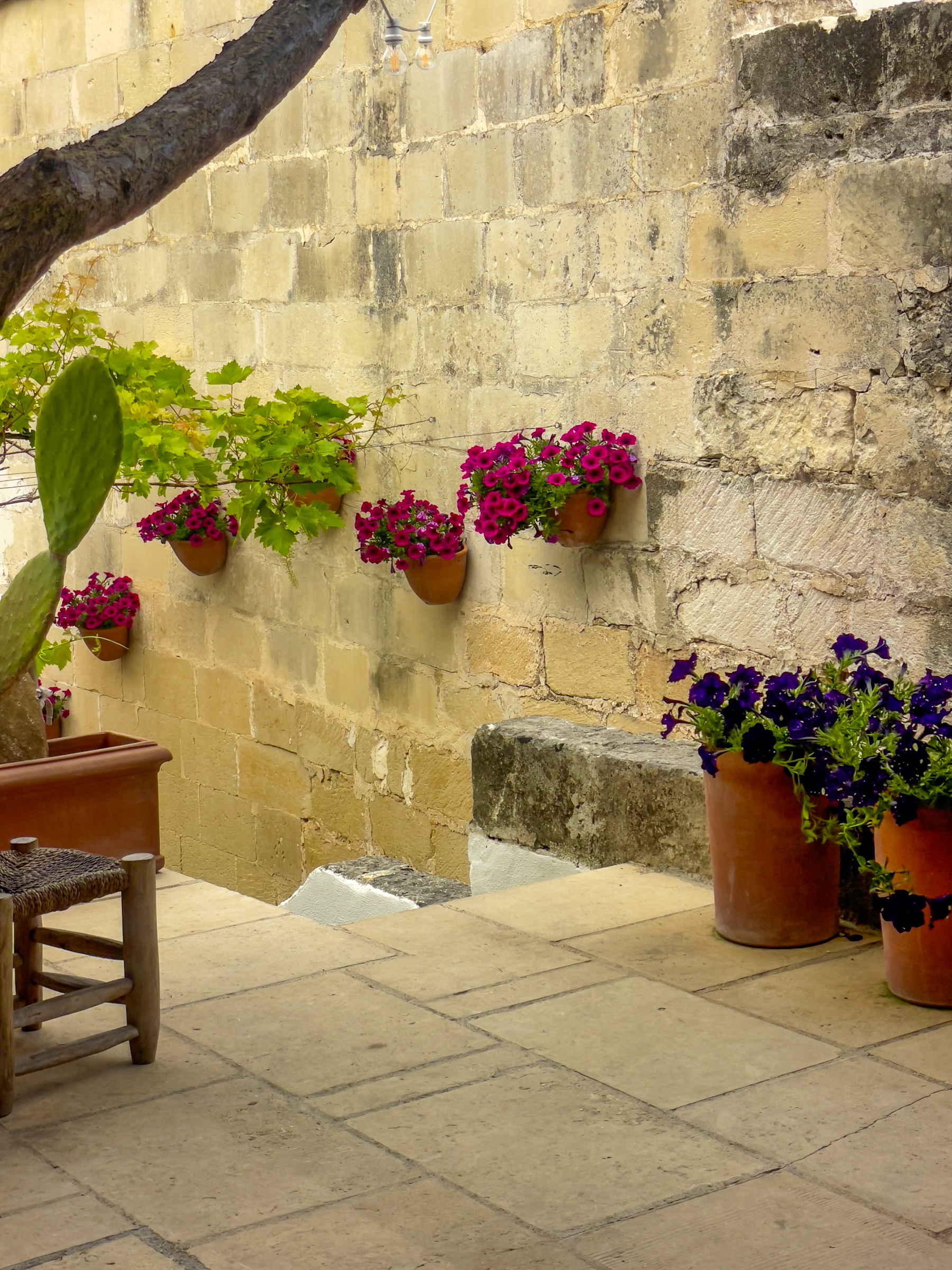
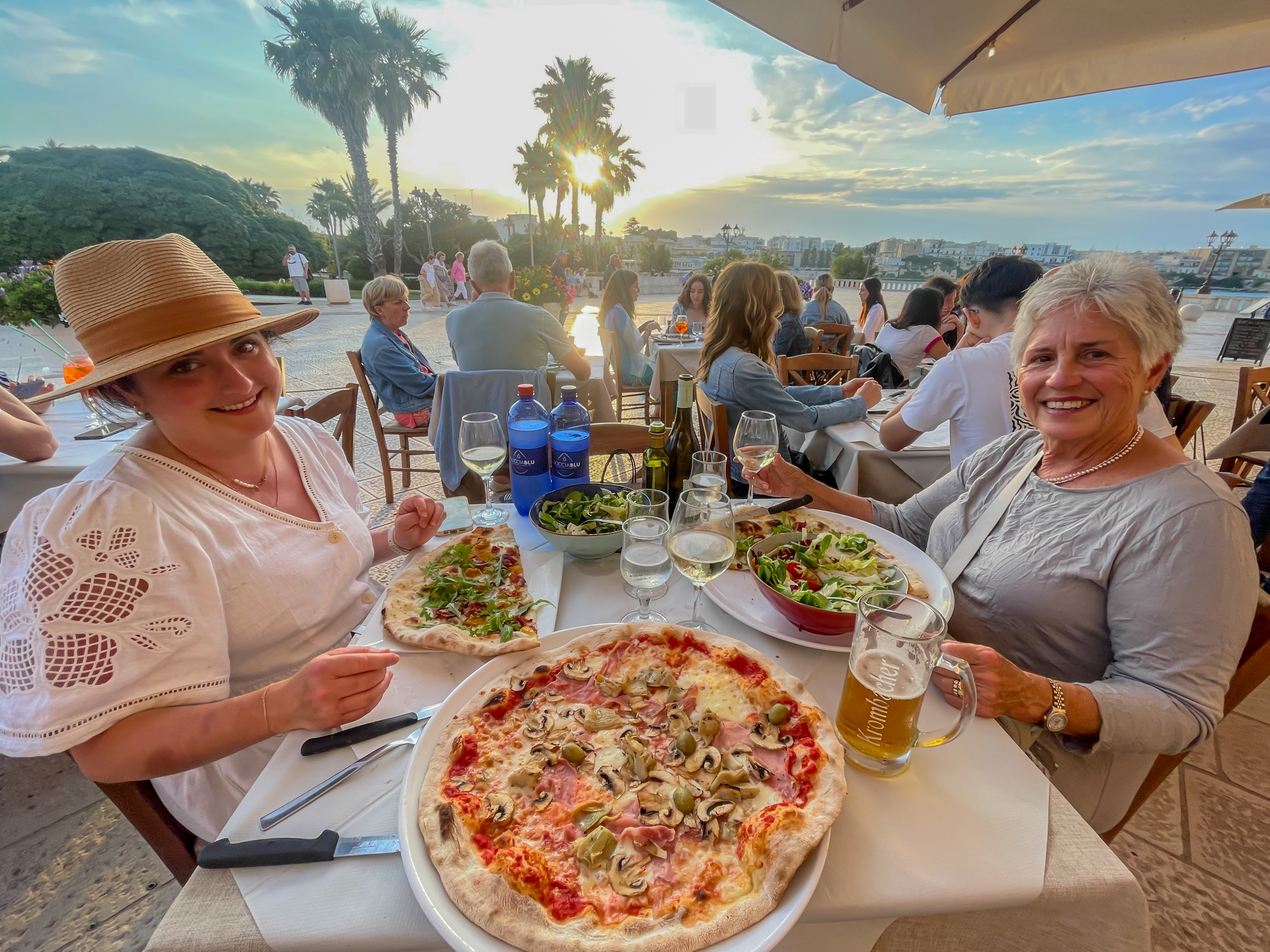
That Moveable Feast thing? In our last evening in Otranto we ended up in an outdoor café near the walled old city arched entryway. We ordered two pizzas and a salad. That morphed into two salads. This could easily have been accomplished with one pizza and one salad…for the three of us. Small portions? No way.
Last look at the Moveable Feast. Breakfast at Corte di Nettuno. How do you get your honey? It just drains with that angled comb holder. And yes, I chewed some hive in the bargain. Yum.

I wish to end by singing my praises of my traveling partners. Both adventurers, particularly as compared to my age-advancing stick-in-the-mudness. If there’s a culture, they want to explore it, all the more so if it involves fine dining. Fancy, refined lodgings certainly, but miles of twisting dirt pathways? Bring it on. I am a most fortunate man, my whole life through, and all the more on moveable feasts like this one.
Ciao, Tommaso
 th2ombre
Recent Comments