th2ombre
It's ALWAYS about the light
Norway, north to south
Posted on October 1, 2025
Never having visited anyplace in Scandinavia was reason enough to explore Norway, a land of stunning topography drawn from a history of plate tectonics and ice-age glaciers, as ocean-centric now as in the time of its Vikings. The straight line coast of Norway is over 1600 miles long, but taking in the undulations of fjords and the circumference of its over 300,000 islands, its actual coastline is 17,991 miles in length. This is a hint at what to expect, and how necessary sea vessels are for getting about. Ours was a curated, self-guided passage built on a suggested itinerary by Inntravel, an outfitter in the UK we have used over the years for less-beaten-path adventures. Getting there and back is not easy from SoCal—San Diego-Montreal-Copenhagen-Bodø, Norway-Svolvaer, Norway…above the Arctic Circle at 68 degrees north and 14 degrees East. The return was Oslo-Copenhagen-Munich-San Diego. Upper Norway is a land of summertime midnight sun and winter perpetual darkness. In September the days were of similar duration to Del Mar, but the celestial bodies favored shallower arcs drifting more purposefully above the southern horizon.
Our outfitter put to rest any worries about conversing in a country whose native tongue has its quirks, including three versions of the “O” vowel of English. And the only one that is pronounced like our “O” is the one spelled as “Å” with a tiny “o” above it, the last letter in their alphabet, btw. English is so widespread and its syntax and pronunciation on a par with right here in Del Mar, that all conversations began with it naturally. We found the citizenry outgoing, friendly and hearty. This is a place of robust elements and the population to go with them.

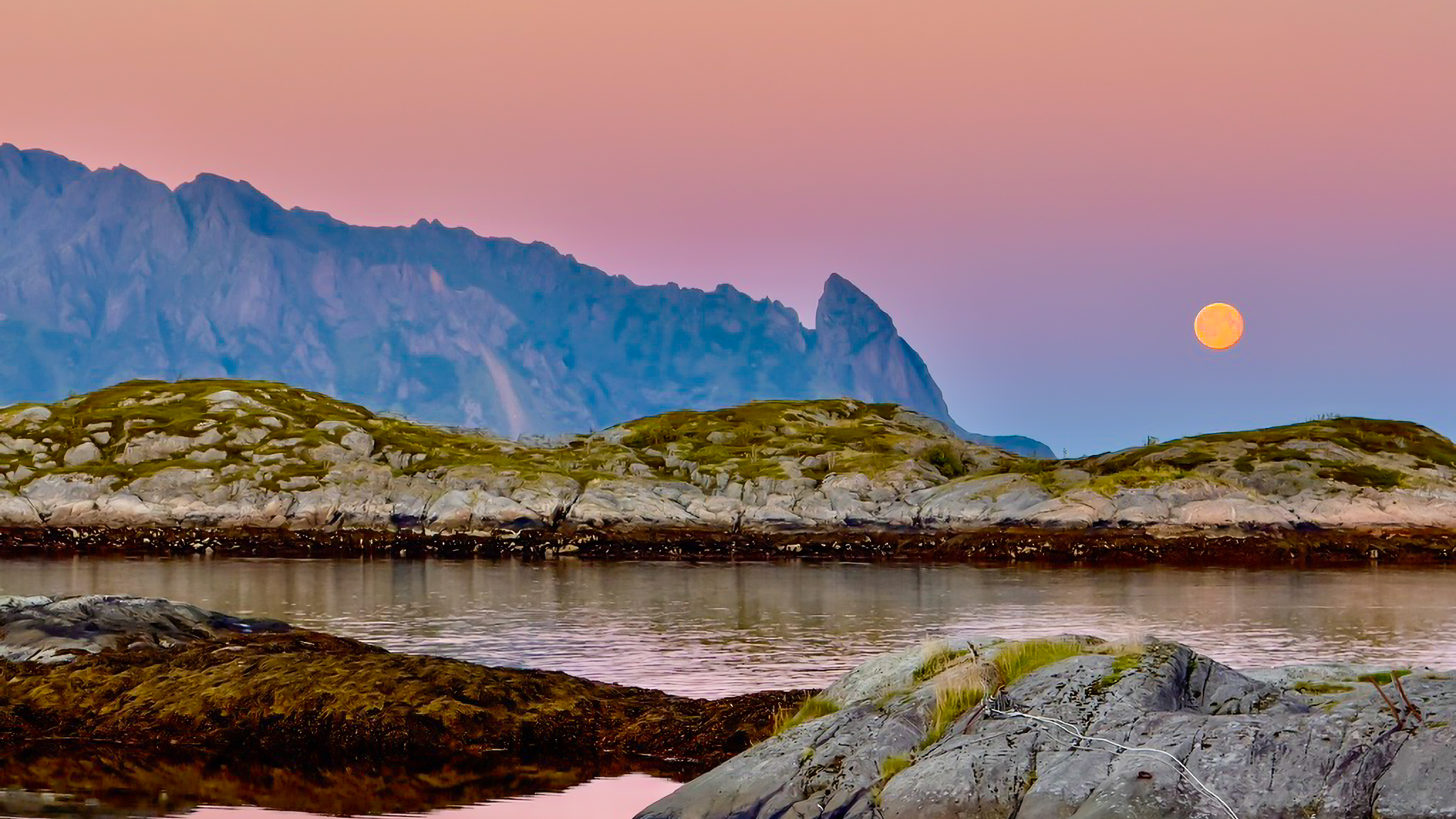
Our Svolvaer lodging, a two bedroom apartment, was on a small peninsula jutting out from the town, proper—the largest “city” in the archipelago of the Lofoten Islands, population 4700. The view, looking south from the balcony of our rooms at 3 AM. The moon never got overhead, staying low to the southern horizon. I was up at this hour in hopes of getting a Time-Lapse and stills of the Aurora Borealis, its green wispy color reflecting in the seawater near at hand, in the above time-exposure.
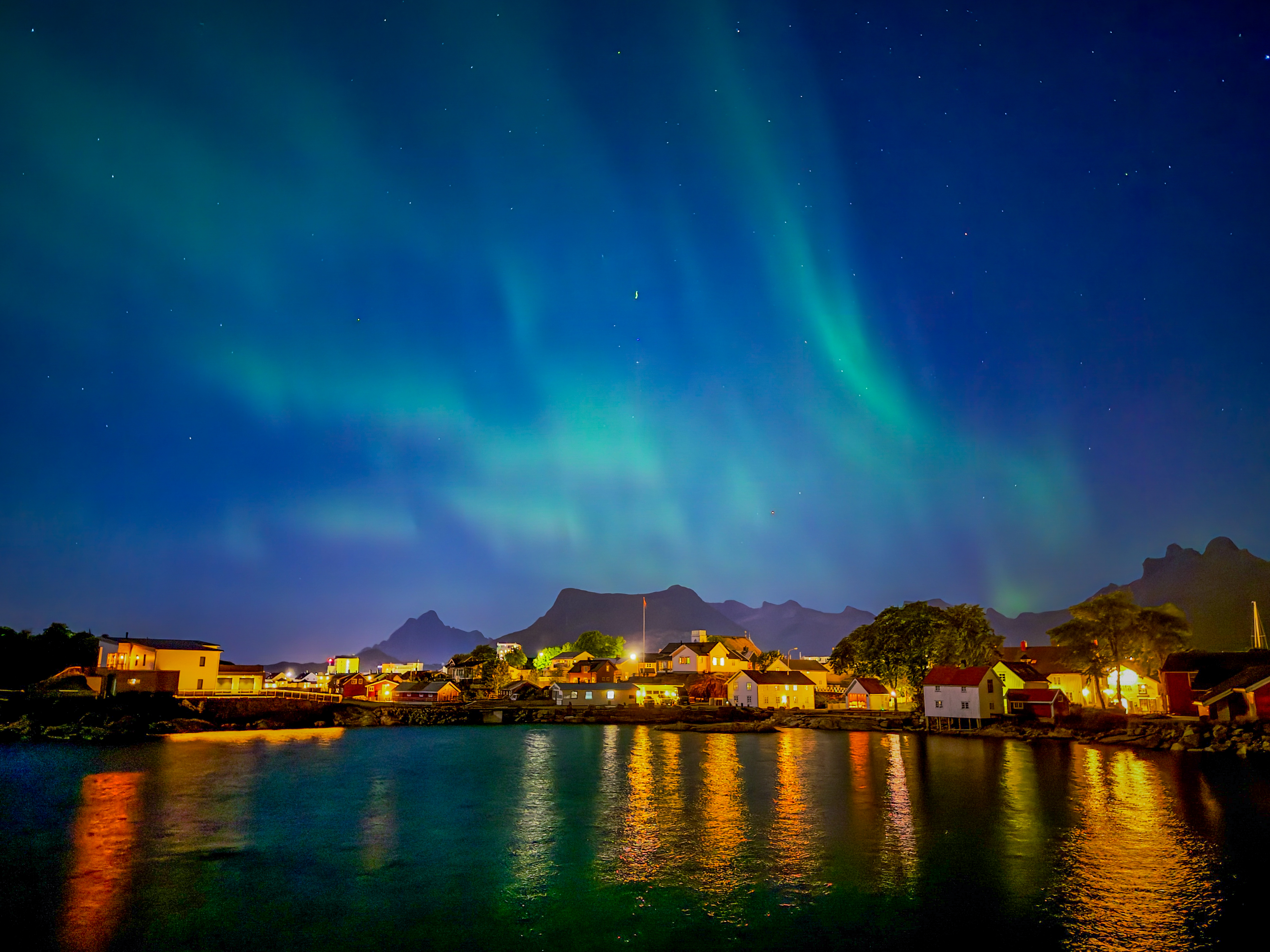
Turning 90 degrees to the right, the Northern Lights, in full swagger, an ever-wafting dance of the veils above the community’s reflections.
The Lofoten archipelago is comprised of six main islands and countless smaller bumps above sea level. Pretty much everywhere one gets used to jaw-dropping scenery.
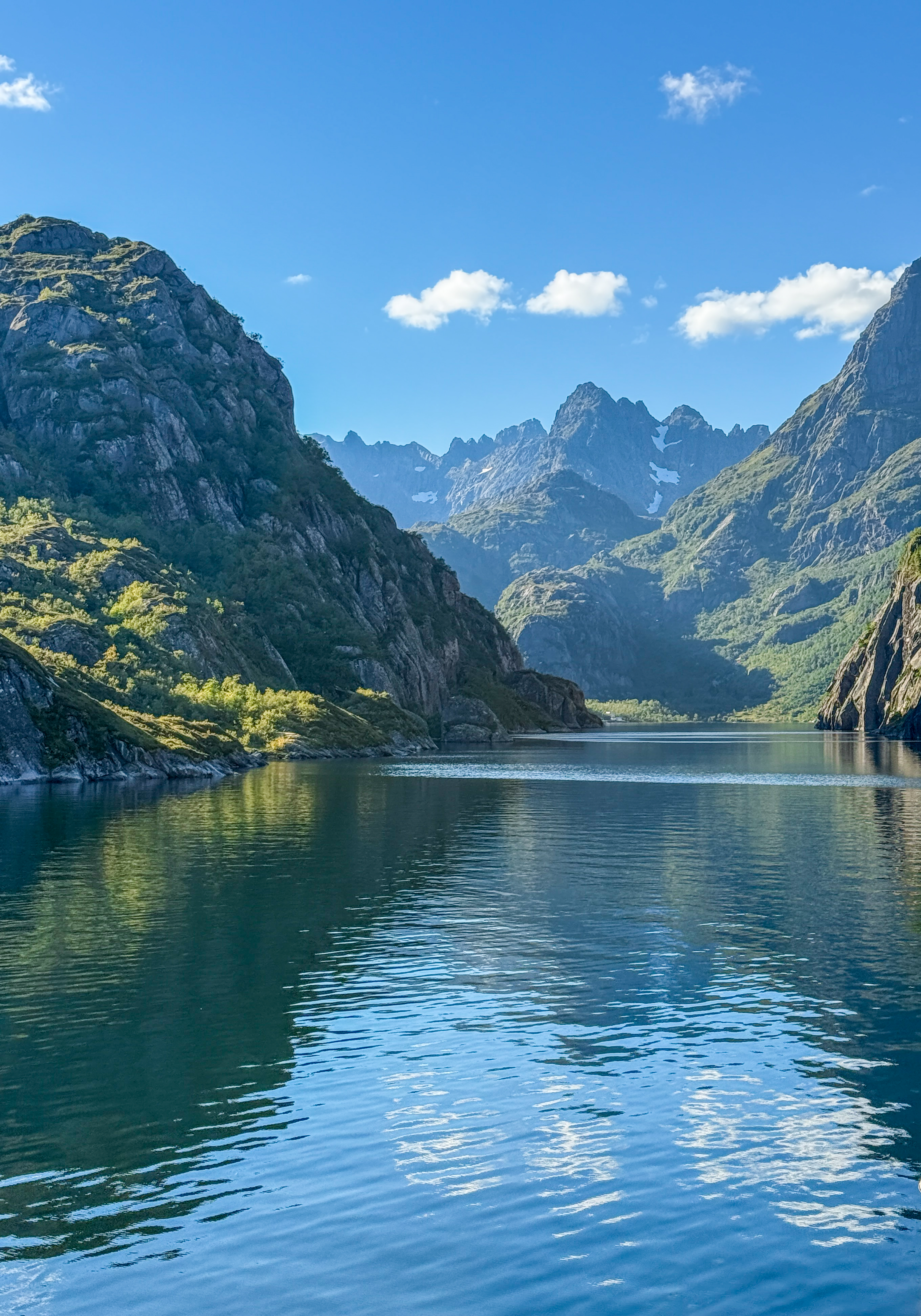
Norway’s west coast is strewn with fjords, like Trollfjord, above. And yes, trolls are part and parcel with Nordic mythology. That Viking thing in another guise.

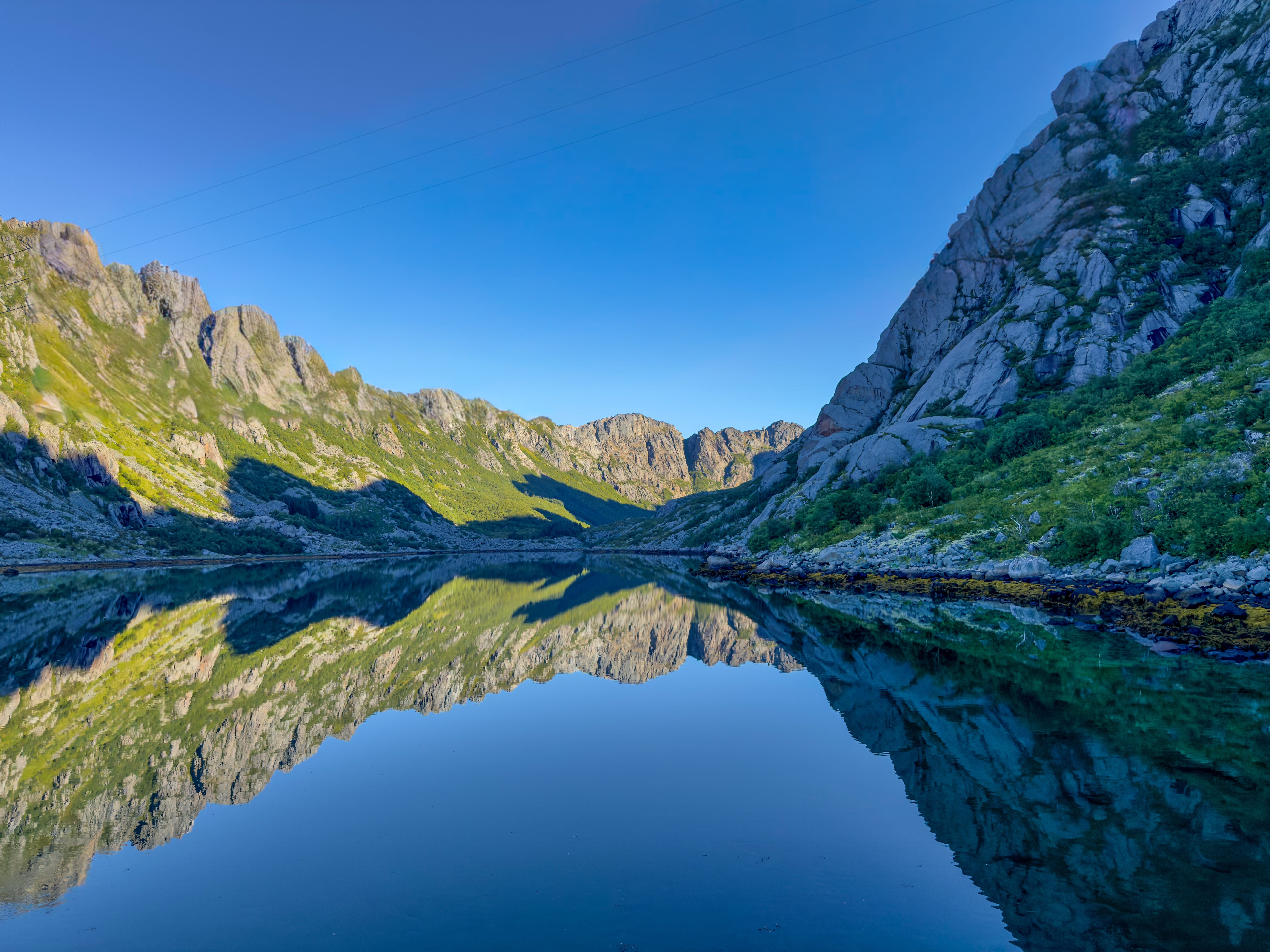
There are other quaint habitations, like Henningsvaer, above, or this inlet a few kilometers away, below. The reflections were so surreal that walking up to get this picture it was actually disorienting—what was rock, and what was reflection? A natural house of mirrors. It’s worth remembering that all of this is seawater, and because the Gulf Stream points right at Noway’s coast, the water temperature felt about like here . I just looked, and as I write, it is 55F in Svolvaer, a bit above our Del Mar winter low.
Above, our last sundown in Svolvaer, before boarding the Havila Polaris, a 179-cabin steam ship running on LNG and electric power, departing at 8:30 PM for a three night/four day passage to Bergen. Not knowing any better, I thought of this as a tramp steamer, given that it made fifteen stops along the way in small coastal and fjord-ensconced villages, the exceptions to “small” being Trondheim and Bergen—Norway’s third and second most populous cities after Oslo. And while I stand by that term, it doesn’t do justice to the refined nature of the Havila Polaris. Neither Cathy or I have ever done any sort of cruise, so I have little to compare with, but this voyage was a mellow passage, always close at hand to jutting headlands, islands and fjords. The views were stunning. The food and drink, and turns around the deck all fine accompaniments.

There are multiple observations to be made here. Norway is a seafaring nation, and has been since the Vikings. That red-hulled ship is a purpose-built vessel serving the oil capture business offshore in the North Sea. Well offshore (pun intended), never seen from our route heading to Bergen. Norway is a highly electrified country, and it gets its electrical energy hydraulically. See pictures of waterfalls, below. The petrochemical take from the sea bottom is sold on the world market to fund the “Government Pension Fund of Norway,” the largest sovereign wealth fund in the world. It is actually two funds, one named as above, and the other, called the “Government Pension Fund Global” where the “global” is a clue to its world-wide investment strategy. Norway, with a population of only 5.6 million, earns money from the oil, and invests that to generate the funds used to run the government and help provide the socially enhanced lifestyle common in Scandinavia. The Krone to dollar math is quite simple for travelers—move the decimal point one space to the left to turn Krone into dollars, e.g. 1,000 NOK more or less equals $100. But sticker shock lurks at the cost of living in Norway for both its citizens and its tourists. A second worthy point to share is the fantastic cloud panoply to which we were treated daily. Unlike our May Gray/June Gloom marine layer blanket, I found the skies routinely showing off four or five layers of clouds, each sufficiently un-overcast to reveal them all. It’s a sky show guaranteed to capture a pilot’s or photographer’s eye.
Below, the wharf area in Kristiansund where we made a one-hour port call. Notice the red forklift which has come out of the red building (a common color theme throughout Norway) and is heading up the ramp to retrieve cargo or to send cargo for on-shipment. Ditto passengers via a separate ramp. The dark-hulled and white superstructure vessel is an auto ferry. They are all over the place along the coast because the fjord-gouged terrain does not lend itself to N-S roads. Anyway, this is supporting evidence to that tramp steamer title to which I default.

Under the heading of “Pilots and Skyscapes” this is one which training teaches aviators to avoid. That is a definitively robust downburst going off just beyond the headland. We rounded the point and took up a courses to the left of the rain shaft. This was a day when there was a shore excursion offered, but which was already full two days ahead of time when we heard of it on boarding the ship in Svolvaer. The excursion was a bike ride to someplace south of Kristiansund, and then transfer to a speedboat to race at high speed to the Havila Polaris as it trundled south at a less clamorous pace. From this, I’ve learned that seasoned cruise passengers select cruise excursions online once one’s bookings are completed, and in this specific case, I take pleasure in not being one of the fool-hearty cruise excursion cognoscenti. Their attire probably needed laundering by the Polaris’ crew that very evening.

Someplace along the west coast of Norway, I haven’t a clue where. Nice sky?

Torghatten mountain, pretty much comprising the entire island of Torget at which we gawked outbound from Brønnøysund. From the backside, it’s just your run of the mill massive rock peak, but from this side, that shadow on the vertical face is a gigantic cleavage in the peak, and at dead center, you can see through to the other side via the natural tunnel that is 35 meters high and 160 meters long. It is a common hiking site in the area, presumably accessed by boat. Given our rocky proximity, perhaps this is a clue as to the importance of careful oceanic navigation, and how abruptly the seashore drops into the depths?

Later that same evening we were treated to yet another near-full moon moonrise, three o’clock in the frame. There’s another of those North Sea platform-service ships. In Bergen I spoke with a crew member of such a ship and learned that they are actually capable of pulling up a drilling platform after closing down the underwater well base, and carting it all to another drilling location to start a new well. Ingenuity.

We arrived early in the morning in Trondheim, founded as the capital of Norway in the Viking times of 997 by the first of two King Olafs, both of whom were instrumental in advancing Christianity in the country.

Trondheim was originally called Nidaros, still the name of its beautiful Cathedral, with its vaulted ceilings and three organs, the largest of which has 30 stops for its 1809 pipes. Herewith, a segue to a further sharing of my ill-fit for cruising. When we arrived at those port destinations during civil daytime hours there was sometimes the opportunity to join an organized exploration program, but also we were free to follow our noses to whatever looked promising . The latter generally comports more closely with Cathy’s and my inclinations, but nonetheless runs up against my “there goes the neighborhood” concern. Passengers raced to be first off the ship. I’m ill disposed to join that stampede, but even hanging back and walking slowly, there was no escaping the feeling that we were sullying the ports. Sigh.

Our steamer transport concluded at Bergen, a World Heritage site, and taking over as Norway’s capital in 1299. Its inner harbor demonstrates multiple lighting moods, all of them luscious. A little gastronomy and history. No surprise that fish are an important part of Norway’s diet. A local delicacy is referred to as stockfish—actually cod, fished in Lofoten waters and then dried, hanging on large outdoors open-framed hjell racks during the winter months. In pre-refrigeration days this avoided salting as a means of preservation. An important source of protein, especially in regions where Catholicism meant Friday and festival fasting on terra firma meats. The dried stockfish was vessel-shipped to Bergen, a vital port for commerce throughout Western Europe and the British Isles. Its inner harbor, seen in the next frames, is actually called Bryggen, a bustling area in the Middle Ages with its various trades being plied by the German-derived Hanseatic League. Bryggen’s etymology is from the Norwegian word for “wharf,” and those colorful structures are built to the edge of the water, and beyond, as successful commerce spawned expansion.


Yes, I’m fond of lunar overwatch scenes, as with William Blake’s “the moon, like a flower in heaven’s high bower, with silent delight, sits and smiles on the night.”

We had two nights and three days to putter about Bergen before slipping aboard a high speed catamaran to take us some four hours up the Sognefjord, Norway’s longest, second longest on earth, at 205 km in length and over 4200 feet in depth.

Destination Balestrand. The view from our room at Kvikne’s Hotel, a lodging from the 19th century and thus reminding me of the Hotel del Coronado.

The Del Mar geezer taking in the scene with King Bele of the early fourteenth century. Picture by Cathy. I’m sitting on the bench back (not the UK Parliament’s back bench) because the seat bottom is rain-wet. Staying fanny dry while taking in his view.

Nice scene, your highness. Sognefjord, a local auto ferry finding a pot of gold.
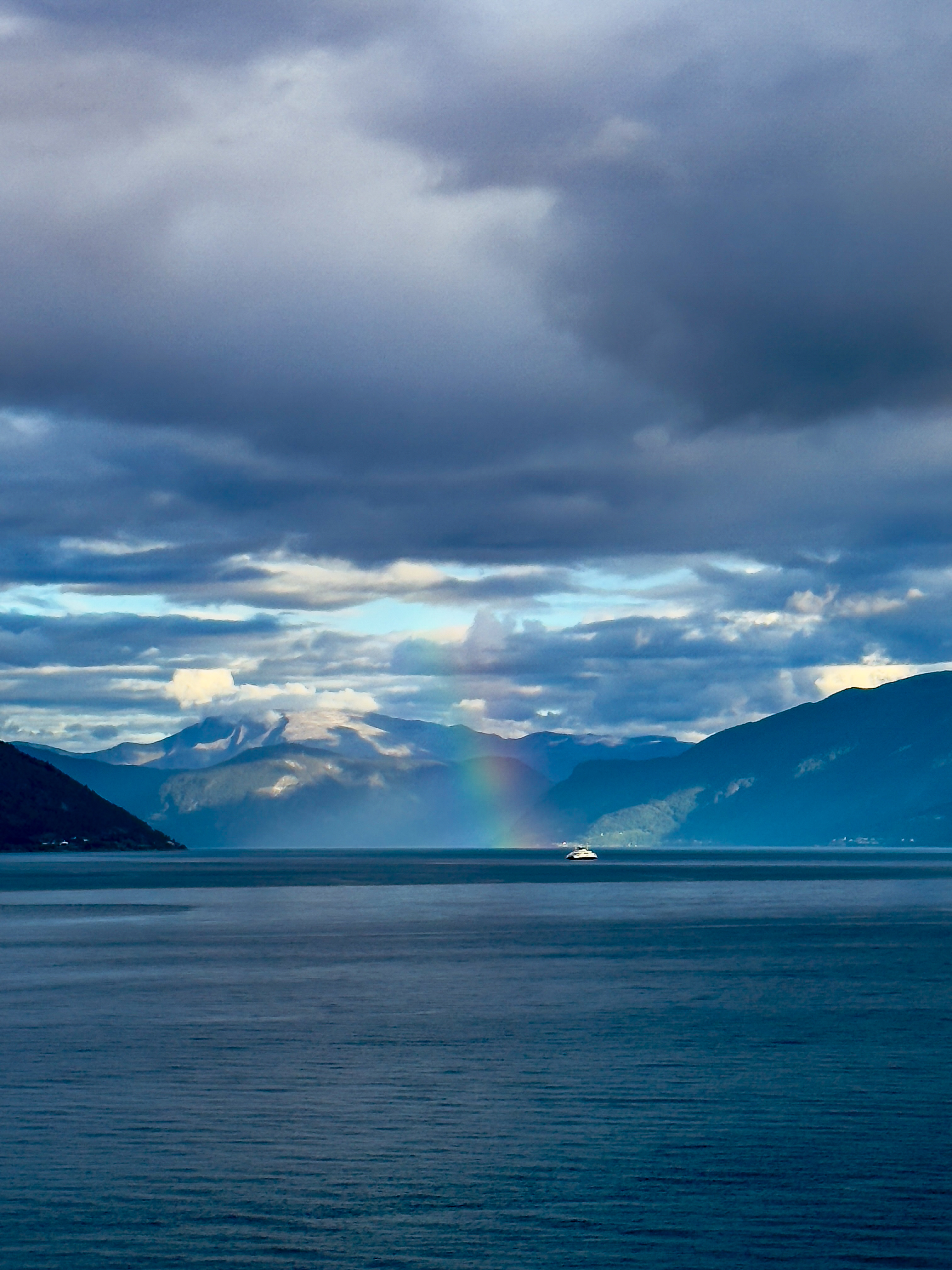
Balestrand is gorgeous, but small. What to do? Hike that ridge to the right in the destination picture above. I’m getting long in the tooth, but I did successfully climb the 1500 feet in some 4 km of up trail, leading, gasping and sweating, with only modest sotto voce grousing….
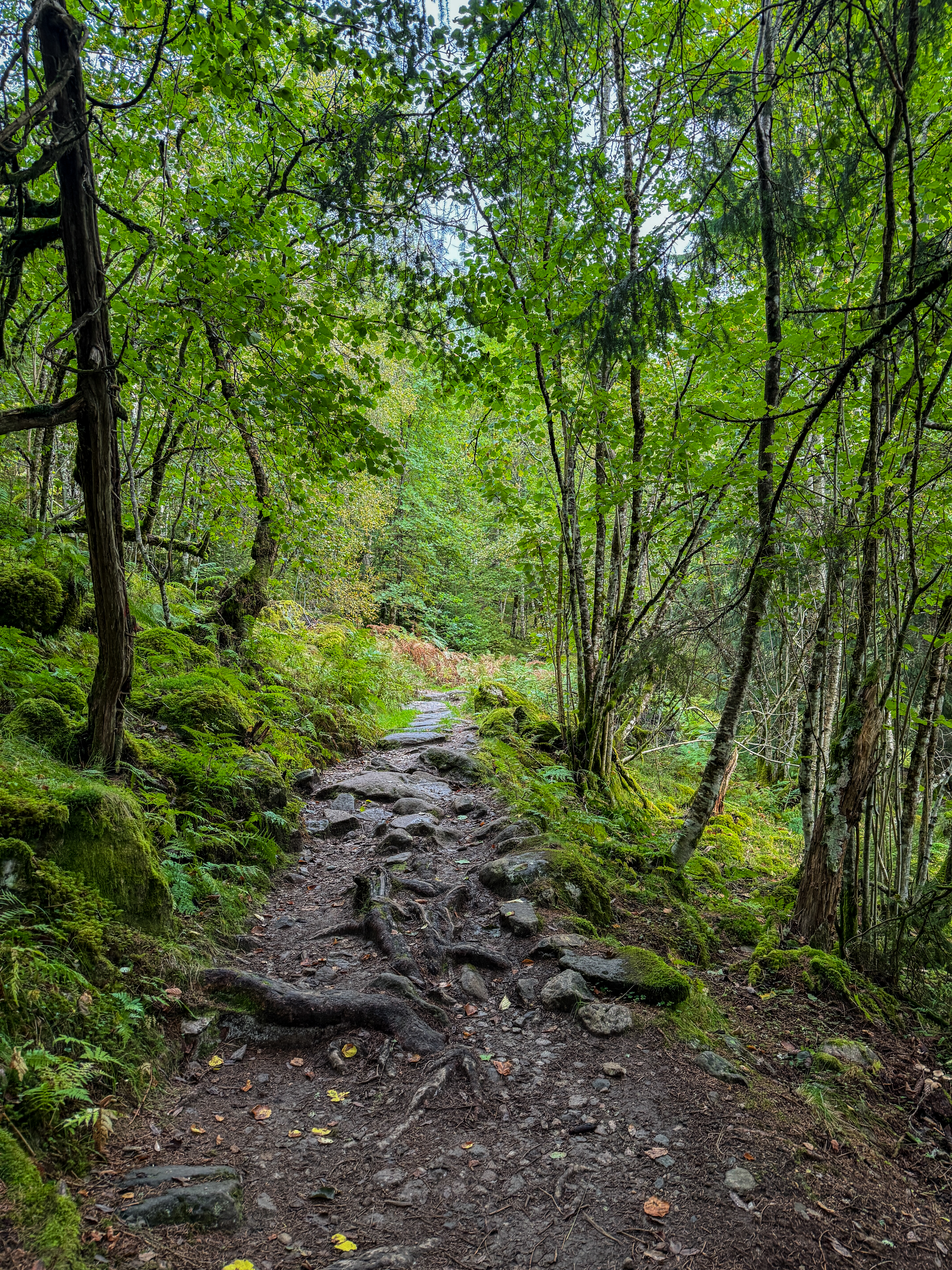
…to this exemplary view of the upper reaches of the fjord. Waay down there at about 7 o’clock in the frame, the tiny rectangular bump at the shore is our lodging—Kvikne’s Hotel. Looks eensy-weensy from up here.

The same vantage point, except from fjord water level the next day. Looking directly up the Aurlandsfjord, an extension of Sognefjord, leading to Flåm, our next destination.

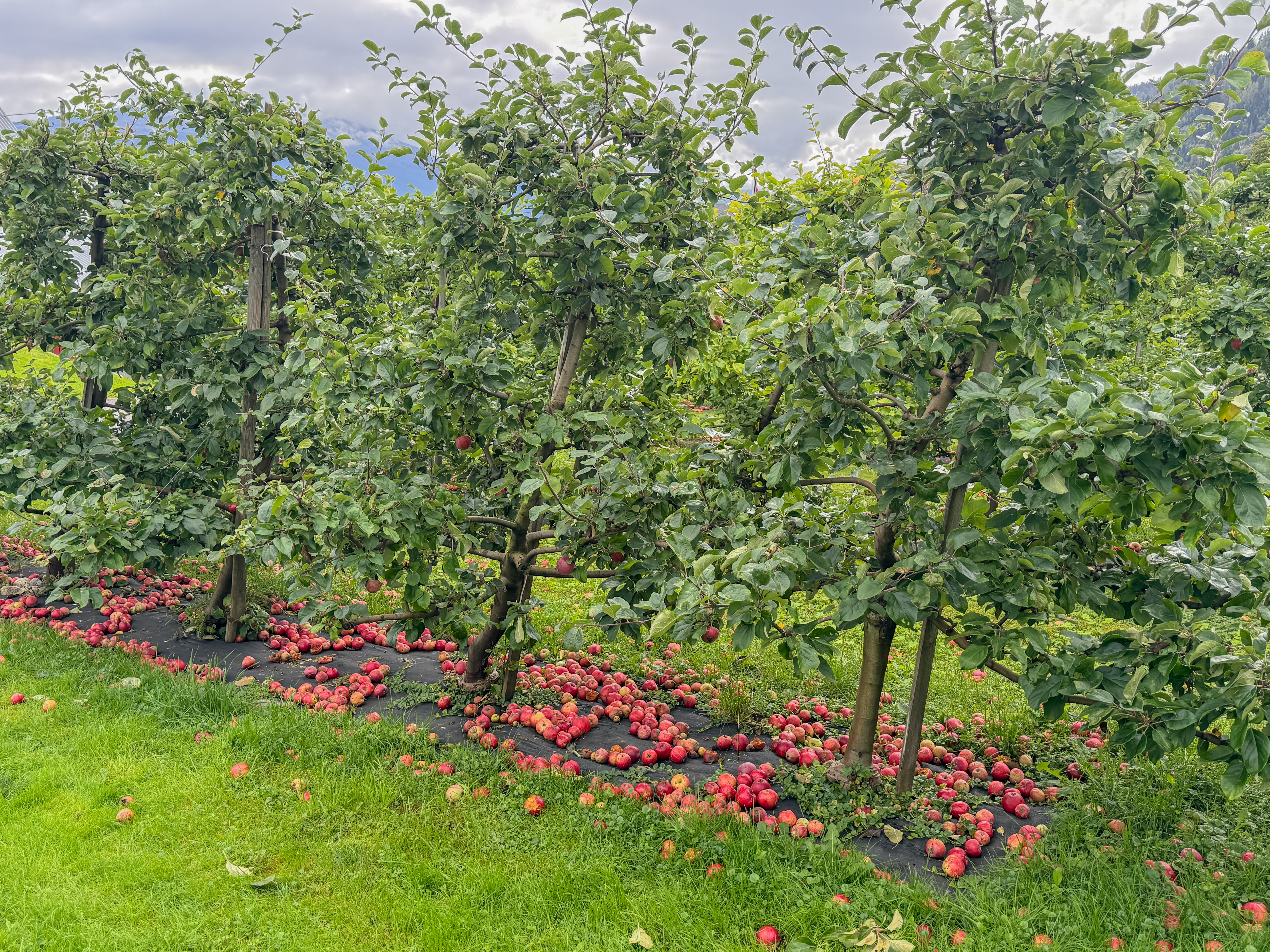
When in Rome, do as the Balestranders do. This is apple growing country, and the delicious fruit was literally falling off the trees, and then in-town processed into cider.
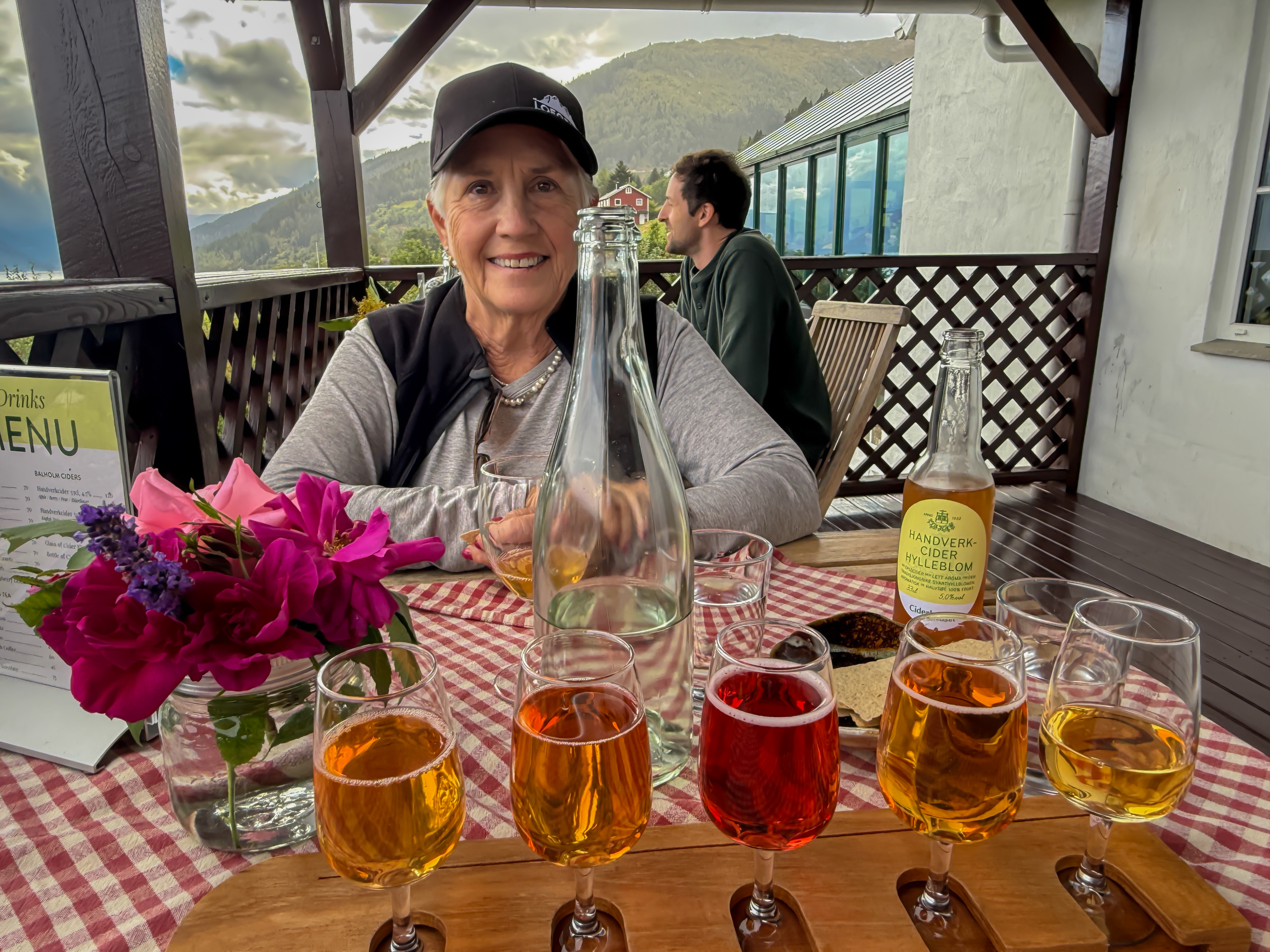
Following our 1500 foot climb, the trail back emptied into a quiet street on which was Ciderhuset, Cider House in English. Cathy chose a tall cider, and I opted for a cider flight to go with our lunch. Mildly alcoholic according to the chemical analysis, but without perceived effect on the body. Well, okay—after lunch and the final one mile stagger back to Kivikne’s, we availed ourselves of an afternoon siesta. But only because of the hike, surely not enhanced by the cider?
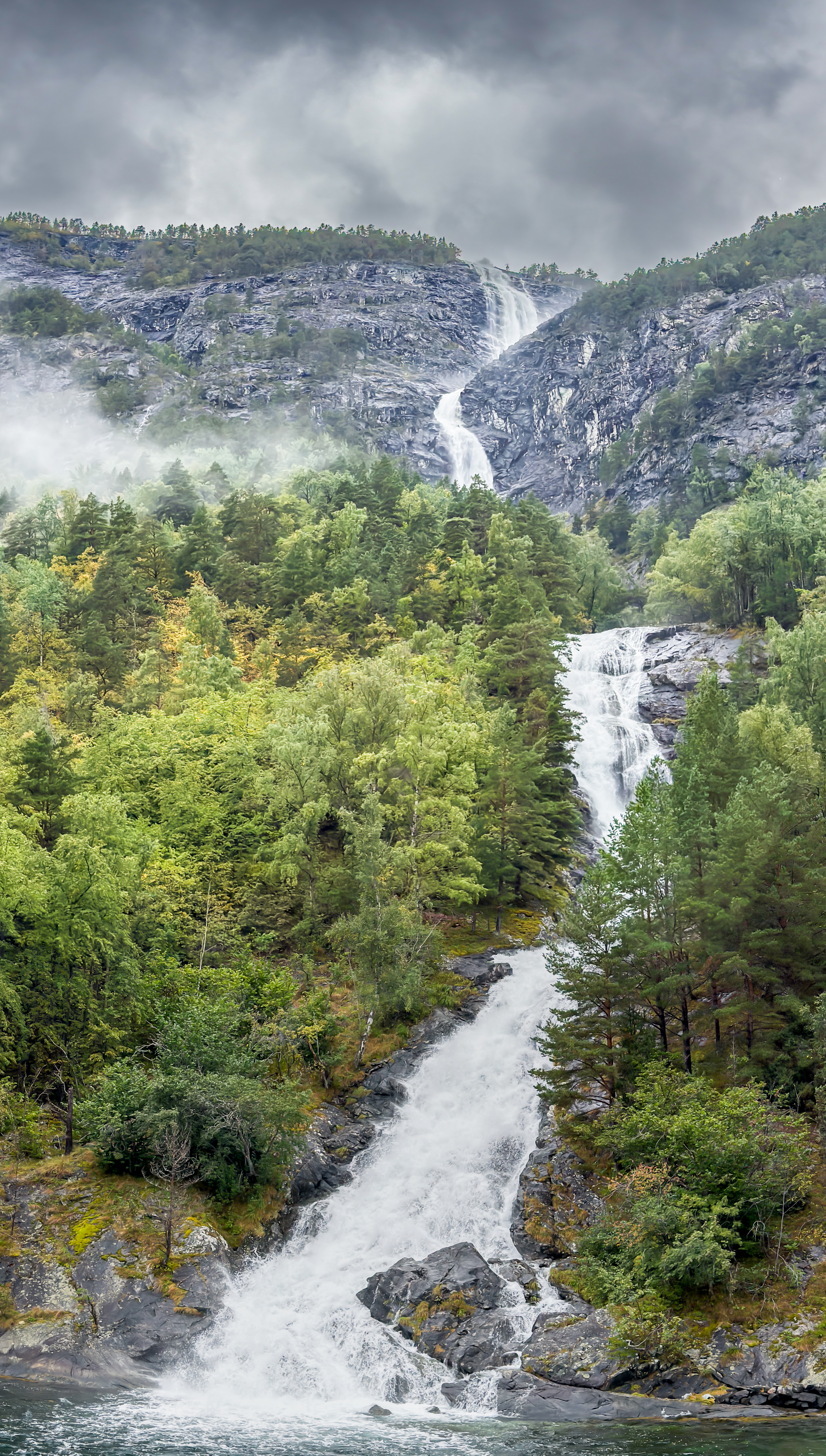
Decamping from Balestrand we took one of the high speed catamarans up the Aurlandsfjord to Flåm, the ship slowing for all of us to marvel at Brekkefossen waterfall. A fine example of how Norway has the means to meet its electrical generation needs with moving water.
Flåm is another outdoors activity haven. We chose to take the Flåmsbana railway the 20 km up valley to Myrdal for an out-in-the-elements return to Flåm. The electrical train stops a short distance from Myrdal to let us passengers stare wide-eyed for :10 at the power of Kjosfossen waterfall with its 305 foot free fall, its deafening roar matched only by the water-strewn air quickly soaking clothing and misting camera lenses. In a nod to tourism sensibilities during this stop the air suddenly comes alive with the tie-me-to-the-mast siren song of Huldra, a forest spirit from Norse mythology whose intention is to lure men into the woods and seduce them. Alongside the tracks, she is portrayed by a woman in red, very near the center of the frame at 3 o’clock in red. Quite the showstopper. I volunteered to join her in the spirit of the production, but Cathy nixed the idea…

The valley views from the train are hard to beat…

…but are nonetheless eclipsed by the views on foot and by bicycle. Near at hand, the steep switchbacks we hiked after disembarking. The train tracks rise 1 foot for every 18 feet, this descent is steeper yet, hence the switchbacks. We had to mince along being careful of our footing to keep from sliding downhill on our bums.

Another of our luck-outs was being there as the fall colors began showing off. Nice trail hike.
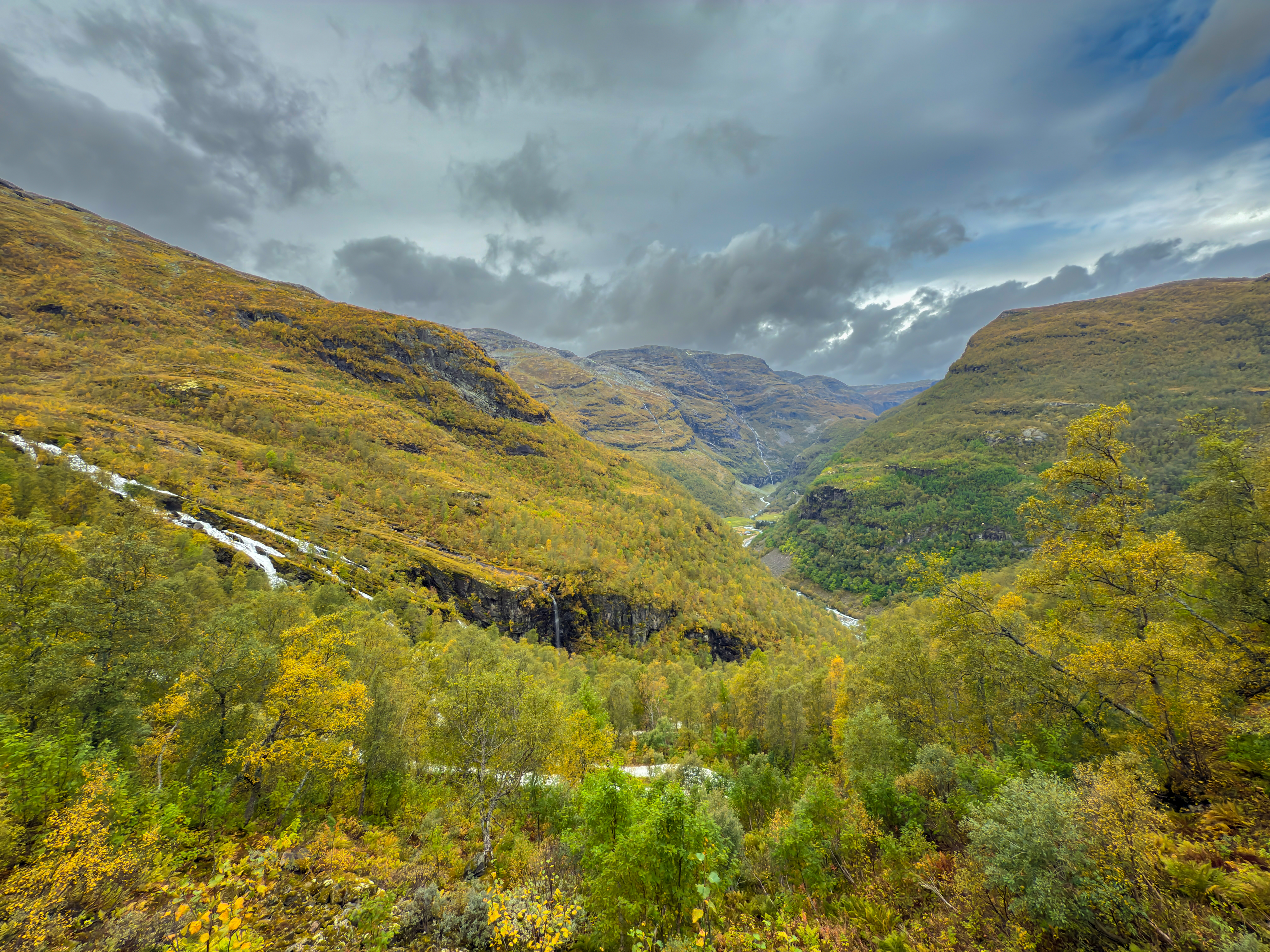
After nearly 5 km of downhill hiking we switched to our rental bikes awaiting us at a farmhouse for the 15 or so klicks back to Flåm. The views continued, unabated. Ye olde bike path.

Resting on our laurels to suck up some splendid mountain air. Waterfalls everywhere.

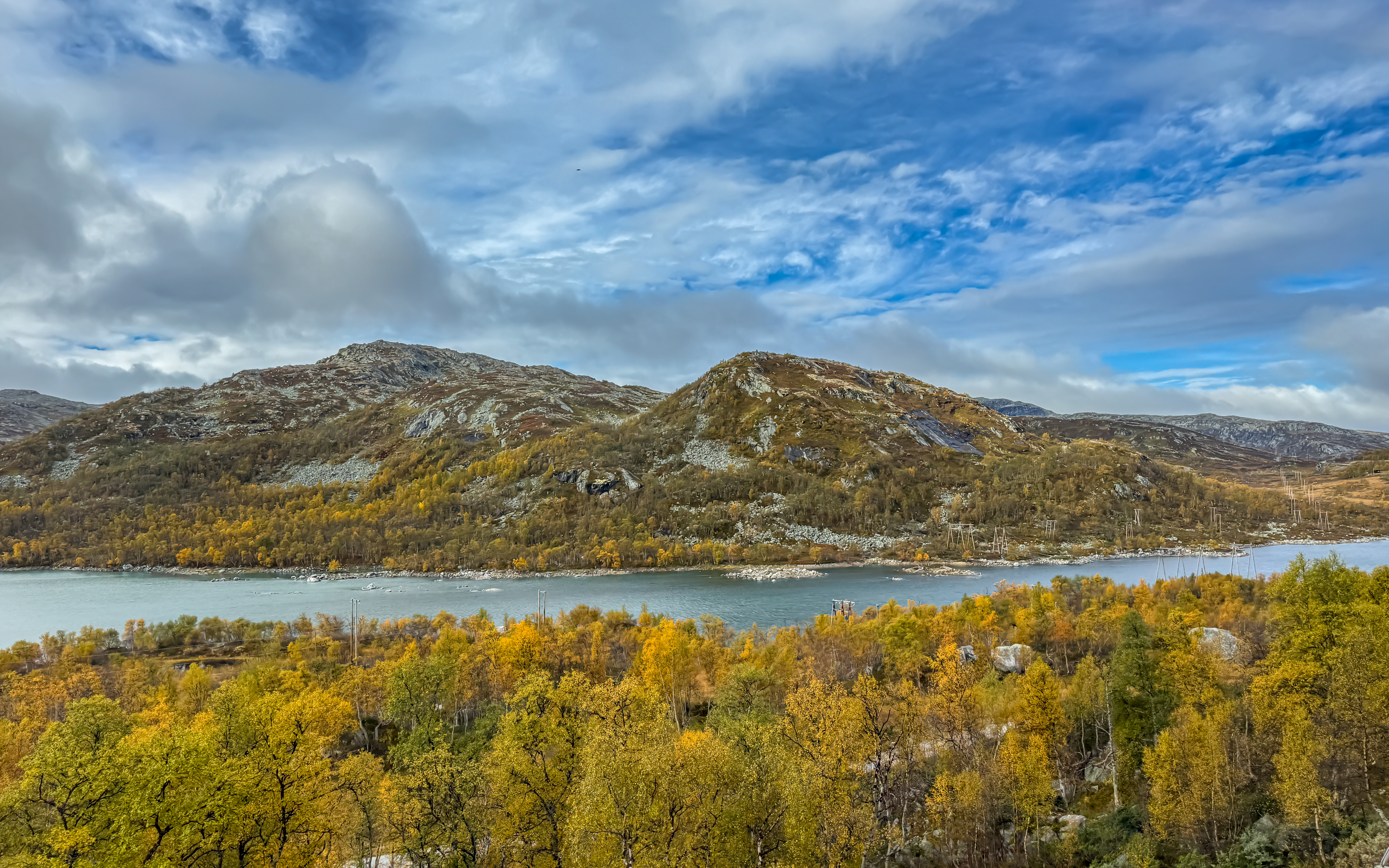
The next day we returned to Myrdal on the Flåmsbana, but now to connect with the Bergen to Oslo train, some five hours duration along an elevated plateau, with its own attention-grabbing views. Just a few km beyond this scene we passed Finse, with its Hardangerjøkulen glacier. Good thing the Norwegians speak English!
Following our afternoon arrival in Oslo Sentralstasjon we used our phone maps (let’s hear it for T-Mobile devices connecting seamlessly in over 200 countries world-wide) to walk to our Thon Hotel Rosenkrantz, then back out the door to explore. We mostly confined ourselves to the mid city and the area near the harbor, including the Nobel Peace Center,

…and the busy waterfront…

…including the Akershus Fortress, with its splendid Resistance Museum, detailing the many small and large resistance and sabotage efforts of the Norse patriots between 1940 and 1945 including their commando destruction of the German heavy water program seeking to develop a nuclear weapon—patriotism and courage worthy of salute.

Later that afternoon, we puzzled out a local train option to the airport, where we caught our flight to Copenhagen in readiness of the next morning’s early flight to Munich and on to Lindbergh Field. Yes, I know it is formally called San Diego International, but it is also where Charles Lindbergh’s Spirit of Saint Louis was made and is still an official name of the aerodrome. When you’ve got it, why not flaunt it?
Torrey, who had held the home front together in our absence, arrived curbside just as we came out of Customs and Immigration. Bogart promptly went bonkers at having us back home. It was reciprocal.
 th2ombre
Recent Comments